


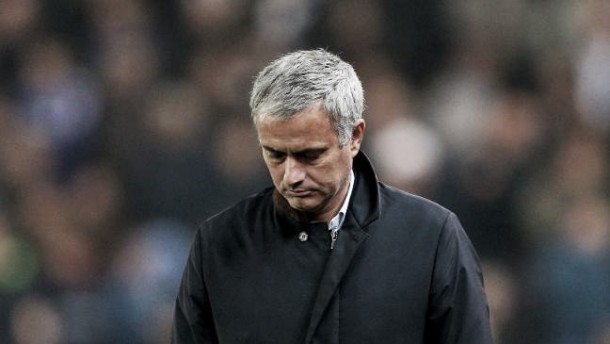

Although José Mourinho added another Premier League title and League Cup trophy to his already illustrious collection of accolades, the Chelsea fan favourite has found himself without a job just the following season.
Premier League champions have endured a torrid defence, having already suffered nine defeats in the league. But after leading Chelsea to the title so dominantly last season, what went wrong for Mourinho?
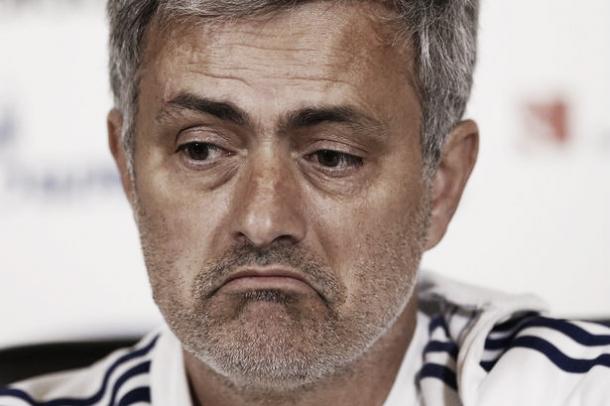
Mourinho in a Chelsea press conference (labeautedufootball)
The Backroom issues
Something did not seem right with Chelsea coming into this season. Signs were there as early as the back end of last season, when a surprise 3-0 loss to West Brom was seen as signs of complacency by the newly crowned champions.
Following this, a disappointing pre-season saw Chelsea lose to Paris Saint-Germain, Fiorentina and New York Red Bulls. Mourinho allowed his players to have a longer break in the summer because of their successful showing beforehand, meaning that some of the players also came into this year’s campaign feeling tired and unready.
Tension in the Chelsea camp were never as evident as when then club doctor Eva Carneiro ran on to the pitch to tend to the apparently injured Eden Hazard. This innocent attempt at seeing to an injured player was her job after all, but Mourinho saw it as a guilty act that stopped Chelsea from chasing a game that they were losing.
This one act spiraled into a full legal case for Chelsea Football Club, and resulted in Carneiro leaving her post. Outrage from the football community followed this, with many fans giving their support to Carneiro and Mourinho’s treatment of her led to criticism from people as high up the ladder as chairman of the FA, Greg Dyke.
Big players, little performances
In the summer of 2014, Spanish duo Diego Costa and Cesc Fabregas were brought in from Atlético Madrid and Barcelona respectively and the two shone brightly in their first season.
Costa went on to become Chelsea’s top scorer, netting 20 times in 26 appearances for the Blues. The Spanish forward had Fabregas to thank for this impressive haul. The former Arsenal midfield made more assists than anyone else in the league with 19.
Hazard scored 14 goals in 38 league appearances, and topped the charts for chances created for his teammates. The 24-year-old's impressive season earned him the 2014/15 Player of the Year award, adding another shimmer to Chelsea’s already gleaming season.
But Mourinho has not been able to rely on his star performers from last season. Hazard, Fabregas and Costa have all had disappointing starts to the campaign. Costa has only managed 3 goals in the league this season, and has spent time frustratingly sat on the bench.
Fabregas has had to spend time out of the team, with Mourinho seemingly unhappy with his lack of defensive talent when Chelsea are under pressure, which they have come under increasingly throughout this season.
Eden Hazard has arguably been the biggest disappointment for Chelsea this season. With his performances last season being touted as on par with world class players such as Luis Suarez and Neymar, his standards were apparently set too high. The Belgian playmaker is yet to score this season, taking away one of Mourinho’s major attacking threats.
Lack of strengthening
Chelsea’s strengthening in the summer was lacklustre. Their transfers seemed more like plugging holes in their squad rather than addressing areas of weakness and bringing in more star power. Petr Cech’s lauded transfer to title rivals Arsenal prompted Chelsea to sign Stoke City goalkeeper Asmir Begovic as back up to Thibaut Courtois.
Club legend Didier Drogba’s move to the MLS also left Chelsea short up front, meaning that Mourinho brought in Manchester United flop Radamel Falcao on a loan move from AS Monaco, but the Colombian have struggled for appearances, only making nine in the league and only scoring one goal.
Filipe Luis’ transfer back to Atletico Madrid saw The Blues sign 21-year-old Augsburg left-back Abdul Baba Rahman, who also is yet to make a significant impact in the squad. Pedro was brought in to add more attacking flair to Chelsea’s front line after Mohamed Salah and Juan Cuadrado were both sent to Italy. The Spanish winger started strong, scoring on his debut against West Brom, only to deteriorate in form.
Mourinho failed in his well-documented attempts to bring Everton defender John Stones to Stamford Bridge. Showing clear signs that a young first choice centre-back was a top priority for the Chelsea boss. However the Toffees stayed strong and kept their man, leaving Mourinho frustrated. The centre-backs that joined were 27-year old Papy Djilobodji who is another signing who has not made an impact in the first team, and 23-year-old Michael Hector who was immediately loaned back to Reading.
Is Mourinho built for the long term?
The Portuguese manager has never lasted more than three seasons at any club he has managed. Despite his tendency to bring silverware to any club he manages, players telling stories of his first class management skills and his name commonly being referred to as the best manager in football, there is always the thought that he is a manager for the short term jobs. It is now 11 years since his famed Champions League triumph with Porto that made him the hottest managerial property in Europe.
Yet in those 11 years, Mourinho has had two spells at Chelsea, one at Inter Milan and one at Real Madrid. Four different spells in 11 years does bring into question Mourinho’s talents for managing a club in the long run despite his claim that he wants to be at the helm of Chelsea for many years.
Three season syndrome is a phrase that is often used when describing his management, but Mourinho is quick to deny these claims. Yet after another third season exit from a top European club, it seems to become clearer and clearer that Mourinho is not a manager for the long term.
