


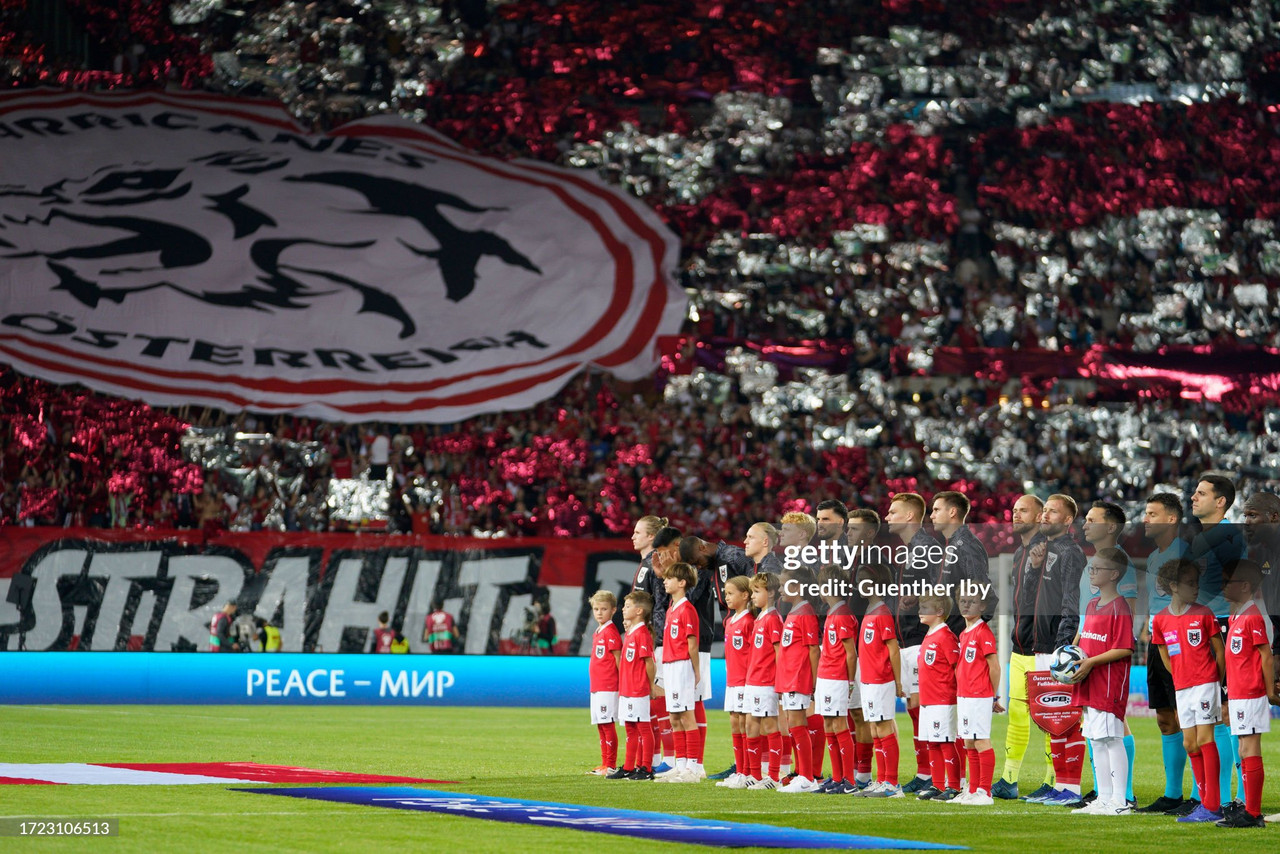

The last time Austria took part in the European Championships, they picked up a first-ever win and their best-ever placement in the tournament, exiting in the Round of 16.
They'll certainly want to improve on that record this time around, and are in a good position to do so, with the team well-drilled and well-motivated thanks to the work of Ralf Rangnick, who has brought the absolute best out of his squad.
With a challenging group stage and several strong opponents around them, could they pull off a major upset?
The Manager - Ralf Rangnick
I am the Austrian team manager with all my heart. This job gives me incredible joy and I'm determined to continue successfully on the path we've chosen,
Ralf Rangnick said after becoming the nation's manager — and he has appeared to have settled nicely into international football.
The German manager took the reins in 2022, and after a slow, shaky start, has now gotten this Austria team playing organised and strong football. He seems comfortably settled, recently signing a contract extension that will last until 2026, whilst also turning down an opportunity to become the new Bayern Munich manager.
Rangnick likes his team to play direct attacking football. There’s a strong focus on counter-pressing, winning the ball back as quickly as possible, and getting the best out of his talented midfield by working the ball centrally and creating opportunities for the lone striker, or switching play to the wings.
The wingers in the system often play more narrowly, and this needs to be the case as Marcel Sabitzer and Konrad Laimer, who both play more centrally for their respective domestic clubs, are the ones that occupy these positions.
This is beneficial to a pressing team like Austria, as they defend in a 4-4-2 shape, meaning several players can push and attempt to win the ball back as quickly as possible, sometimes even risking to commit a foul to regain possession.
Width in the team is provided by the two full-backs, who both have the freedom to push forward in attacking situations, offering an extra passing option if an opponent commits players to challenge in the middle of the pitch.
This is a system that clearly works for Austria, and it's one that Rangnick has been given time to fine tune and adapt during his time at the helm.
How they qualified
Austria’s qualifying period was very strong, with six wins out of eight games. Defensively they were solid, with only 7 goals conceded, scoring 17 in return.
They went unbeaten against the majority of the group, which included the likes of Sweden, Azerbaijan, and Estonia. However, a narrow 3-2 defeat to group winners Belgium meant that Austria settled for second place.
Impressively, aside from the narrow Belgium loss, Austria have gone unbeaten in all of their remaining games, with their last loss coming almost two years ago in the Nations League.
It will be very interesting to see how Austria handle the pressure of the tournament itself, however, with more challenging matches guaranteed around the corner.
Player to Watch - Christoph Baumgartner
Rangnick will be left with a few headaches, as four key players will miss the EUROs for Austria through injury - goalkeeper Alexander Schlager, defensive duo David Alaba and Phillipp Leinhart, and midfielder Xaver Schlager.
The latter will be a huge miss for Rangnick, who had fit his system like a glove, though there are certainly several names who will look to fill the gap.
One such name who will now serve an even more important role in the team is Christoph Baumgartner.
The 24-year-old attacking midfielder is the nailed choice in Rangnick's system, offering a golden combination of experience as well as youthful energy and drive.
Providing three goals and two assists in the qualifying matches, Baumgartner has shown he can provide an attacking output, but also excels at dropping deeper into the midfield and offering a passing option, and can also be used as a right winger if needed.
His off-the-ball movement is solid, which seeks to dislodge the opposition defence and gives space for either himself or the striker to occupy and score.
Furthermore, having a player who is competent with the defensive game in this role means Baumgartner can push up alongside the striker in Austria's defensive 4-4-2, and has the ability to counterpress as well as cut opposition passing lanes.
His form has shone under the guidance of Rangnick, and he is certainly a key player to keep an eye on this tournament.
Predicted Lineup
Rangnick will most definitely stick with his tried and tested 4-2-3-1, though it will certainly be interesting to see the adaptions that are made to the squad following the mentioned injuries.
There is enough talent in Austria's back pocket to plug the gaps, but many will be left wondering how much of a difference this will make.
Predicted starting lineup (4-2-3-1)
Patrick Pentz (Bayer Leverkusen), Stefan Posch (Bologna), Kevin Danso (RC Lens), Maximilian Wöber (Leeds United), Phillipp Mwene (Mainz), Nicholas Seiwald (RB Leipzig), Florian Grillitsch (TSG Hoffenheim), Konrad Laimer (Bayern Munich), Christoph Baumgartner (RB Leipzig), Marcel Sabitzer (Borussia Dortmund), Michael Gregoritsch (SC Freiburg).
The Group
Following a successful qualification period, Austria enter into a challenging Group D, and will face Poland, the Netherlands, and potential tournament favourites, France.
Austria's group-stage matches are as follows:
Austria vs France - Monday 17th June, 20:00 BST (ITV)
Poland vs Austria - Friday, 21st June, 17:00 BST (ITV)
Netherlands vs Austria - Tuesday, 25th June, 17:00 BST (BBC)
Overall Prediction
Austria are certainly an interesting team to keep an eye on, and the nation will be hoping they can improve upon their Round of 16 finish at the 2020 EUROs.
They certainly have the potential to match that result, as even a third-placed finish in their group could be enough, or they may even turn a few heads with a surprise result against France or the Netherlands.
This is certainly a strong Austria side — one of the strongest we have seen in the last few years. At this tournament, they also have the potential to be one of the most entertaining sides to watch, and there's no doubt there will be passion and motivation within the Austria camp to cause a few shocks and surprises.
Despite that, Austria should be on track to match their R16 finish from the last EUROs, with the potential to reach the quarter-final stage, though this may prove a difficult ask given their injury list.
This is a great chance for Austria to demonstrate how far they've come under the management of Ralf Rangnick, and it will give them a tremendous opportunity to continue to grow.
