



The two worst fears for FIFA ahead of the 2025 Club World Cup would be that the clubs won’t turn up and the fans won’t turn up.
There looks to be little to worry about regarding the first of these. With Real Madrid and Bayern Munich paying transfer fees to ensure Trent Alexander-Arnold and Jonathan Tah, respectively, are available for the tournament, and Chelsea’s new signing Liam Delap choosing to play in the Club World Cup over the England under-21s, it looks as though the top clubs are taking the tournament seriously.
And why wouldn’t they? With a potential $125 million on offer for the winners, the Club World Cup is worth far more than competitions like the FA Cup or UEFA Conference League.
But FIFA might be getting nervous about the tournament’s viewership. Media reports around the tournament have been overwhelmingly negative, and many of the games are yet to sell out.
Ticketing Trouble
Headlines about ticket prices dropping due to unsold seats are a bit misleading as the tickets are being sold through a dynamic pricing system. This system, which is common in the U.S., sees ticket prices rise when demand is higher, based on an algorithm that maximizes profit, rather than filling seats. It has led to huge games involving the US national team or other major nations at Copa America or the Gold Cup being played to half-empty stadiums.
For FIFA, which is trying to build credibility for this tournament, that’s a big concern. Despite the ticket pricing mechanism being the root cause of the empty seats, many will rather use the half-empty venues as proof that FIFA has failed despite similar scenes in those other tournaments in the U.S.
FIFA faces a tough balancing act. Its remit for the Club World Cup is to grow the game outside of Europe, but it can only do that by using Europe’s top clubs.
Balancing Act
Drumming up interest in the matches not involving top European sides is a challenge. Even Lionel Messi isn’t that big of a draw when fans in Miami watch him every week anyway.
Should South Korea play South Africa in the World Cup next year, Koreans and South Africans, and those with ethnic or cultural links to those two countries, will likely have an interest in the game, even if they are not regular football fans. Can the same be said of Ulsan HD versus Mamelodi Sundowns? It is harder for small club sides to gain casual fans, and it is unlikely that fans of Kaiser Chiefs or Incheon United would fly to the States to watch a rival club.
Fans of sides not involved in the Club World Cup might give it a miss, leading to far fewer viewers for games not involving the top sides from Europe.
FIFA knows which side its bread is buttered. The prize money is not given equally, but weighted in favor of those top European sides, with the likes of Real Madrid getting a participation fee that’s approximately four times that of the Asian, African and North American teams in the tournament before a ball has even been kicked. South Korean side Ulsan HD’s club president has said that this distribution is reasonable, and that it still provides lots of incentives for the Korean club, who could net $20 million if it can reach the knockout rounds.
FIFA has also said a quarter of a billion dollars from the tournament will be distributed to clubs around the world.
Odds Stacked Against Rest Of The World
The previous annual editions of the Club World Cup, in its more unpredictable knockout format, showed the disparity between confederations. You have to go back to 2012, when Brazil’s Corinthians beat Chelsea, to find a non-European winner.
For this year’s Club World Cup, it will be even tougher for non-European sides to progress far in the tournament. Football analytics site OPTA gives River Plate, its top-ranked non-European side, just a 0.3% chance of winning the tournament. FIFA wants to narrow this disparity through the Club World Cup, but the gulf is far too wide to be fixed by a few summer tournaments.
Interestingly, OPTA rates Paris Saint-Germain as the most likely to win the whole thing, giving PSG an 18.5% chance of lifting the Club World Cup trophy. Real Madrid are only fifth favorites with a 9.8% chance of glory in New Jersey.
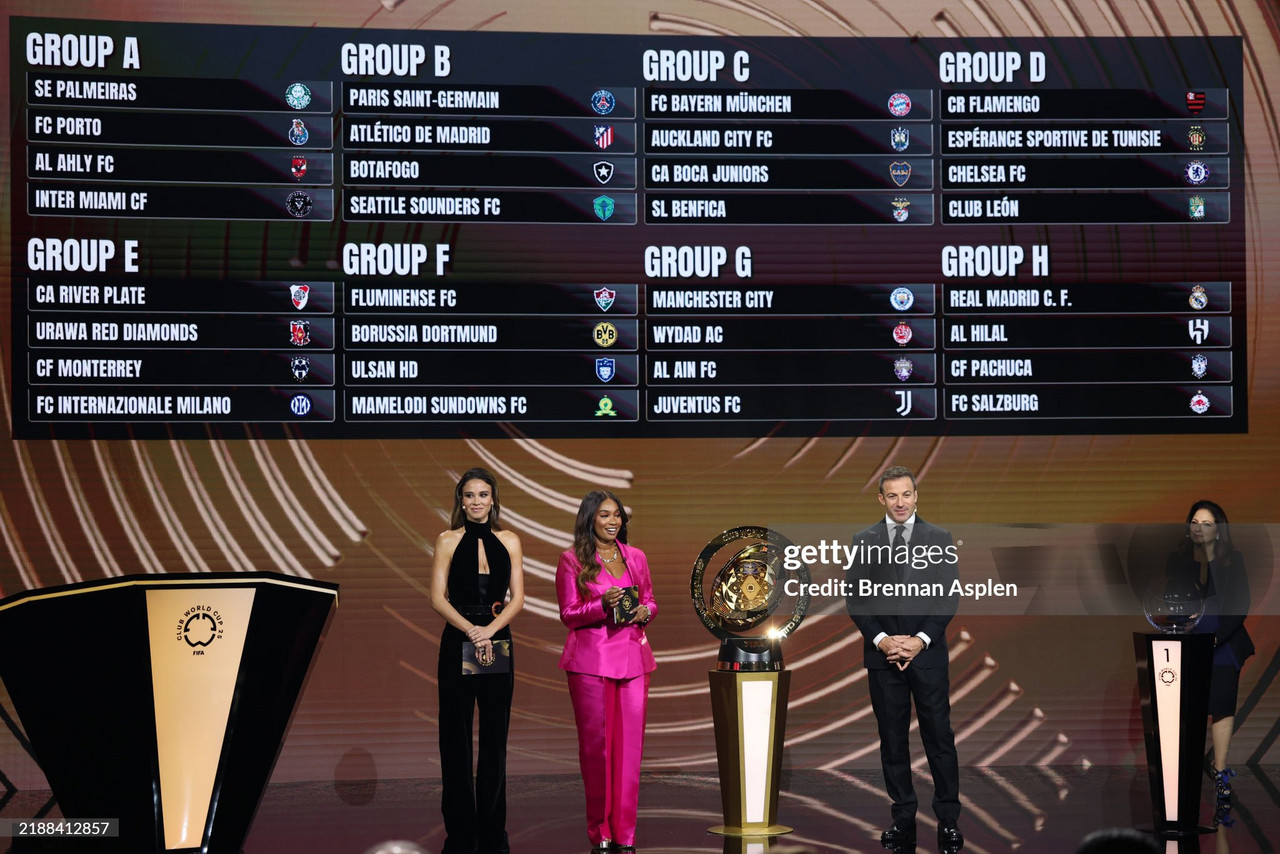
The group stages run the risk of being rather lopsided in some cases. On paper, perhaps Group B is the “group of death” with South America’s current top side, Botofogo, and home advantage for Seattle, meaning Paris Saint-Germain and Atletico Madrid might not have quite as easy a ride as they’d like. Some of the other groups look very straightforward.
On the whole, the tournament might be a bit of a slow burner. It lacks the months of build-up that the World Cup has, and interest might only start to pick-up once the tournament reaches the knockout stages. But due to the disparity between confederations, those latter knockout stages risk becoming a mini summertime version of the European Champions League.
