





Simply saying the three letters FFP nowadays is enough to provoke wild arguments over spending sustainability and competition regulation in the world's biggest sport.
Football has long been plagued by issues surrounding financial fairness, especially between so-called 'bigger' clubs at the top of Europe's elite, and those lower down the football pyramid.
No club has epitomised that divide more over the past year than Chelsea, whose high spending has been discussed myriad times already.
Questions have already been asked about whether the Blues can avoid sanctions relating to their transfer splurges this season and last, with multiple reports attempting to explain the finances of the current situation.
However, even assuming the west London side do indeed manage to avoid punishment this year, there is an underlying problem which threatens to rear its head just at the worst possible time for the club.
Fundamentally, it all comes down to the infamous seven, eight, and even nine-year contracts that Chelsea have been offering their new signings, and the way those are recorded on the books.
But this is not just another article explaining how amortisation works - after all, anybody can grab a calculator and divide a transfer fee by the length of a contract.
Instead, this will show how Chelsea have a near £200 million deficit that they must fill within two years time if they are to avoid fines, bans, or even exclusion from competitions altogether.
The Calculations
First, a disclaimer: the figures quoted here are obviously all subject to the accurate reporting of fees within the media. This will not, and could not, be an exact science without detailed access to the club's financial records.
Nevertheless, given the publicly available information, there are a number of calculations that can be done to see quite how significant the problem is.
As mentioned previously, amortisation has been the word of the year in football, and the concept is a simple one. Using reported transfer fees, as well as contract lengths, VAVEL have created a full list of every Chelsea player currently on the books who was bought for any sort of fee.
There are 28 players in total - seven of whom are on loan - and obviously this does not include academy players who effectively have 'no fee' attached to them in accountancy terms.
For example, take Moises Caicedo. Signed for £115 million on an eight-year deal, this equates to a cost of £14.375 million per season, for every year from now until the 2031/32 campaign.
A similar process is applied to all players (for January signings, contract lengths are rounded up to the next highest number), until the following table is created. Admittedly, it looks a bit of a mess.
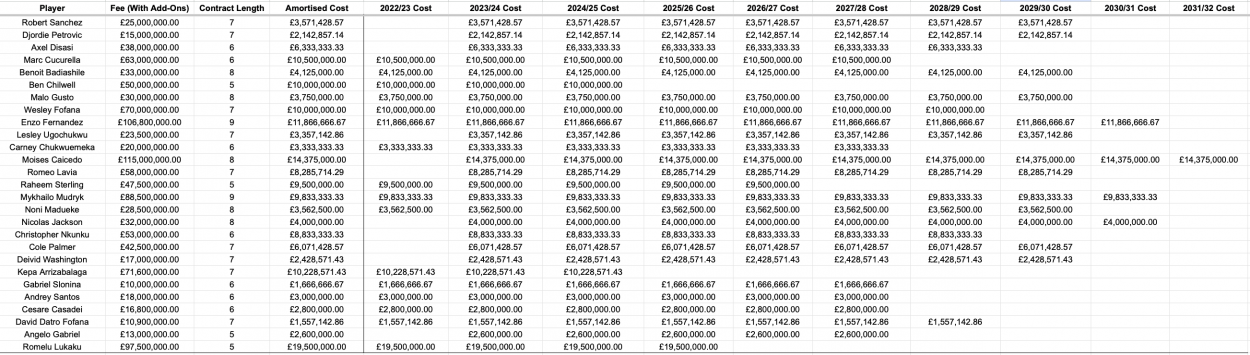
What it does show, though, is how Chelsea will still be recording fees for several players in multiple years' time, before the number tapers out around 2028.
This then allows us to work out the 'projected cost' for each upcoming season, based on current amortisation costs, assuming no more players join and none of these players leave before the end of their contracts (more on that in a moment).

Now, for the sake of more complicated calculations (due to swathes of players leaving this summer who joined under different contract arrangements several years ago), this article will not examine either the 2022/23 or 2023/24 seasons - these have already been looked at extensively by other sources, including the excellent Swiss Ramble.
Instead, the focus will be on the 2024/25 season onwards, with those representing arguably the most overlooked issue for the Blues.
The Rules
In order to examine whether Chelsea look set to break any rules, we need to actually understand what the rules are.
The important factor here is that there are two sets of FFP regulations - one for the Premier League and one for UEFA.
For now, we'll focus on the Premier League's rules - officially known as the 'Profit and Sustainability Regulations' (P&S). These state that clubs cannot make a loss of more than £105 million over the course of a three-season monitoring period.
For the sake of argument, we'll cut this down to a £35 million loss maximum each year. This includes all aspects of a clubs income and expenditure, from transfers, to wages, to commercial deals.
With wage structures not common knowledge outside of rough estimates, these will be excluded, but this is predominantly cancelled out by the exclusion of any commercial income, which again is kept under wraps.
Hence, we are left in a, by and large, 'neutral' profit / loss situation, with only player trading (otherwise known as transfers) remaining.
So, using those calculations from earlier, we can then allow for a £35 million loss each season, and see (roughly) how much Chelsea will need to bring in via player sales in each of the upcoming seasons in order to abide by the P&S rules.
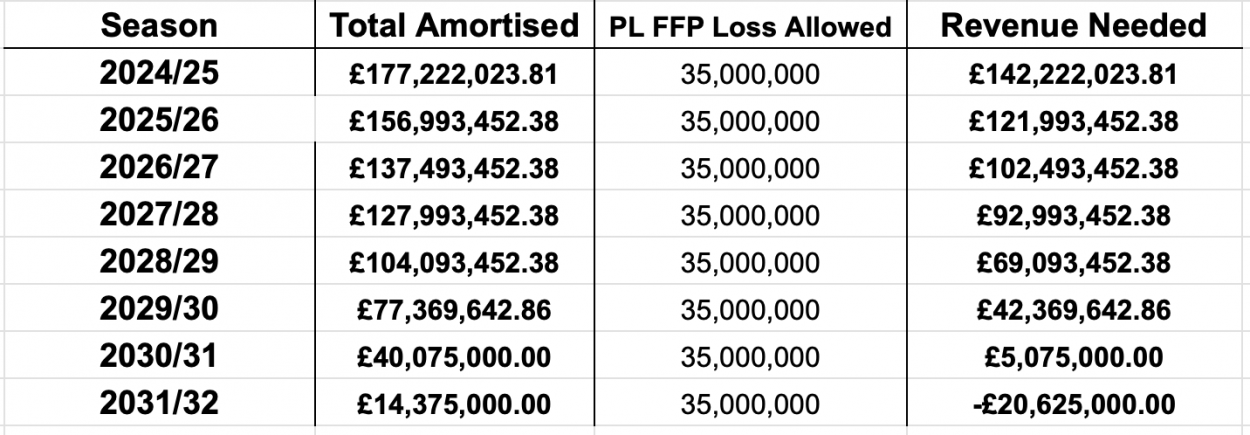
As shown in the table, according to VAVEL estimates, the Blues will need to raise player sales of a little over £142 million in the 2024/25 season to fit with P&S regulations.
That, of course, will naturally have to come from players currently at the club, and clearly once they have been sold their amortised cost in the subsequent years of their contract (if any) is then wiped from the books.
Hence, assuming Chelsea reach that £142 million threshold, they will then theoretically be in a much stronger position for the following seasons, when the revenue needed will be lower as there will be fewer amortised costs remaining.
With that said though, this assumes no more signings between now and then for Chelsea which, judging by their transfer market tendencies so far appears unlikely.
Even then, if they were able to raise such funds (which could conceivably be done from three £50 million sales), a bigger problem awaits Chelsea - and this is what appears to have been overlooked.
The UEFA Problem
Earlier in the summer, in an apparent response to Chelsea's willingness to hand out near-decade long contracts, UEFA instigated a new rule into their FFP regulations, which meant that contracts could now only be amortised over the course of a maximum of five years.
Now, given Chelsea failed to qualify for any European competition this season, that is not an issue currently - but presumably they will be hoping to get back into continental competition over the next two years or so, which means it will become an issue very quickly.
Taking into account the five-year rule for all new signings from July 1 2023, our initial calculations from earlier must be significantly adjusted, and they result in newer figures, as shown below.
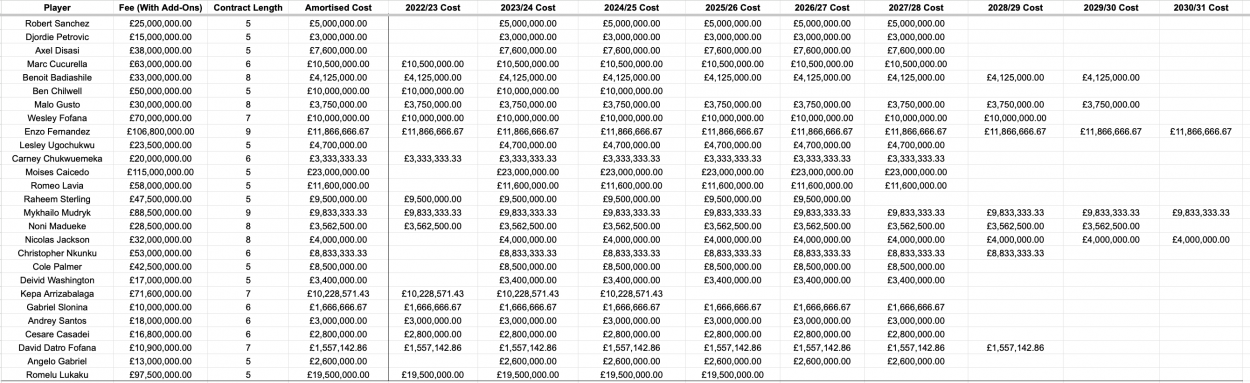
It hardly takes a mathematical genius to figure out that amortising a contract over a shorter amount of time will result in a higher figure for each season, and that is exactly what will happen when reporting under UEFA's rules.
Equally, the allowed loss by UEFA is less than that of the Premier League, with clubs only allowed to lose a maximum of €60 million (£51.5 million) over three seasons.
Again, taking an average of €20 million (£17.1 million) per season and removing that from the current cost, the following numbers are found for the revenue Chelsea will need to bring in to avoid falling foul of UEFA's regulations.
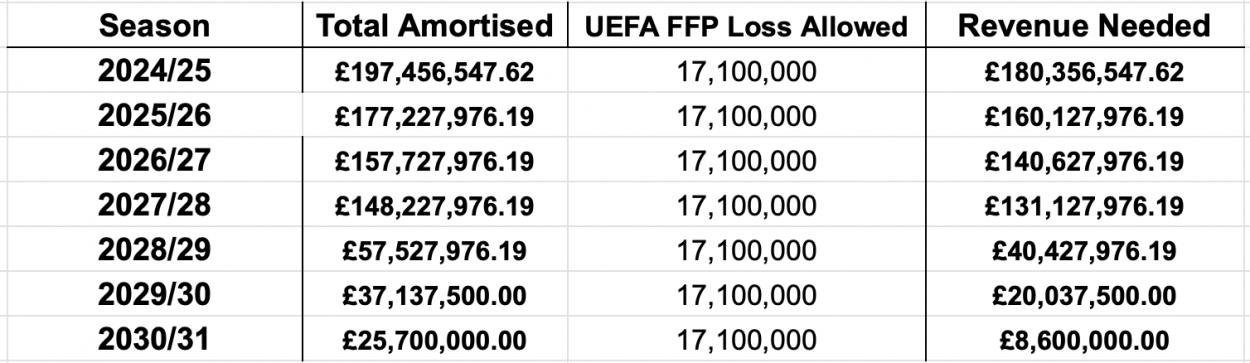
As before, if the Blues do manage to get their business in order and ship out £180 million worth of players in 2024/25, they should be covered enough for the seasons after that, but that is a huge if.
To put £180 million of sales into perspective, this summer the Blues have raised £230 million, but it has cost them over 10 different players - something that would be repeated with this newly-assembled squad.
Even if there were a couple of big money moves in the region of £100 million each, it would then lead Chelsea back into the market to replace them, starting their problems all over again with a freshly-amortised fee.
Add on to all of this the fact that the commercial deals and prize money may very well not cover the ever-growing wage bill and this problem is only worsened, potentially requiring player sales of over £200 million in just one season.
And then there's the fact that players will likely still keep coming in, meaning a further bout of sales will need to be sanctioned in the 2025/26 season, seemingly locking Chelsea into an endless, dispiriting cycle.
The Caveats
Of course, there are a large number of caveats to add onto this analysis and it would not be right to point out the major ones associated with it.
The first, as mentioned earlier, is the fact that until Chelsea release their accounts, all of these figures are merely estimates - and some, like the wage bill, are extremely rough estimates at that.
Secondly, commercial deals could well cover a significant amount of these deals if the Blues can get back to their trophy-winning style and pick up silverware almost every year, as they have done for practically the past two decades.
Thirdly, and linked to the previous point, prize money could plug a huge proportion of this gap, especially that of a strong-placed finish in the Premier League, which the club have not achieved for some time now.
And finally, it may be that even if Chelsea do breach the rules, it is considered only minor and they are subjected to merely a fine rather than more serious punishments such as a transfer embargo or a ban from European competitions.
Regardless, even with those caveats applied, it is hard to deny the level of the potential issue Chelsea have at hand in just a couple of years time.
A tough market to sell in will only be made more difficult by the fact other clubs will be aware of the situation the Blues are in, causing them to be in a stronger negotiation position.
Much of the conversation surrounding Chelsea's spending has been an unfair representation of what has, in truth, been an eye-opening exposure of the fallibility of financial fair play regulations.
But with the solution so far seeming to be 'kicking the can down the road', it does feel as though only a matter of time until the problems outlined in this article come to fruition.
Perhaps there will be another currently unforeseen loophole to escape from such trouble, or that the problems are not as severe as they appear from the outside, however that seems more wishful thinking than anything else.
Chelsea have assembled the most expensive squad in football history - yet they may need to sell much of it before they've even started.
