


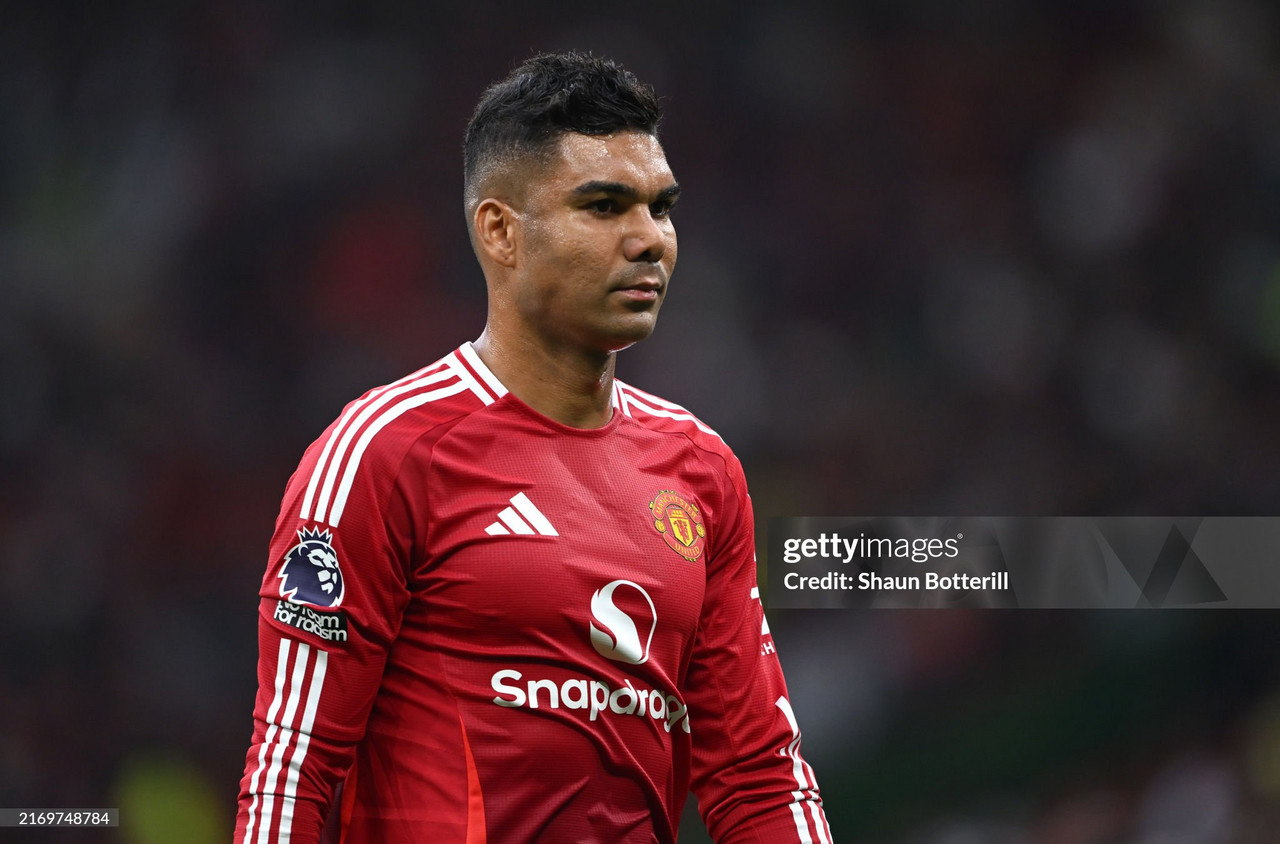

Casemiro arrived at Manchester United in August 2022 as one of Erik ten Hag's marquee signings. A five-time Champions League winner with Real Madrid, Casemiro was brought in to add much-needed steel to United's midfield.
Casemiro's debut season at Old Trafford was regarded as a success. The Brazilian played a key role in helping the Red Devils secure a top-four Premier League finish and win the EFL Cup, bringing much-needed stability to United's midfield.
However, after an underwhelming 2023/24 campaign and a shaky start to the 2024/25 season, doubts about his form and long-term suitability have intensified.
The latest blow to his standing came this past Sunday, during a humbling 3-0 loss to rivals Liverpool. Casemiro was withdrawn at half-time after a lacklustre performance, fueling speculation that his time at United could be running out.
Decline in form and fitness
At 32, Casemiro seems to be grappling with the intense physical demands of the Premier League. His recent performances have been a far cry from the commanding displays that characterised his impressive debut season at the club.
Once renowned for his impeccable defensive positioning, Casemiro now appears vulnerable, often caught out of place and unable to keep up with the pace of younger, more agile opponents. His decline in mobility has exposed him in critical moments, raising concerns about whether he can still anchor United’s midfield as effectively as before.
During the defeat to Liverpool, Casemiro was exposed on multiple occasions. His inability to keep pace with the tempo of the game allowed Liverpool to dominate the midfield, repeatedly breaking through United's lines with ease.
Casemiro's physical decline has been gradual but increasingly evident. Although he was never the quickest midfielder, his excellent positioning and sharp anticipation once allowed him to offset any lack of pace.
Now, however, he appears noticeably slower, with a reduced ability to recover during transitions. This decline has placed additional pressure on United's already fragile defence, which has been hampered by injuries and inconsistency over recent months.
The 32-year-old has been poor in possession at times, particularly against Arne Slot's side on Sunday. The Brazilian's lacklustre passing gifted Liverpool possession for their two opening goals, leading to his swift withdrawal.
Casemiro's half-time substitution felt like a clear acknowledgement by Ten Hag that the Brazilian was not up to the task, particularly given that he was replaced by 20-year-old Toby Collyer, who was thrust into the deep end for his Premier League debut.
The decision to replace the seasoned veteran with a young, inexperienced player in such a high-pressure game showed Ten Hag's concern with Casemiro’s performance and added weight to the growing doubts about his ability to meet the demands of the top level moving forward. For a player of his calibre, such a public demotion raises serious questions about his future at the club.
Is the Brazilian a misfit in Ten Hag's system?
Casemiro’s struggles are not just physical—they’re also tactical. Under ten Hag, United’s most effective football has been characterised by high-energy play, intense pressing, and rapid transitions.
While Casemiro excelled in a more static, deeper defensive role at Real Madrid, the Premier League’s high tempo and Ten Hag’s more energetic style have exposed his lack of mobility.
A clear indication of this tactical misfit was Casemiro's exclusion from the squad for last season's FA Cup final. Despite his experience and status, Ten Hag opted to leave him out, perhaps a signal that Casemiro no longer fits the dynamic, high-pressing approach the manager wants to implement at United, which saw the Reds secure a 2-1 over rivals Manchester City in the FA Cup final.
The challenge for Ten Hag is whether Casemiro can adapt to these new demands. His vast experience and footballing intelligence might still allow him to play a role in the squad, but he would need to evolve his game to remain relevant in the fast-paced environment of the Premier League. Without these adjustments, Casemiro may find himself phased out in favour of younger, more mobile midfielders.
Leadership and experience
While Casemiro’s on-pitch performances have faltered, his leadership and experience are still highly valued at Old Trafford. As one of the most decorated players in United's squad, Casemiro brought a winning mentality and a wealth of experience that were crucial when he arrived.
His presence in the dressing room has been important, particularly for mentoring younger players, and his influence extends beyond matchday.
Nevertheless, leadership alone may not be enough for the Brazilian to keep his spot, as United’s midfield has been exposed on numerous occasions this season, with Casemiro's declining performances contributing to the team’s struggles. The arrival of Manuel Ugarte, who brings youthful energy and aligns more closely with Ten Hag’s tactical demands, puts Casemiro's spot in the starting 11 at risk.
As a result, Casemiro’s role may shift from being a regular starter to a senior squad member used strategically. His experience and leadership could become vital in specific situations, but he may no longer be a fixture in the starting XI. If Casemiro cannot adapt to the evolving needs of the team, his future at Old Trafford might be limited to a more peripheral role.
What lies ahead for Casemiro?
The coming months will be pivotal for Casemiro. If he can rediscover his form and adapt his game to fit the demands of Ten Hag’s system, he could still play a significant role for United this season.
However, with the arrival of Manuel Ugarte from PSG, Casemiro faces intensified competition. Ugarte’s youthful energy and mobility might see him earn a spot in United's starting lineup in the near future as the Reds aim to cultivate a more dynamic and aggressive midfield unit.
Ugarte appears to be better suited to United's system. His mobility, work rate, and defensive intensity align more closely with Ten Hag's vision for a modern midfield, making it increasingly difficult for Casemiro to retain his place in the starting lineup.
If Casemiro’s form continues to decline, United may look to offload the Brazilian, with potential interest from European clubs, the MLS and the Saudi Pro League providing possible exit routes.
In the interim, Ten Hag will need to manage Casemiro’s game time judiciously, leveraging his experience and defensive skills in situations where they are most beneficial.
Balancing Casemiro’s deployment with the need to maintain a high-energy, mobile midfield will be crucial for United as they navigate the challenges of the Premier League this season.
