


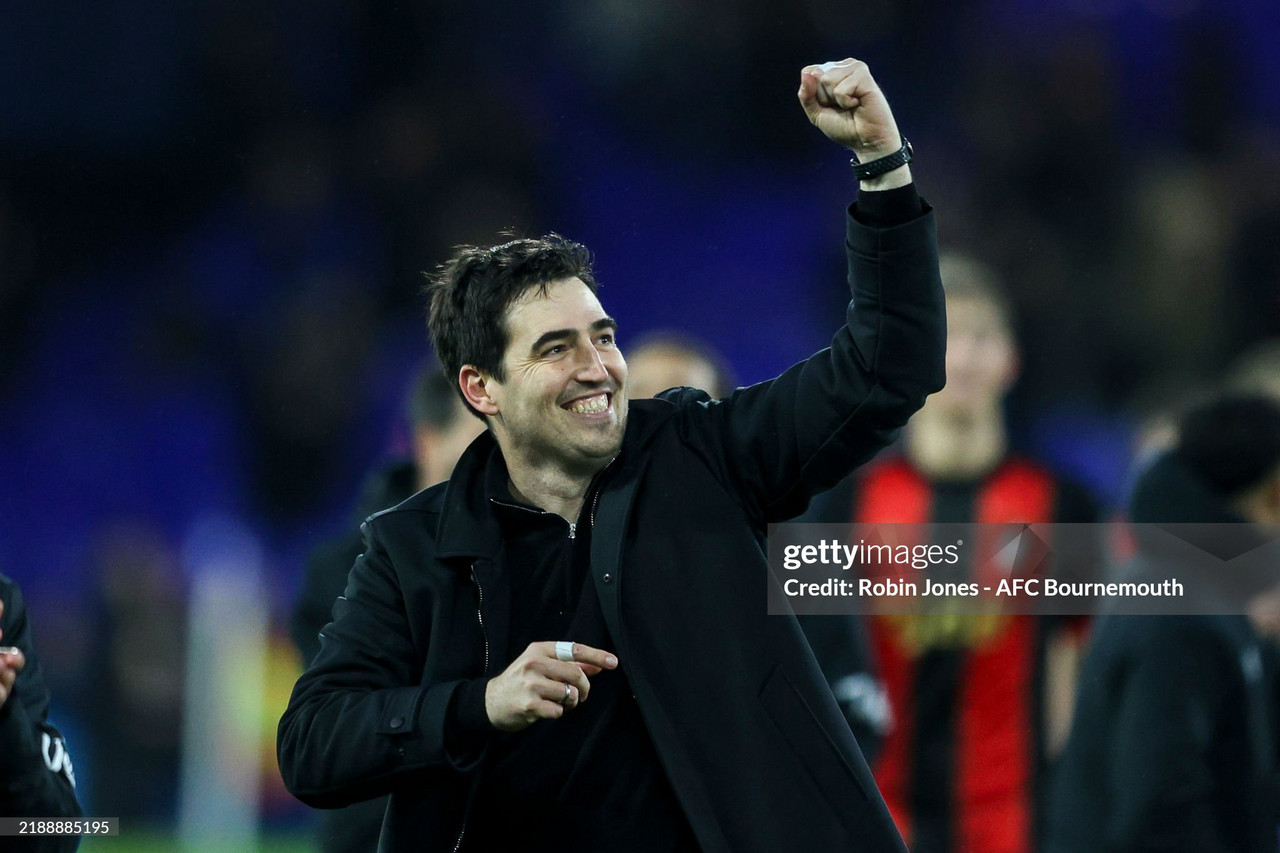

Andoni Iraola’s Bournemouth side have embraced a significant tactical edge this season, using substitutions as a tool to shift game momentum and save themselves from defeat on multiple occasions already.
Known for his high-press, breakneck style of football, Iraola’s strategy goes beyond fresh legs. It is all about injecting last-minute energy into his team's game plan, helping keep intensity up over 90 minutes.
This approach paid off notably against Aston Villa, where substitute Evanilson scored a late equaliser; Everton, where bench players added a late offensive push that shifted the game’s tempo and completely turned the game around; and the latest ‘super sub’ showing against Ipswich Town on Sunday afternoon.
To explore how Iraola’s substitution strategy has become essential for Bournemouth’s resilience in the Premier League during this campaign and why it has worked so well, VAVEL looks at who has come on and when.
-
Iraola’s tactical approach
Iraola’s tactical style emphasises high-intensity pressing, fluid positioning and rapid transitions to create relentless pressure.
He adopts a compact, aggressive formation where players press high up the pitch to quickly recover possession and initiate counter-attacks.
This dynamic playing style demands high fitness and versatility, with wide players pushing forward to create width while central players frequently rotate positions to maintain structure and defensive resilience.
His approach favours constant movement and calculated risks, focusing on forcing errors and converting opportunities swiftly when the opposition is vulnerable.
Because Iraola’s high-intensity pressing system requires sustained energy and constant movement, substitutes are essential to maintain pressure late during games.
-
How Iraola uses his bench
Iraola has often hinted that his approach goes well beyond the starting eleven, reflecting a deep reliance on his squad’s depth.
While his regular core line-up provides structure, he frequently rotates and adapts players to meet the demands of each game, ensuring tactical flexibility.
This approach allows Bournemouth to press relentlessly, staying dynamic and effective even as matches progress.
Substitutions, often around the 60th minute, are crucial to sustaining intensity, a hallmark of Iraola’s aggressive, high-energy system.
This late-game strategy often results in goals in the final stages, exploiting the fatigue of opposing teams.
Iraola’s tactical variety is equally noteworthy.
Bournemouth balance intricate short passing with more direct long balls, utilising their central defenders’ distribution skills to bypass midfields or pressure high defensive lines.
When trailing, Iraola is not afraid to shift to a more traditional two-striker system, leaning into physicality and aerial play to chase results - a bold yet calculated risk.
Another defining feature of Iraola’s bench management is his propensity to shift players’ roles mid-game, tailoring responsibilities to adapt to tactical changes.
Substitutions often form part of a larger strategy rather than isolated changes, amplifying their impact.
It is no surprise Bournemouth frequently turn late deficits into valuable points, and it is a testament to Iraola’s tactical ingenuity and excellent squad management.
-
Two case studies:
Let us take a look at two matches this season where Iraola used his bench to great effect and changed the game from losing positions.
-
Aston Villa 1-1 Bournemouth
In Bournemouth’s draw with Aston Villa, Iraola’s substitutions subtly yet crucially changed the game’s trajectory.
The standout impact came from Evanilson, whose late goal secured the draw.
But his influence stretched beyond that moment; replacing Enes Ünal, Evanilson brought pace and pressing intensity, making off-the-shoulder runs that drew Villa’s defence deeper and created valuable space for Bournemouth’s midfield to sustain possession and exploit passing lanes.
Iraola’s early swap of Adam Smith for Julián Araujo in the first half was equally vital.
Araujo had struggled to contain Jacob Ramsey, who was finding too much space on the wing.
Bringing Smith on restored a more disciplined structure, limiting Villa’s advances and stabilising Bournemouth’s defence.
Further changes added fresh attacking options: Marcus Tavernier replaced Justin Kluivert and provided a creative spark, delivering the late free-kick cross that led to Evanilson’s equaliser.
Tyler Adams also came on in the final minutes, giving Bournemouth’s attackers greater freedom to commit forward in the hunt for a last-minute chance.
Iraola’s subs not only reinforced the team’s structure but added layers of energy and control, helping Bournemouth claim a well-earned point.
-
Everton 2-3 Bournemouth
Bournemouth’s remarkable 3-2 comeback against Everton was a testament to Andoni Iraola’s sharp tactical adjustments.
Down 2-0 and struggling with Everton’s physical play, Iraola recognised the need for defensive and offensive shifts.
He replaced Marcos Senesi with Dean Huijsen, a young defender known for his aerial strength and composure on the ball.
Huijsen’s presence allowed Bournemouth to build more effectively from the back and move into midfield, pushing the team further up the pitch and unsettling Everton’s rhythm by challenging their tactics and adding stability in defence.
Offensively, Iraola’s introduction of Luis Sinisterra and Dango Ouattara proved decisive.
Ouattara injected speed and intensity, relentlessly pressing Everton’s backline and delivering dangerous balls into the box.
His tenacity forced Everton’s defenders into errors, while his willingness to make direct runs added energy to the attack.
Sinisterra, replacing Evanilson, transformed the team’s forward play with his fluid movement, drifting between Everton’s defensive lines and offering the creativity Bournemouth had been lacking.
Sinisterra assisted Lewis Cook’s equaliser with a well-timed cross, demonstrating his playmaking ability.
His own match-winning goal came in stoppage time as he connected with a deep cross from Kluivert, finding the space to sneak between defenders and header in the winning goal.
Iraola’s substitutions were carefully calculated to exploit Everton’s weaknesses, with all three Bournemouth goals coming from crosses - an intentional shift to exploit Everton’s organisational problems.
The result highlighted the manager’s tactical flexibility, turning a disjointed Bournemouth performance into a memorable comeback victory on Merseyside.
-
Keeping the squad happy
As an added bonus, Iraola’s approach to substitutions keeps the squad motivated and engaged, with frequent rotation meaning no player can take their place for granted.
This gives everyone meaningful minutes to prove themselves, strengthening squad unity and competition whilst ensuring that all players are comfortable playing with each other.
Bournemouth have largely avoided the injury crisis that saw them struggle last season, keeping a broad selection of fresh talent at Iraola’s disposal and helping to change the outcome of games.
With an intense fixture list ahead, this rotation will be even more vital as Iraola maximises each player's impact, sustaining energy and adaptability throughout each match.
Fans can expect more impactful, game-changing substitutions as the season unfolds and should learn to not discount their side at any point in the game, even when losing with less than ten minutes left.
