


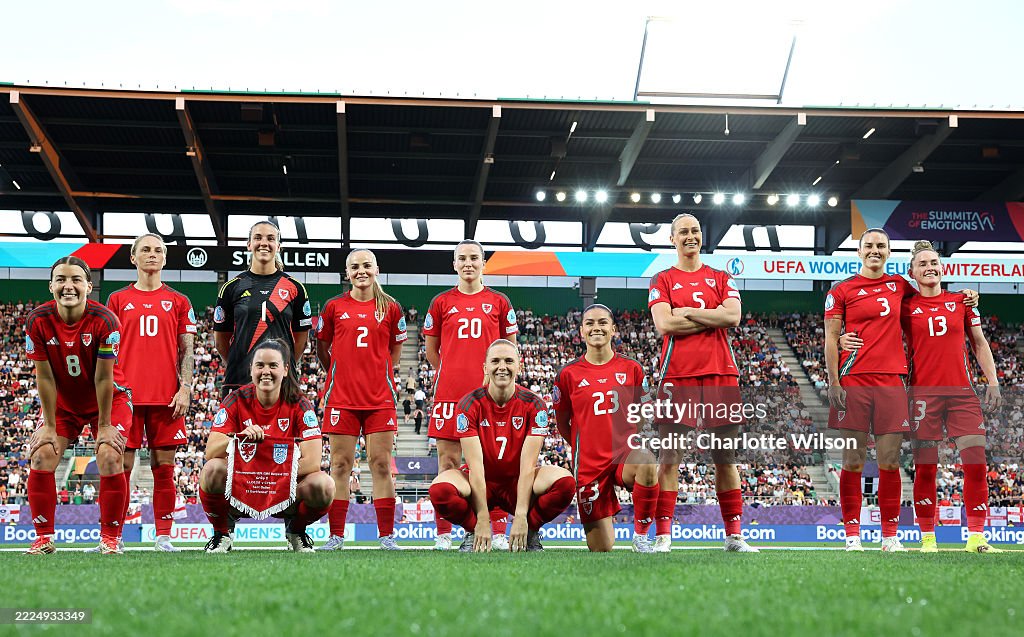

Wales ended their inaugural UEFA Women's Euros campaign with a humbling defeat at the hand of neighbours England.
Six goals from six different scorers saw the hungry Lionesses - who went on to qualify for the quarter-finals - win 6-1 in St. Gallen as Rhian Wilkinson's side finished fourth in the group.
A sublime finish from Hannah Cain did allow the Welsh fans to celebrate another goal this Euros, having witnessed Jess Fishlock level things up against France during the 4-1 loss.
Here are four things we learnt as the Dragons bow out in Switzerland.
-
Slow starts still costly
Perhaps the most pressing takeaway from Sunday’s defeat is another early setback. Wales have made it a habit in recent months of going behind in the opening stages of matches.
Of the nine times they have gone behind in 2025, seven have come within the first 20 minutes.
Only once, in their home outing against Sweden, have they been able to retrieve a point from going down so soon after kick-off.
It is a habit that they will have to go cold turkey on. Early goals not only disrupt pre-prepared plans but any way of gaining a foothold - something Wales have needed this year given the higher calibre opposition they have faced.
The opening game against the Netherlands began with a stronger platform in this regard, only to go agonisingly behind before the break.
-
Back five quandary
Sunday night also saw Wales afford England far too much space in the wide areas that were routinely exploited by the talents of Lauren James and Lauren Hemp, with James in particular making it look like exhibition football at times.
Even the likes of Ella Toone, Alessia Russo and Alex Greenwood began intentionally drifting out wide as Wales failed to sure it up.
Wilkinson’s decision to go for a back four proved an unfortunate misjudgement, with Ffion Morgan being the extra player up front instead.
That was not an entirely fruitless endeavour. Morgan’s energy and pressing from the front meant she staked her claim to be a regular starter against less high-profile or possession-shy opposition.
But, given the Lionesses smelled blood early on from the wings, another body further back may have been more beneficial. An apparent knock to left-back Lily Woodham did not aid things either.
Wilkinson did employ a back five in the clash with the Dutch, but opted for a more front-footed approach against France and England. This did, in fairness, provide Wales with more moments of counter attacks, - and two goals - but also gave up some that a tighter defensive unit may have avoided.
Wilkinson has shown her willingness to change things and experiment regularly. Going forward may mean some fine tuning to specific systems instead.
-
Future planning needed for central midfield
Though the wide areas were continuously exploited on Sunday night, Wales’ biggest headache beyond this tournament will be in the middle of the park.
Illness to Hayley Ladd meant the Dragons were desperately short of someone to partner Angharad James-Turner, who imposed herself as much as possible given her lack of assistance.
Captain James-Turner was the only recognised central midfielder starting against Sarina Wiegman's side. It felt at times, as it did against France, that she was having to play the role of two or three players on her own.
It was also slightly puzzling how the talismanic Fishlock was still operating as further up despite her playmaking abilities often causing more problems from deeper, as well as the lack of minutes for Alice Griffiths to fill this issue in the middle.
Post-Euros chatter will be full of ‘what next’ questions. Not just in terms of short term tactical tweaks, but long term options. Wales’ most notable names, like Fishlock, Sophie Ingle, and Rhiannon Roberts, are nearing the end of their time with the national team.
There have been moves to bring in younger players to central defence, goalkeeper and the strikers in recent months, but it was evident that a gap is beginning to appear in central midfield.
-
The Red Wall shows that the future can be bright
In the space of four years, Wales have gone from taking five supporters onto the continent to over 8000 making the trip to the Euros. The relentless singing and sea of red shirts have been reminiscent of Euro 2016, where the men’s side coined 'the Red Wall' to describe their fans.
This summer has at least shown that there is not only appetite for women’s football in Wales but a sizable demand for it.
Having broken the home record attendance during the 1-1 draw to Ireland in Cardiff last year, things are generally looking up for Wales despite their showings at their first major tournament.
Wilkinson has spoken before about her frustration in Wales’ national backing.
"The FAW [Football Association of Wales] has the 'Together Stronger'. I think it's incredible, as long as it means something, if it's just a slogan on a wall, don't bother."
In the wake of the defeat to England, the mission of growing a greater culture surrounding women’s football in Wales was still at the forefront of her mind.
"The next stage is that I need to get back to Wales, and I need to keep making sure that across our country, we continue to push opportunity for our young girls for all sport."
Even in the first team squad, regular game time has been limited for a number of players this past season, meaning the national team are missing out on a team full of players with rhythm and match fitness.
While the players have individual responsibility to keep competing for starting spots, the FAW and supporters who have recently began following Wilkinson’s side likewise have a responsibility to invest in the future of the women’s team, with both money and dedication, in order to ensure that this Euros campaign was not merely a one-off.
