


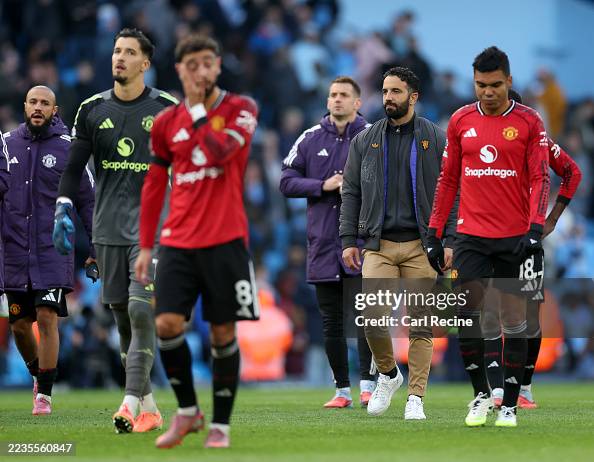

Since Rúben Amorim’s arrival, several Manchester United players have found it difficult to adapt to the tactical demands of his set-up.
Below are four players whose performances have dipped as they try to fit into the new framework.
-
Amad Diallo
Once regarded as one of United’s most exciting attacking prospects, Amad has struggled to adapt to Amorim’s requirements.
Traditionally used as a right winger or No.10, he is now often deployed as a right wing-back, a role that prioritizes defensive discipline over creative freedom.
While Amad’s attacking flair thrives in advanced positions, this new role forces him to track opposition wingers, maintain focus in defensive transitions, and limit forward runs. As a result, his instinct to attack is curtailed, and he rarely finds himself in dangerous areas where he excels at creating chances or scoring goals.
The lack of rhythm in this hybrid position has affected his confidence and made it difficult for him to establish consistent form.
-
Casemiro
Casemiro’s experience and quality remain invaluable, but the intensity of Amorim’s two-man midfield has exposed the limitations that come with age.
He is asked to break up play, shield the back three, and simultaneously help progress the ball into advanced areas. Balancing those responsibilities requires stamina and sharpness over 90 minutes — something increasingly demanding for the veteran.
A midfield three would better suit Casemiro, allowing him to focus on shielding the defence while supporting attacks in a more controlled manner. Without that extra support, he often appears overstretched, creating an imbalance in the middle of the park.
-
Kobbie Mainoo
Kobbie Mainoo, one of United’s brightest young prospects, has also found the transition challenging. Naturally comfortable as an adventurous No.8, Mainoo thrives when he can dribble, dictate tempo, and exploit pockets of space.
However, Amorim’s system frequently requires him to operate as a box-to-box midfielder with greater defensive awareness and physicality. Tracking runners and dominating midfield battles are areas he is still developing. As a result, he has struggled to secure a regular starting role, often finding himself on the bench.
A system featuring a traditional midfield three could provide Mainoo with the balance and protection needed to unlock his full potential.
-
Joshua Zirkzee
Joshua Zirkzee has yet to showcase his best form since joining United. Deployed in various attacking roles — from false nine to advanced playmaker — he has lacked the impact expected of him.
Amorim’s approach demands high intensity, quick decision-making, and strength in duels, qualities Zirkzee has yet to consistently display.
When pressed aggressively, he can appear hesitant, and his tendency to slow the tempo limits his influence. A role as a traditional striker, where he could receive the ball with his back to goal, link play, and arrive late in the box, may better suit his skill set.
A tweak in approach could help highlight his creativity and finishing rather than expose his lack of explosive pace.
-
Summary
These players possess clear talent but have not reached their potential within Amorim’s current setup. Without tactical adjustments or role changes, they risk stagnating or even being moved on — a scenario that would represent a significant missed opportunity for Manchester United, given their importance to the club’s future.
