


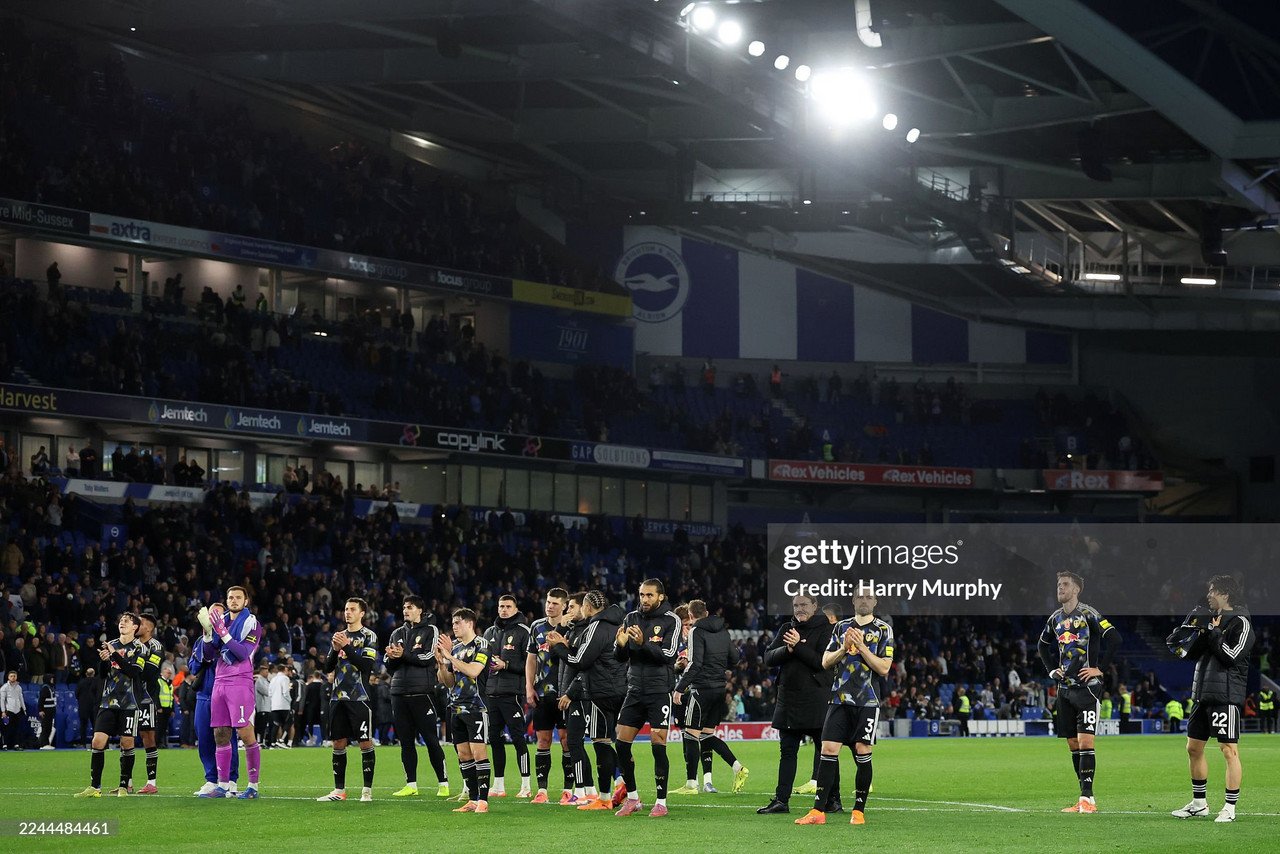



Leeds United were handed a reality check at the Amex, falling 3-0 to Brighton in a bruising night that exposed every structural flaw Daniel Farke’s side have been skating over for weeks. Brighton took total control from minute one.
The Whites made a slow start and conceded early once again, with Danny Welbeck finishing from a flowing Brighton move inside 11 minutes.
Leeds’ best chance should have fallen to Dominic Calvert-Lewin shortly after, but he wasn't able to finish from Jayden Bogle's cross.
Farke's side continued to struggle creating any notable high quality chances, and quickly fell 2-0 behind on the hour mark - with Diego Gomez tapping in from close range after Yankuba Minteh got beyond Gabriel Gudmundsson.
Gomez then snatched the second for his brace to make it 3-0 - again finding space in the box after being set up by former Leeds star Georginio Rutter.
The Seagulls suffocated Leeds’ build-up, overloaded central zones, and found it far too easy to play through pressure over and over again. Leeds never found rhythm, never established sustained possession, and never looked like they could actually flip momentum.
Leeds United Player Ratings
Lucas Perri - 7
While the result was brutal on the scoreboard, Perri was one of the very few players who actually came out of this match with credit.
He made multiple important interventions that genuinely kept the scoreline from being heavier, especially during the period where Brighton looked like they could score at any sequence of sustained possession.
Gudmundsson actually had some decent passages and tried to provide a progressive outlet when Leeds were attempting to get into Brighton’s half.
He carried well, attempted to link through the left half space, and physically he did not hide even when Brighton were completely dominating the ball.
He was not decisive enough overall but he was one of the few that at least showed the willingness to keep Leeds active in build and not just panic pass backwards under pressure.
Jaka Bijol - 5
Brighton’s positional rotations, especially between their advanced midfielders and their inverted wide zones, consistently pulled Bijol into indecision.
He was frequently caught between stepping and screening and as a result Brighton entered between Leeds defensive shape far too easily.
Joe Rodon - 5
Rodon suffered the same principle issues. He struggled to anticipate Brighton triggers in advance. He often reacted one beat too late which in Premier League tempo is fatal.
He was not horrific individually, but he was constantly uncomfortable because the game was being played faster around him than he was prepared and set for.
Jayden Bogle - 4
Brighton targeted him. Over and over. They pressed his touch side aggressively, forced him into rushed passing sequences, and isolated him in wide channels.
Extremely difficult viewing at times.
Ethan Ampadu - 5
This is normally a match type that suits the former Chelsea man. Big intensity, transitional tempo, physical duels.
But Brighton manipulated Leeds’ defensive structure so much through rest defence and rotating ball circulation, that Ampadu was constantly trying to put fires out rather than dictate the tempo of the match.
Sean Longstaff - 6
Longstaff had some strong defensive readings and some important counter press interventions. However, Leeds did not sustain enough possession in the opponent half for his progressive carrying and rotational timing to actually matter.
Not a bad performance individually, but a limited one in final match impact.
Ao Tanaka - 6
Tanaka was the sharpest of the midfield three with the ball. He tried to carry through Brighton’s pressure pockets and was one of the only Leeds players that showed purpose with forward direction.
Unfortunately the game state made it almost impossible for his influence to scale. Brighton controlled the tempo and Tanaka was chasing the match not shaping it.
Brenden Aaronson - 5
The energy was there but the final third impact was not. He never managed to become a real threat between Brighton’s lines and his decision making on the ball was too passive at crucial moments.
When Leeds needed incision, he lacked the sharpness.
Noah Okafor - 6
He was the one Leeds attacker who genuinely looked capable of creating a moment out of nothing. He had small flashes where you could sense Brighton defenders actually reacting.
The problem is nobody else around him could elevate with him. He cannot do it alone.
The former Evertonian struggled to make much of the little service received throughout the game - looking rather isolated and devoid of any real threat from his own movement.
-
Substitutes
Anton Stach – 7
His entrance immediately made the structure more stable.
The German looked composed - he controlled sequences, and gave Leeds a level of control they did not have before. Leeds needed him earlier.
Dan James - 6
Gave Leeds some direct wide threat, but the match was gone by the time his influence could hold value.
Lukas Nmecha - 5
Ran lanes but did not alter the dynamic.
James Justin - 6
Clean, safe, reliable minutes. Did not harm but could not change outcome.
Jack Harrison - 6
Improved wide possession retention and at least looked composed under pressure.
Manager Focus Going Forward
This now becomes a Daniel Farke inflection point. The speed of adjustment and the quality of structural correction in the next few matches will determine whether this becomes the turning point that prevents Leeds spiralling into a sustained crisis at the bottom of the table. Leeds cannot continue to be passive in mid block or indecisive during first line pressure moments.
The team needs immediate structural clarity, immediate defensive compactness and immediate tactical simplicity without compromise. Creative shape experimenting can return later when stability exists. Right now stability is the priority.
Leeds want to survive relegation and they must prioritise survival football over style until safety is secured. Match control, clean defensive spacing and a far more risk managed approach to possession phases is the correct path now. The Premier League never waits for artistic evolution. The league rewards foundational solidity and punishes structural naivety. Leeds need to become far more cold and far more calculating in their match management. They must reduce chaos, control zones behind their full backs far more aggressively and bring the physical rhythm of every game back down to where Leeds are not being physically or emotionally overwhelmed.
One short term structural solution that makes functional sense is shifting into a three at the back structure while this stabilisation phase is ongoing. It would provide more natural coverage behind the ball, stop centre backs being isolated so easily and allow wingbacks to create safer possession exit routes.
This does not need to become their permanent football identity, it simply needs to become a survival tool. Leeds have enough talent to stay in this division, but talent alone will not keep them up. Tactical pragmatism will.
