


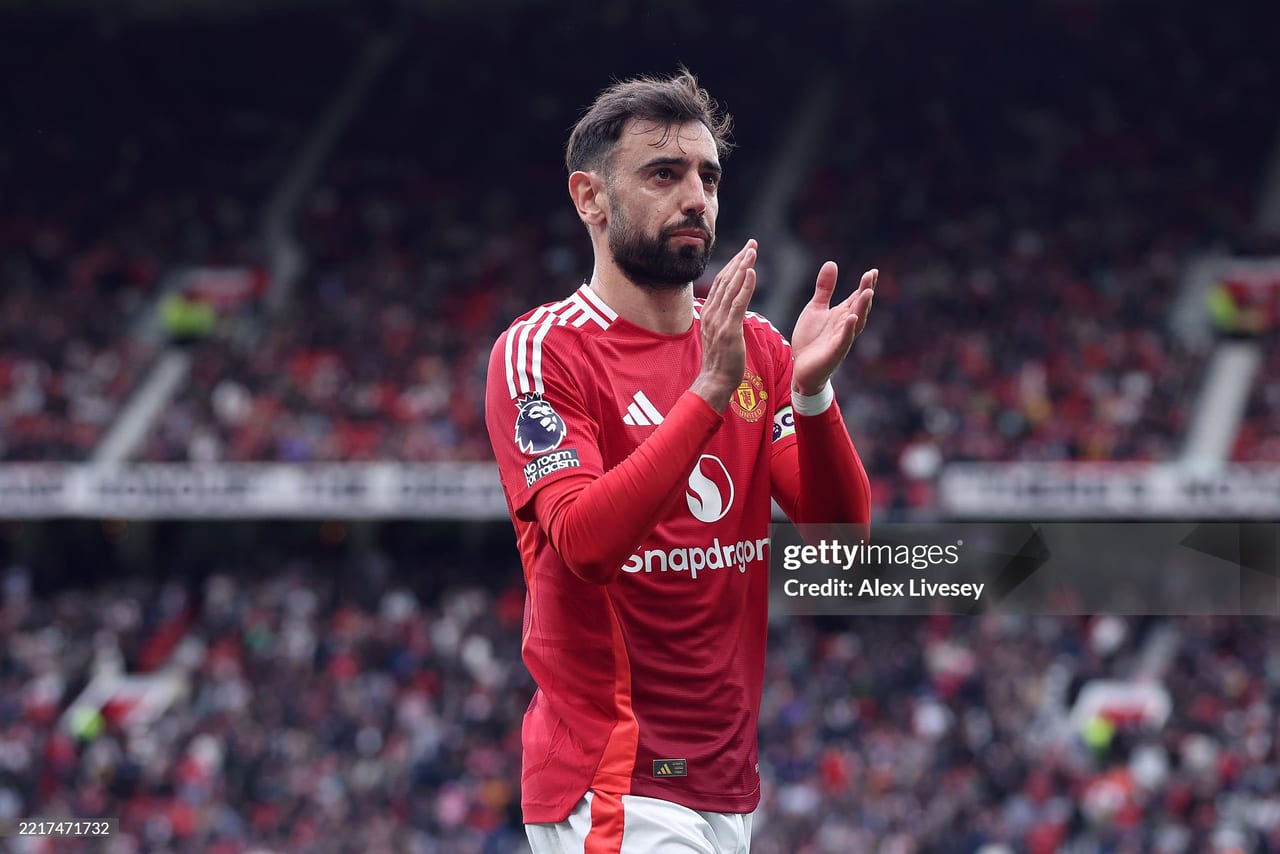

Some seasons can be explained through numbers alone.
Then there are seasons where numbers only begin to explain the weight a player carried.
Bruno Fernandes’ 2025–26 campaign belongs firmly in the second category.
On the surface, the numbers are historic. Twenty Premier League assists. A fifth Sir Matt Busby Player of the Year award. The FWA Footballer of the Year honour. A place alongside Thierry Henry and Kevin De Bruyne in Premier League history.
No player in Premier League history had previously reached the 20-assist mark for Manchester United. But statistics alone cannot fully explain why Bruno Fernandes still defines Manchester United.
This was not a smooth or stable season at Old Trafford.
It was chaotic, emotionally draining, and structurally unstable from beginning to end. Managerial changes split the campaign into two completely different tactical eras. Key defenders disappeared through long-term injuries. Major attacking figures departed during a ruthless squad rebuild.
For long stretches, United looked like a side searching desperately for identity.
Yet through all of that instability, Fernandes remained the one constant.
While systems changed around him, his responsibility only grew.
Manchester United eventually secured a third-place finish and Champions League qualification, but the achievement masked a campaign filled with operational friction and emotional turbulence.
The dismissal of Rúben Amorim in January after public disagreements with the INEOS hierarchy created another moment of uncertainty inside the club. Michael Carrick stabilised the situation impressively after taking charge, but by then the squad had already spent months operating under pressure.
That context matters when discussing Fernandes’ season.
This was not a player producing numbers in a perfectly functioning team. This was a captain dragging a fractured side through transition while remaining its primary source of creativity, leadership, and emotional intensity.
Tactical Sacrifice Before Creative Freedom
Tactically, his season almost felt divided into two separate identities.
Under Amorim’s rigid 3-4-2-1 structure, Fernandes was often pushed deeper into midfield alongside Casemiro.
Instead of operating close to goal, he became a disciplined controller responsible for helping United survive buildup phases with an injury-hit defence behind him.
It reduced his attacking freedom significantly. His shooting numbers dropped, his final-third touches became less frequent, and much of his work revolved around stabilising possession rather than directly deciding matches.
Yet even inside those restrictions, Fernandes adapted rather than resisted.
That tactical sacrifice quietly defined much of United’s first half of the season.
With Lisandro Martínez suffering a serious ACL injury and Matthijs de Ligt sidelined following back surgery, United’s defensive structure frequently collapsed under pressure.
Fernandes repeatedly dropped close to his own penalty area simply to help progression from the back. Against Bournemouth in March, that responsibility became obvious.
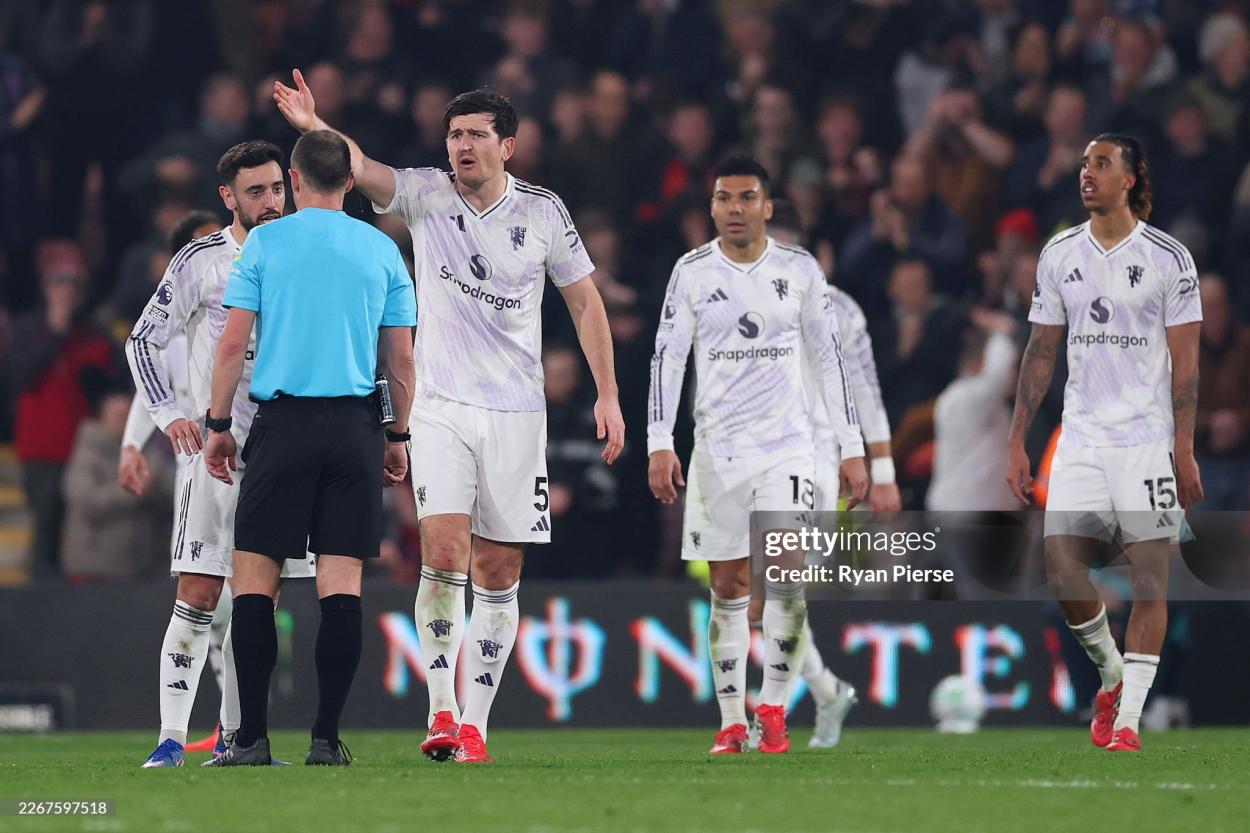
United’s makeshift defence struggled badly against Andoni Iraola’s aggressive pressing structure, forcing Fernandes to perform almost every midfield function simultaneously.
He dropped deep to receive possession, escaped pressure through quick combinations, triggered the counterpress after turnovers, and still found the energy to drag United back into the match.
That performance captured the exhausting reality of his season.
At times, it felt like he was doing far more than just creating chances. He was constantly repairing structural problems around him.
Carrick’s Arrival Changed Everything
Carrick’s arrival shifted the entire mood around the team.
The shift back toward a fluid 4-2-3-1 immediately restored Fernandes to a more advanced role behind the striker, allowing him to operate with far greater positional freedom.
Suddenly, the creative instinct that had been partially restricted under Amorim returned fully.
The transformation became clear during the 3-1 victory over Aston Villa in March.
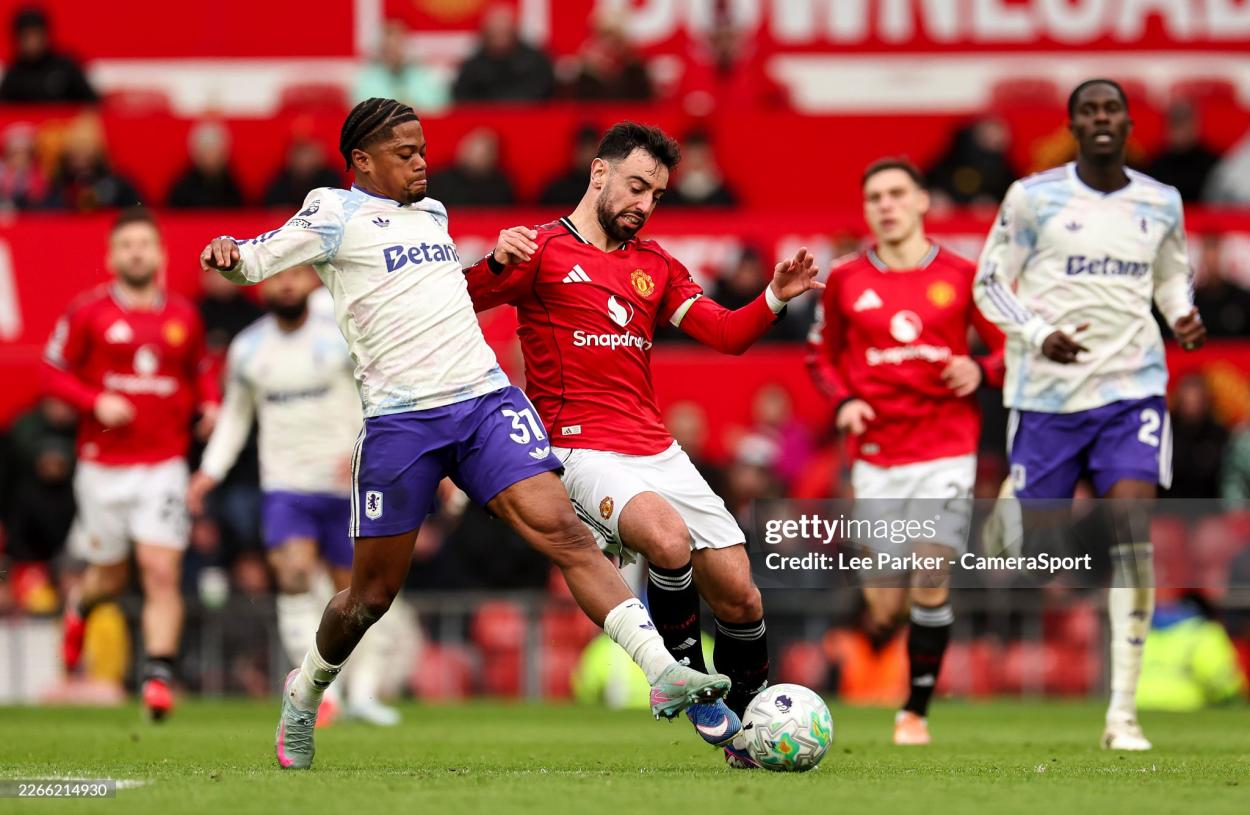
Operating high between the lines, Fernandes dictated the entire rhythm of the game.
He drifted across the pitch searching for overloads, manipulated Villa’s defensive shape through constant movement, and produced two assists that completely changed the momentum of United’s top-four race.
More importantly, the match represented something symbolic. That evening, Fernandes officially surpassed David Beckham’s long-standing club assist record from the Treble-winning era.
It felt fitting that the moment arrived during a performance where he finally looked liberated again.
Carrick’s tactical flexibility allowed Fernandes to rediscover the unpredictable movement that makes him so difficult to contain.
Rather than remaining fixed centrally, he constantly drifted into the wide channels to escape compact defensive blocks.
Those movements became one of United’s most important attacking mechanisms.
Instead of relying purely on delicate through-balls, Fernandes frequently created chances by moving wide before delivering dangerous early crosses into the penalty area for Benjamin Šeško or Bryan Mbeumo.
It was not always elegant football, but it was functional, direct, and devastatingly effective.
More Than Just an Assist Record
That adaptability explains why his assist record deserves greater context.
Unlike previous creative record-breaking seasons built inside dominant attacking structures, Fernandes produced these numbers while playing for a side that frequently struggled to create coherent attacking football collectively.
There were matches where United’s entire attacking identity depended almost entirely on him finding solutions individually.
The goalless draw against Sunderland in May highlighted that dependence brutally.
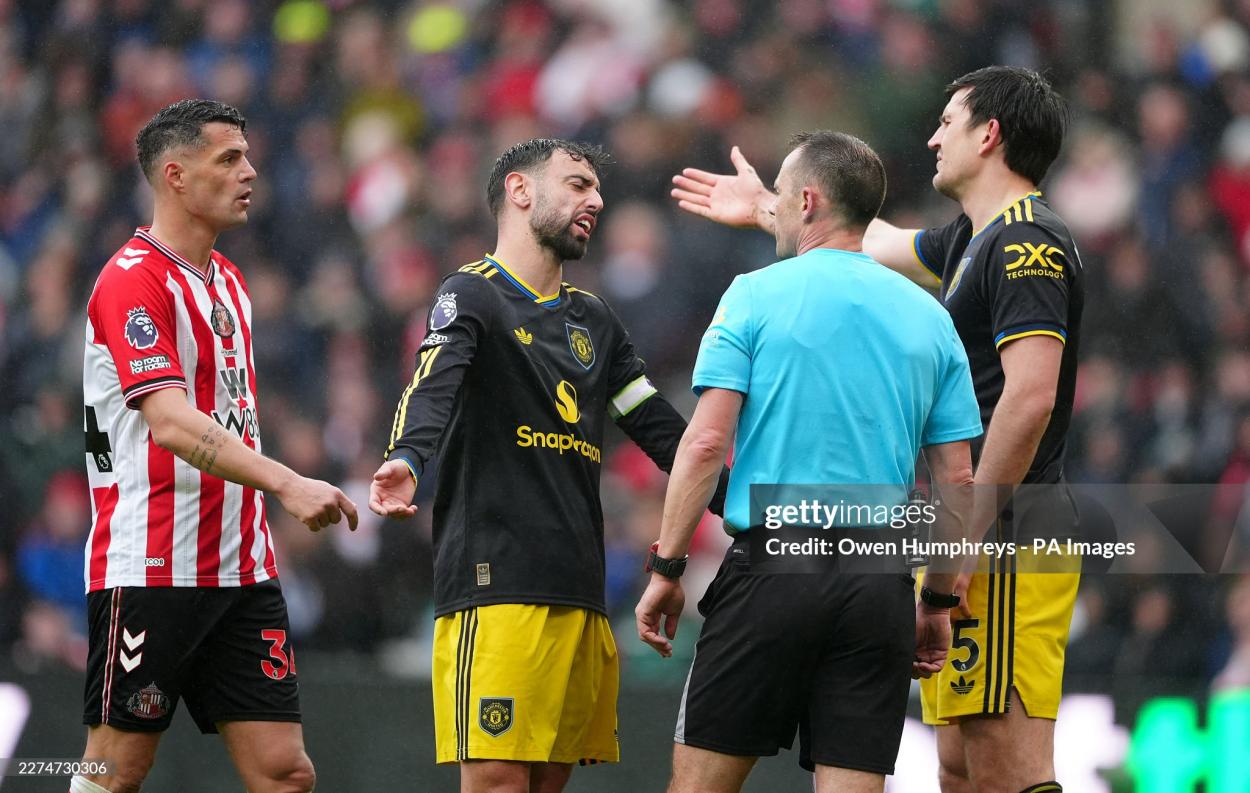
Sunderland defended inside a compact low block, cutting central passing lanes and limiting Fernandes’ influence between the lines.
In response, he spent most of the game drifting wider and wider in search of crossing angles, desperately attempting to stretch the defensive shape.
United still struggled to break Sunderland down.
United managed almost no attacking threat throughout the match, exposing how heavily the entire system depended on Fernandes generating moments of invention.
That contrast makes the Nottingham Forest victory feel even more significant. Fernandes once again delivered when the emotional pressure peaked.
In the 76th minute, he drifted naturally into the right half-space before firing a precise low cross across the box for Bryan Mbeumo to convert.
Assist number twenty.
With that assist, Bruno had matched a Premier League record.
The Emotional Weight He Carried
Yet perhaps the most impressive aspect of Fernandes’ season was not the creativity itself. It was the durability behind it.
While injuries devastated almost every department of the squad, Fernandes remained relentlessly available.
He played nearly 3,000 league minutes, carried enormous physical workloads, and still maintained elite creative output despite obvious fatigue late in the season.
That consistency slowly became one of his defining leadership traits.
When Amorim’s tactical system compromised his attacking numbers early in the campaign, Fernandes accepted the responsibility without public frustration.
When young academy defenders were forced into difficult situations because of injuries, he constantly organised and protected them on the pitch.
When United’s season threatened to collapse emotionally after the managerial change, he immediately embraced Carrick’s ideas and helped stabilise the dressing room.
That is why the Player of the Year awards felt inevitable.
They were not simply rewards for statistics. They reflected his importance to the club’s survival during one of its most unstable modern seasons.
There may still be questions surrounding Manchester United’s long-term direction under INEOS.
There are certainly tactical and structural issues the club must solve moving forward.
But this season reinforced one reality more clearly than ever.
Even amid chaos, tactical instability, injuries, and rebuilding, Bruno Fernandes remained the player who carried Manchester United forward. Not just creatively. But emotionally too.
