


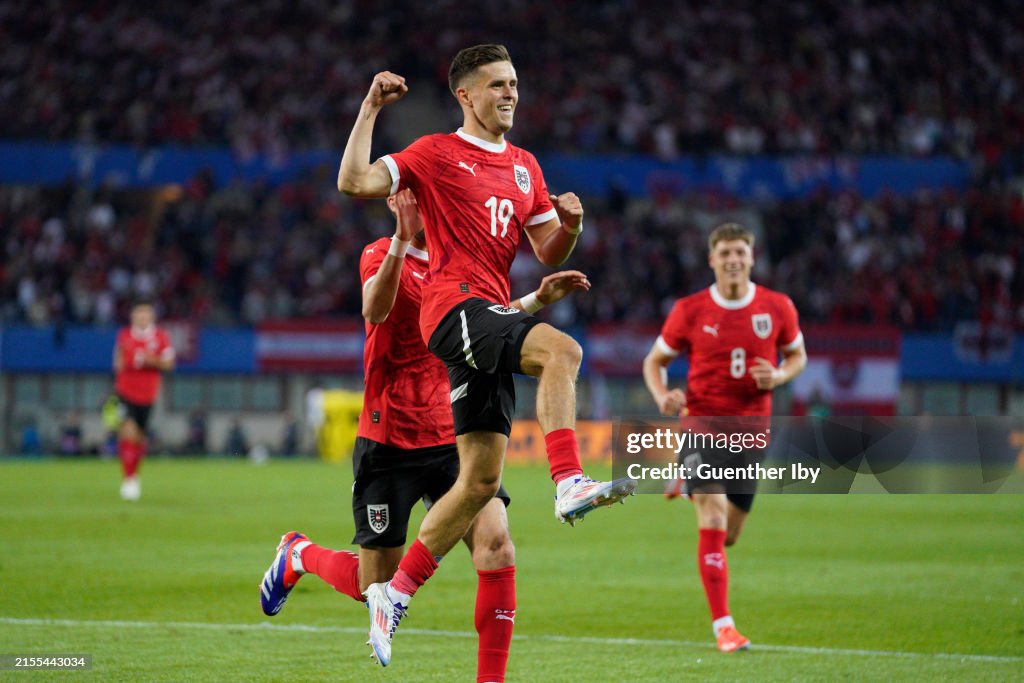

Ralf Rangnick's men showed great defensive fortitude to hold off Serbia and continue their momentum heading into Euro 2024 next week. These were two nations that knew each other well on a football pitch and for Austria, this victory was even sweeter considering that Serbia had beaten them three times in the past.
After being denied what looked to be a pretty clear penalty straight from kickoff, Austria rectified this by opening the scoring in the 10th minute thanks to a clinical finish from Patrick Wimmer.
The tracking of players for Wimmer's goal by the Serbian players was questionable, but the defending for Austria's second goal was truly bewildering as it seemed that Christoph Baumgartner had all the time in the world to pick a corner and finish from just outside the box in the 13th minute.
Serbia got a goal back 10 minutes before half-time with an instinctive header from Serbia left-back Strahinja Pavlovic that a striker would be proud of. The game really opened up in the second half as both teams were trying to ensure victory.
Both teams made attacking substitutions but the nuance lied in Austria being slightly more defensive-minded as Rangnick opted to replace both his centre-backs, whilst Serbia boss Dragan Stojkovic only subbed one centre-back off.
Towards the end of the game, Austria defended valiantly and managed to hold out until the final whistle to secure the W. Here are four things we procured from last night's game.
Clinical finishing was the name of the game for Austria
Austria didn't have many chances - as a matter of fact, they only managed three on-target all game. However, two of those three shots found their way into the back of Vanja Milinkovic-Savic's net, and the finishes were particularly impressive.
Wimmer was able to find a yard of space in the right side of the box due to poor tracking of his run from Serjeg Milinkovic-Savic, but Wimmer still had a lot to do with the shot. He had to twist his body in a split-second and strike the ball cleanly to make sure that it fired right into Milinkovic-Savic's far post.
Baumgartner didn't have it any easier - in fact, the only thing relatively easy about Baumgartner's goal was how much time he had to shoot.
Serbia really struggled to track runners in the first-half, and their issue reared its ugly head yet again as Baumgartner snuck in behind multiple Serbia defenders and found himself in quite a bit of space to drive a few yards toward the box and pick a corner to aim for, which happened to be the bottom right corner.
The chances Austria had to score were not easy by any means, and they made the most of them due to the calm heads of Wimmer and Baumgartner.
Austria made a point of overrunning the middle-third
It is likely that Rangnick planned for Serbia's midfielders not being as athletic or as technically secure as his, so it is unsurprising that Austria were constantly trying to force the ball into the middle of the pitch and overrun the mid-third with players, dragging Serbian players out of position to allow runners in the final third.
Austria were not as present in the final third as Serbia, but they made up for this by keeping their possession in the mid-third and keeping their duels in the mid-third too. For this to have been successful, however, efficient first-phase buildup was essential, and this is where the back-line really came through for Austria.
Kevin Danso, Maximilian Wober and Alexander Prass in particular played their way out of multiple presses very well, making it easier for their midfield compatriots to keep playing in the middle of the field. It wasn't just about Austria's work in possession though, as Austria had to put out multiple fires due to Serbia's increasing incentive to score.
The entire back-line performed diligently in their duelling, particularly Prass, who showed imperious defensive ability by winning 10 out of his 12 ground duels.
Serbia's lack of ability to control the game cost them
It isn't surprising that Serbia's one shot on target, being the goal, came from Serbia trying to force the issue. A hopeful cross into the box, a header onto the post from Pavlovic's teammate which ricocheted into the path of Pavlovic, inviting him to instinctively head the ball into the net.
Outside of the goal, however, the chances that Serbia created just lacked quality, making it even harder for players like Dusan Vlahovic and Aleksander Mitrovic to eat.
The fitness of Serbia's players also has to be questioned, as in the second-half in particular the Serbian midfielders looked leggy and sluggish in their movements and their pressing.
It was the sluggish and almost lackadaisical movement from Serbia's deeper players that led to the concession of both goals, and it goes without saying that the physical intensity of the squad needs to be addressed before the Euros start.
Stojkovic may look at employing a two-striker system
There is no way around it: Serbia have a goal-scoring problem. Serbia's output in recent games has been quite shocking, especially when taking into consideration the level of attacking output they have.
Vlahovic found it difficult to affect the game last night because a lot of the time he didn't have anyone to play off of.
When Mitrovic came on they immediately looked more dangerous because despite their creation in the final third not being ineffective, they were finally sustaining attacks in Austria's defensive third and forcing them to stay deep and counter-attack.
Stojkovic needs to realise that his team just don't have the resources to control games, so he should be settling for the next best thing: Becoming a potent attacking force.
