


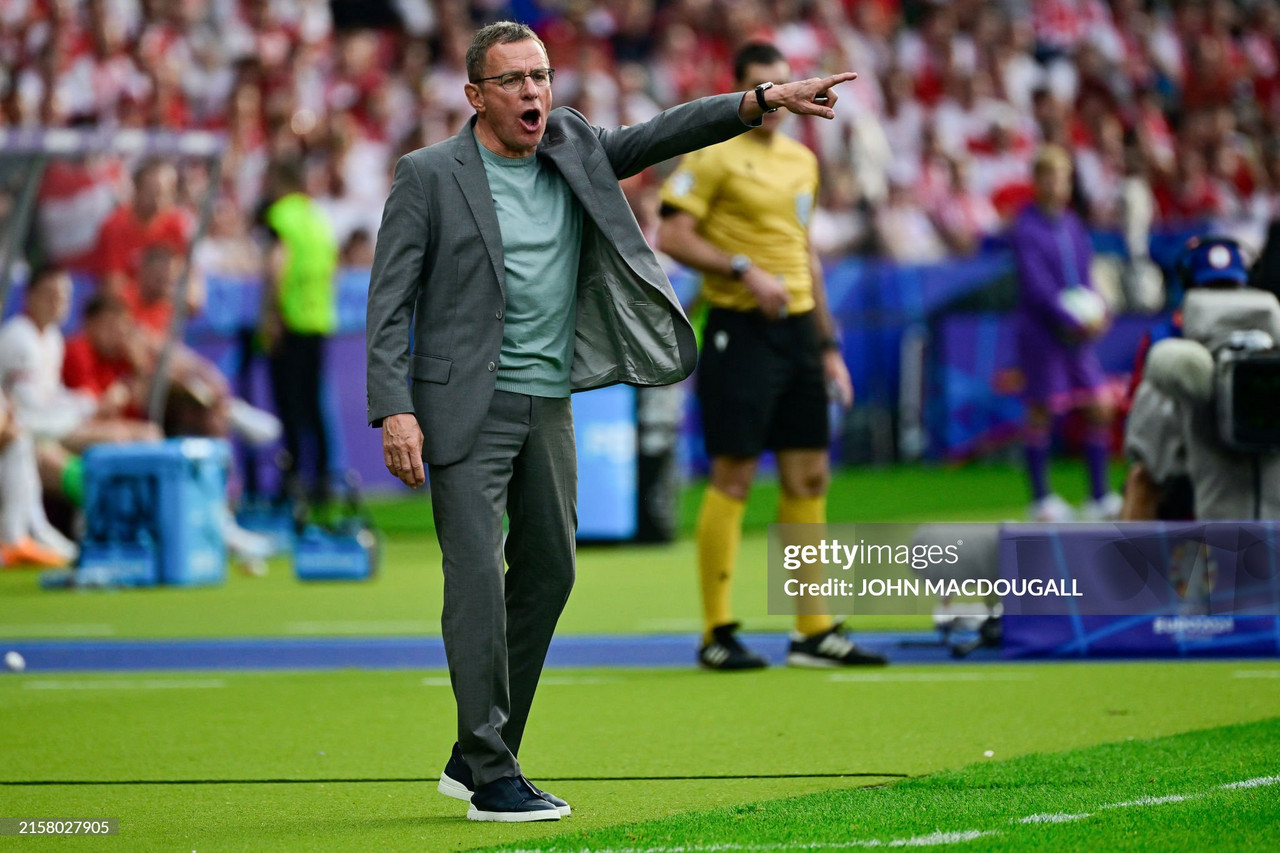

In November 2021, Ralf Rangnick was appointed interim manager at Manchester United. This seemed like an uncharacteristically savvy move from the Red Devils at the time.
The club was in disarray and needed revitalisation; who better to revitalise them than the man whose influence has shaped the careers of coaches such as Jürgen Klopp, Thomas Tuchel, and current Germany manager Julian Nagelsmann?
But the problems at the English giants were far greater than Rangnick had anticipated.
Public fallouts with marquee players and disastrous results on the pitch marred his tenure at the club, and the German was labelled an unmitigated failure in the eyes of English football fans, especially Manchester United supporters.
While still managing Manchester United, in April 2022, he was surprisingly appointed as the manager of the Austrian national team.
Many saw this as a way for him to escape the pressure cooker of club football and an opportunity to retire quietly with an international side.
Not Rangnick. He saw this as an opportunity to cleanse his name after the debacle with Man United and help lift a nation that has debatably underachieved, given some of the great players and footballing minds to come out of Austria.
As the 2024 UEFA European Championship approached, Austria had largely gone unnoticed and were not considered to have much chance of having a genuine impact on the tournament.
That may have something to do with the challenging group they found themselves in, which included France, Netherlands, and Poland. Many saw it as a straight shootout between Austria and Poland for third place.
Instead, Austria stood firmly and won their group, winning against the Netherlands and Poland and only slenderly being beaten by France.
Das Team now find themselves in the last 16 of the competition, with a game against Turkey on Tuesday night. Not only that, but they are on what many consider to be the weaker side of the bracket, meaning a deep run into the competition is possible.
But what has Rangnick done to revive not only a footballing nation but also himself?
-
The Gegenpress
"The Gegenpress is the best playmaker." These were the words from Jürgen Klopp when discussing his footballing philosophy.
But what is it?
At its essence, it is an answer to teams that tend to monopolize the ball. Rather than simply letting ball-dominant teams have that control, a team will relentlessly hurry and harass them.
When you think of a Klopp team, you do not often think of them having bouts of sterile possession or surgically working their way through teams. Instead, you think of them working unbelievably hard at all times, especially off the ball.
Rangnick is thought to have influenced Klopp's beliefs and play style. The similarities are obvious when watching his Austrian team play.
When a single Austrian player has the ball, there is often a couple of teammates surrounding them; why is that?
That is so the team is constantly ready to counter-press, meaning the moment their teammate loses the ball, at least two players will immediately go after it in an attempt to retrieve possession.
When they do not have the ball, their hunger to win it back is extraordinary. Their desire to win the ball high up the pitch is two-fold: the first is to win the ball in a promising position to attack their opponents when they are least prepared. The second is to guarantee the opposition does not counterattack.
The system can mean some players are not in traditional positions—due to players trying to squeeze the pitch and make it smaller- so it is paramount that attempted counterattacks are shut down quickly.
The system requires a high level of fitness and a high footballing IQ.
Many national teams do not adopt this method due to the lack of time to work on systems and tactics, but Austria looks like a club side with the ease with which it is currently being used.
Every team the Austrians have faced so far have looked as though they cannot match Austria's physicality and fitness.
The only doubt among some is that the deeper Austria goes into the competition, the more energy they will use using this particular style.
If Austria were to reach the quarterfinals, they would likely have exerted more energy than their opponents, meaning tired legs, which often leads to tired minds.
But Rangick will not wain; he will not hold back. If he truly believes his side can go far with the Gegepress, he will continue with it into the knockouts.
-
Togetherness is key
If you look through Austria's squad, you can pick out a couple of marquee players, but on the whole, not too much clear individual talent.
Yes, you have Marcel Sabitzer, Konrad Laimer, and Stefan Posch, but conventional wisdom says there is not enough quality to compete against Europe's biggest teams.
And yet, they have looked every bit the equal of the two "bigger" teams they have played so far.
This shows that coaching from Rangnick and his staff goes far beyond the pitch.
An internal self-belief has been installed in this squad, and it is apparent watching them play. They are playing for one another; they look like brothers in arms when out on the pitch.
During his disastrous tenure in Manchester, Rangnick was often criticised for low morale in the Old Trafford dressing room and the team's lack of togetherness.
It is the polar opposite with this Austria side; they are a team that wants to be together and want to fight together.
The best example of this is with David Alaba. The Real Madrid star ruptured his ACL against Villarreal back in December. The injury meant that he would miss not only the rest of the domestic campaign but also the European Championship,.
Many players would have (understandably) wanted nothing to do with their national team if they were not physically involved on the pitch, not Alaba.
He made it abundantly clear that he wanted to be with the team. He has been with them since the pre-tournament friendlies and can be seen on the sideline as the non-playing captain.
Alaba's desire to be with the squad is a testament to how Rangnick has brought this squad together and given them a sense of community, which is difficult to harbour in national teams.
Any side that comes against them will be facing a unified outfit willing to do anything for one another.
-
Belief with a hint of realism
As mentioned previously, Austria have landed on the more favourable side of the draw.
If they are to beat Turkey on Tuesday night, their opponents will likely be The Netherlands. A team they have already beaten in this competition.
There is a more than realistic route to the semi-final stage at least for them.
Austria is a nation gripped by the European Championship, and the natives' belief in doing something special is starting to grow.
Tempering expectations while stimulatingly allowing people to be optimistic is incredibly difficult. When Rangnick spoke to the press after the victory over the Netherlands, he acknowledged that going all the way would be tough.
"I have said months ago I don’t think it is very probable to win the Euros," but he also said: "The lads want to go as far as possible.”
With Rangnick at the helm, there is a chance to do something special. Austrians should be allowed to dream big.
