


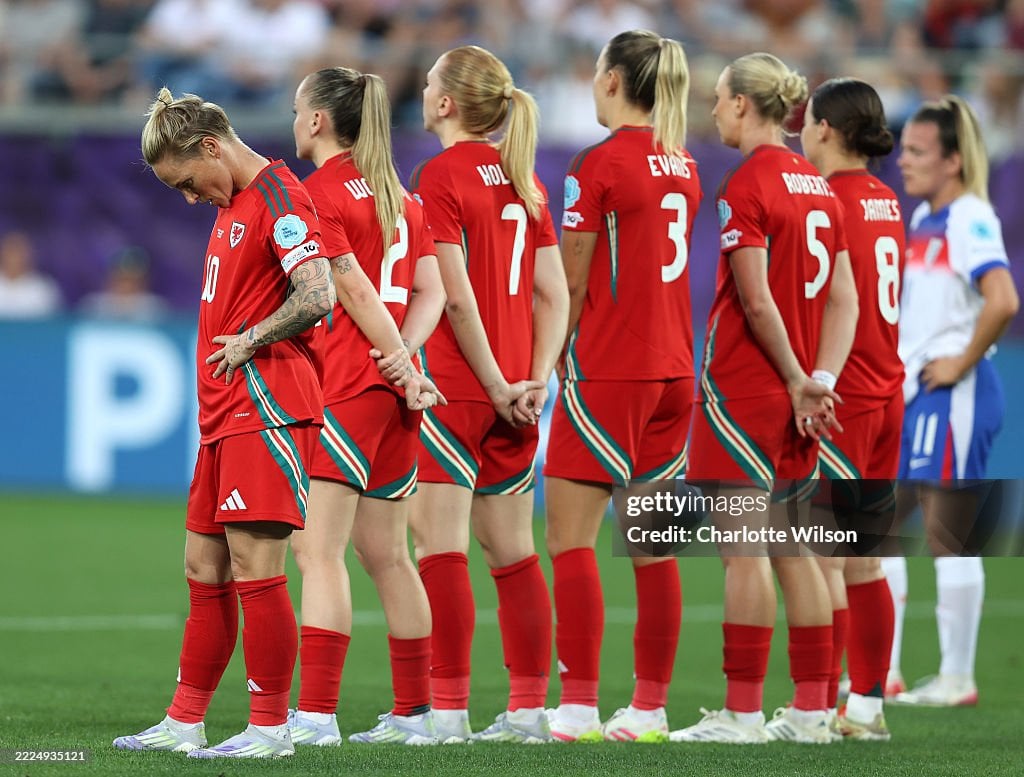

After over 20 years representing Wales, midfielder Jess Fishlock has announced her retirement from the international game.
It is a moment that Welsh fans would have been dreading. Though it is not much of a surprise, given Fishlock is 38 years of age and has been playing for the national team since 2006.
She is the most capped Welsh footballer in history with 165 outings, in addition to topping the scoring chart with 48 goals heading into her final match.
In her hometown of Cardiff, Wales host Australia - a country where Fishlock played for five seasons, between Melbourne City and Melbourne Victory - in what is set to be an emotional evening for everyone associated.
Head coach Rhian Wilkinson paid tribute last week, "I think what we’re all realising and recognising now is that she is a generational player that has given everything for her country.
"It’s 2pm on a Saturday [the Australia game] and we’ve done that on purpose to make sure that there are as many young people, old people, Welsh people and footballing fans in the crowd as possible. Don’t miss this opportunity, because it is quite literally the last one."
There is still a chance to add to her 16 strong titles at club level, with her current outfit, Seattle Reign, reaching the NWSL playoffs.
As for Wales, losing any player with those kinds of numbers would be a huge blow to any team, but Fishlock’s influence is still keenly felt below the surface.
-
'Generational' influence until the very end
A five-time Welsh footballer of the year, Fishlock's individual achievements at club level speak for themselves - twice a winner of the Champions League, five inclusions in the National Women's Soccer League Best XI, with an NWSL MVP accolade in 2021.
Despite this success, she told BBC Sport Wales after qualification for UEFA Euro 2025 was secured that finally reaching a major competition with her nation was "by far the proudest moment of my life."
Still the most naturally talented player of the current Welsh crop, she remains at the heart of almost every attacking move on the international stage, with her influence arguably growing through the years, aging like the finest of Modric-esque red wines.
Fishlock had 12 goal involvements during qualifying for the Euros, while the next best was Kayleigh Barton and Rachel Rowe’s four each. It is also worth noting that Barton converted three penalties.
During Euro 2025, Fishlock ranked second for progressive carries for Wales and first in progressive passes made. She was also third in progressive passes received, meaning she was not only the main creative spark but was often one of the furthest players up to mould moves into chances.
This is likely because head coach Wilkinson switched between deploying Fishlock as a traditional advanced midfielder and partnering her with Ffion Morgan as a more aggressive front two against France and England.
Wales did lose some of her attributes in progressing the ball, doing this, but her skillset being so unique to this Wales team meant Wilkinson, in hindsight, was likely attempting to get her as close as possible to the opposition's goal.
This worked as, on the counterattack, Fishlock was there to score Wales’ first goal at a major tournament against Les Bleues and slide a perfectly weighted pass to Hannah Cain for consolation against Sarina Wiegman’s eventual champions.
So often being the one to inspire the Dragons, Fishlock always played with the handbrake off, meaning moments of individual brilliance could come from anywhere. Like her sublime lob off the bench in a pre-tournament Nations League battle with Italy, where she was managing an injury.
An easier group in Switzerland may have provided more opportunity to display her true abilities. Wales were only afforded an average of 29% possession after all. Even so, there were enough flashes that showed just how special a footballer she is and how intrinsic she has been to her country's fortunes.
-
How Wales could replace Fishlock
Since you cannot clone people (yet), the short answer is that Fishlock’s influence cannot be fixed with one player, and it will take time to restructure things. Now for the long answer.
For Euro 2025, veterans such as Fishlock, Rhiannon Roberts, Angharad James-Turner and Sophie Ingle got their well-deserved time to shine. However, there has been a much-needed injection of youth in this latest selection.
Wilkinson has remedied this in her latest squad. Only three players were 21 and under at the Euros. This window, Wales have nine, including five teenagers.
The Canadian coach also has nine uncapped players at her disposal, including Teagan Scarlett of Arsenal and Scarlett Hill of Manchester United. There are also returns in red for young players who have had their debuts already, namely Mared Griffiths and Mary McAteer.
Injuries have certainly played a part in this, but the need for Wales to regenerate was felt almost immediately following the final whistle of their final group game against England in the summer.
Fishlock’s upcoming absence echoes the retirement of Gareth Bale on the men’s side as a player who was instrumental during Wales’ most successful years.
It took about a year or so for Wales to find their footing after Gareth Bale retired, and that largely came down to Craig Bellamy being brought in and reshaping the style of play.
The positive thing for Wilkinson is that she has already laid the foundations for an attacking mindset, even becoming increasingly bolder during the European Championships against France and England.
A priority should be filling the midfield. Taking Fishlock’s creativity out of the team means there needs to be more numbers in an already sparse middle.
Wales do not yet have a Keira Walsh or Patricia Guijarro who can bypass a press or progress the ball from deep, so having greater numbers in the middle will help aid Fishlock’s absence, especially given that, during Euro 2025, James-Turner was often the only recognised central midfielder on the field.
The reintroductions of Griffiths and Anna Filby, with another newbie, Mia Ross, will aid this, as will the slew of young defenders that could give the opportunity for Hayley Ladd and Ingle to interchange playing higher up as midfielders, giving that area more grit and experience.
This may also see Wales increasingly rely on their ability on the break, with a number of players, such as Ceri Holland, Hannah Cain and Ffion Morgan, capable of spearheading counterattacks.
Wilkinson has not been adverse to this style of play, especially when taking on higher-profile sides, and so leaning into that directness may hold the key to life without Fishlock in the immediate future.
The Tuesday encounter with Poland could give a glimpse into this. Although in her final game against Australia, Fishlock will likely want to get on the ball as much as possible, so this will not be a time to sit back.
Wales’ next mission is to qualify for its first-ever World Cup. The 2027 edition will be held in Brazil, and Llanrumney's own Fishlock has the flair that would have fitted football’s spiritual home to a tee. Alas, the Dragons will have to try and book their tickets without her.
Fishlock has inspired a generation of female footballers in Wales, some of whom have just earned their first call-ups. Although these youngsters are not under pressure to perform right away, they will now be crucial in the task of reshaping their nation’s style of play in the coming years.
Footballers of Fishlock's generation have played most of their careers out of the limelight. On the one hand, it is a shame that her talents and those of her teammates were not as widely recognised prior to the turn of the decade.
On the other hand, they have continued to ply their trade during the most prosperous time in women's football, meaning that, on Saturday, Fishlock will be able to soak in the attention and acclaim she helped create.
