


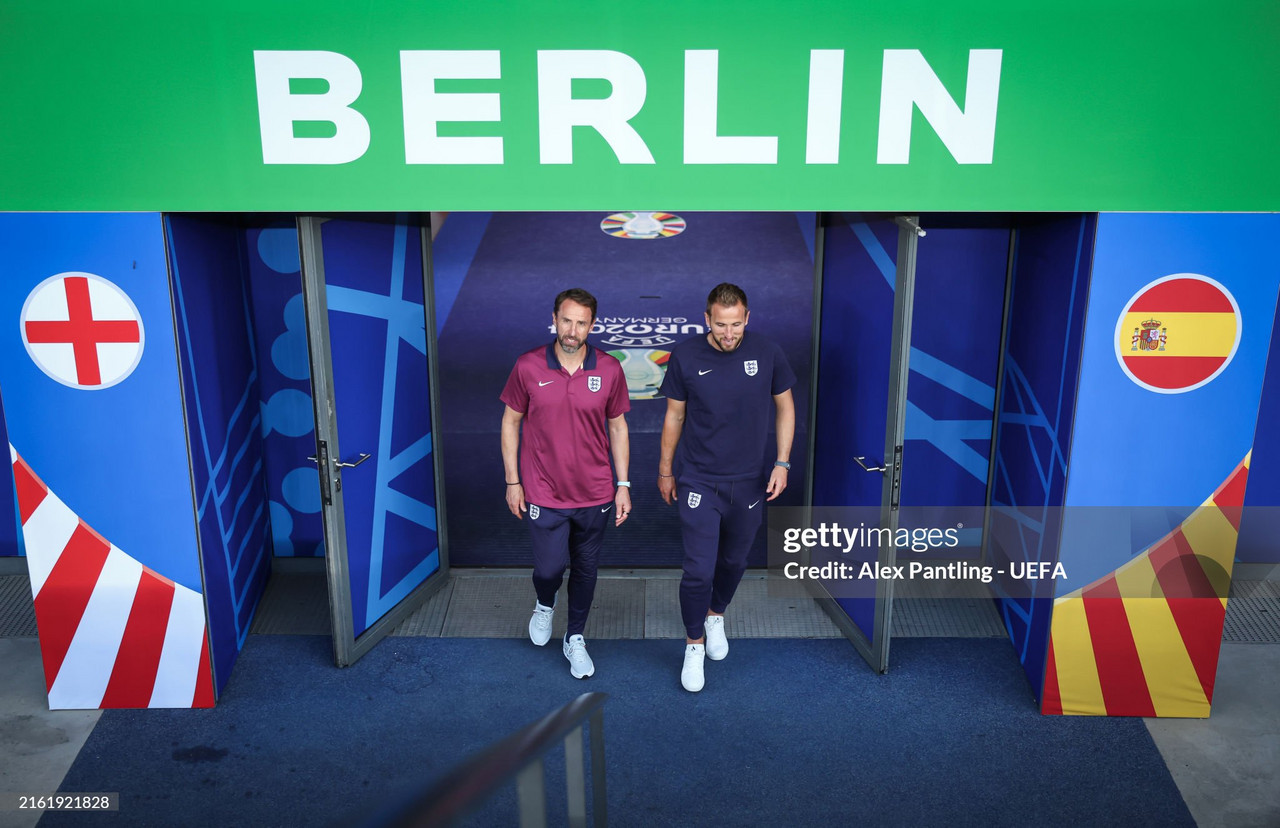

England face a date with destiny as they head to Berlin’s Olympiastadion for an unmissable Euro 2024 Final clash with Spain.
While Luis de la Fuente’s Spain have been the most impressive team of the tournament, winning every single game they have played including knockout ties against Germany and France, England arrive at the Final blooming into their best form.
Ollie Watkins’ 90th-minute Semi-Final winner against the Netherlands confirmed the growth that Gareth Southgate’s side have achieved since a dour Group Stage and Round of 16, restoring English confidence ahead of a first overseas Final in a major international tournament.
Spain have the pedigree with three previous European Championship titles in 1964, 2008 and 2012, while England have been Europe’s most consistent nation ever since Southgate took over.
By reaching a second consecutive Euros Final, to go with runs to the Semi-Finals and Quarter-Finals of the last two World Cups, Southgate has surely established himself as England’s best-ever manager as well, sustaining success better than even Sir Alf Ramsey.
However, Southgate – much like de la Fuente – would admit that nothing has been achieved yet.
England are where they expected to be in this tournament while Spain have enjoyed a surprise ride to the Final, so the pressure will be on the Three Lions in Berlin to prove why they were pre-tournament favourites.
With countless world-class players on display and some fascinating tactical battles to expect, it is a Final that deserves all of the big build-up it has received.
-
Formations and Tactics
Neither Spain nor England have ultimately stumbled into this Final, and they will take huge confidence from the way their respective tactics worked in their Semi-Finals.
Spain beat France with a side depleted by suspensions and a tournament-ending knee injury to midfielder Pedri, displaying energy, quality and huge ambition – personified by now-17-year-old Lamine Yamal – to cast off the 2018 World Cup winners.
De la Fuente set his side up in a 4-2-3-1 formation, accepting that Dani Olmo could not replicate the role of Pedri in a three-man midfield but using the RB Leipzig player positively to buzz between midfield and attack.
La Roja pressed France high up the pitch and moved the ball quickly, knowing the French would be keen to nip in and exploit the pace advantage Kylian Mbappé, Randal Kolo Muani and Ousmane Dembélé had over their defenders.
As with their previous matches, Spain also used their width with unabashed regularity.
Marc Cucurella and Jesús Navas pushed forward at every opportunity, whether carrying the ball themselves or offering support to Nico Williams and Lamal, who had licence to put crosses in or shoot at goal.
Play was built through goalkeeper Unai Simón to centre-backs Nacho and Aymeric Laporte, and then Rodri, who acted as a quarterback to shovel the ball anywhere he saw space in the French half.
None of this should change against England, who set up slightly more favourably against La Roja than the French did.
England’s only dilemma before this match will be whether to elevate Luke Shaw to the starting XI after the Three Lions hugely improved against both Switzerland and the Netherlands once he came on.
Kieran Trippier would be the man to miss out if that change was made, after the Newcastle United man played on the left all tournament without complaint.
England have nominally played in a 3-4-2-1 formation since scraping past Slovakia, although there is much flexibility between a back three and back four during match situations.
Kyle Walker and Bukayo Saka on the right have played tirelessly and unselfishly to cover the entire length of the touchline and almost got the reward their excellent Semi-Final outings deserved when they combined late on for a Saka goal, only for Walker to be ruled offside.
Phil Foden has enjoyed more freedom in the new formation popping up everywhere across the frontline, which has vastly improved England’s overall output as defenders find it hard to contain Harry Kane, Jude Bellingham, and Saka to begin with.
Southgate will be expected to retain this system, albeit with Shaw selected as a more inverted option than Trippier, when the line-ups are announced.
-
Key Battles
Spain and England share many similarities in their styles and qualities, with the effect of a more multicultural Premier League in recent seasons rubbing off on the make-up of the national side.
As much as both countries have shaped him, Pep Guardiola has had an obvious influence on both Spanish and English football too, and it is fascinating that several of his players at Manchester City possess key roles in this Final.
Rodri and Foden will have a huge rivalry in the heart of the Spanish half.
While the former stands out as the pre-eminent talent in this Final, the latter has been flourishing after England’s formation change and should be confident of causing major headaches for his club teammate and – if used in a slightly deeper role – Fabián Ruiz.
Bellingham is the more obvious physical rival to Rodri and could be used to harass La Roja’s lynchpin in a manner that previous opponents have been reluctant to do.
England will pack the central areas but ask their players to be flexible and energetic, and this is where their system fluctuates somewhat from Spain’s.
De la Fuente has been steadfast in supplying his wide players, and given England’s weaknesses lay here, the match-ups will be fascinating.
Williams will face a tremendous battle of wits and ground speed against Walker, while Yamal will be faced with either Trippier or Shaw, both of whom have their flaws defensively.
It has been pointed out that Trippier, being right-footed, has the superior capability to deal with Yamal’s left-footed driving infield runs, and this could play a part in Southgate’s selection process.
Elsewhere, the battle between each defence and strikers who have not necessarily shined this tournament is intriguing.
Harry Kane is matched up against Laporte and Robin Le Normand, who are solid defenders without being reminiscent of their country’s best-ever, while Álvaro Morata faces John Stones and Marc Guéhi, who have shown frailties in gifting goals to Slovakia and Switzerland before growing as a pair.
England must also ensure that Saka targets his full-back every possible time, as whether on the left or the right, Spain have a vulnerability to crosses and edge-of-the-box defending – as shown with France’s early Semi-Final goal.
-
Striking similarities
“Statistics are like bikinis. What they reveal is suggestive, but what they conceal is vital,” someone smart once said.
What the statistics from Euro 2024 show about both teams in this Final backs up a previous point in this piece – that the sides are similar.
From six games apiece, they boast 58.8% and 57.3% possession, and 90.3% and 90% passing accuracy.
It might be surprising to learn that England are the ones with the slightly superior statistics in both departments; the 'Pep influence' indeed.
Elsewhere, the stats show this ‘Freaky Friday’ effect even further, with the Spanish attempting more crosses (104, to England’s 91) and making more tackles (74, to England’s 70).
More revealing aspects of their tournaments to date are that Spain, in scoring almost double the number of goals England have (13, to seven), have done so while firing in double the amount of shots on target (37, to 19) and off-target (44, to 22). Meanwhile, England have had more shots blocked than on or off-target - a whopping 25.
It has been tough for England to work their opportunities given how sluggish Kane has looked and how ineffective they look at set-pieces without Harry Maguire, but they must find a way around this, as Spain are guaranteed to cede dead-ball chances.
La Roja have committed the most fouls in the tournament by a long distance – 83 – while England have suffered the most times from being fouled – 84 – meaning bookings and free-kick or penalty opportunities will be a big factor.
-
The success of a system
Whichever way the result goes on Sunday, it will be the result of a huge amount of planning and progress outside of the month-long tournament window, and courtesy of efforts far above the heads of either manager.
The Spanish and English Football Associations are amongst the most successful in the world in ensuring engagement, opportunities and silverware are high across the board.
La Liga and the Premier League have been the world’s two strongest divisions since toppling Serie A around 2006, raking in huge levels of profit and attracting magnificent players and managers to assist with the development of homegrown talent.
Lower-league systems are strong in both nations too, with the chance to rise through the leagues central to how the national teams operate.
England has pulled away domestically with Manchester City, Arsenal and Liverpool three of the strongest teams in the world currently, but Spain still has the upper hand in producing players and coaches.
Guardiola, Mikel Arteta, Unai Emery, Andoni Iraola and Julen Lopetegui are five of the Premier League’s best managers, and this is just the tip of the iceberg, with countless others managing around the world.
Yamal, also, represents the continuation of a legacy from Pedri, Gavi, and others who have burst onto the La Liga scene in a manner that is much rarer in England.
With Spain’s system questioning itself for not producing standout players like Kane, Bellingham and Foden for this tournament, however, they are at a transition point, while England are looking to build from a position of strength.
A win in this Final would do wonders for the PR, initially, of both structures, but would also go some way to prompting further action and to seize momentum while they have it.
Neither nation’s men’s side – despite the success of their women – has had this opportunity for some time, and there will be huge ramifications depending on who wins out in Berlin.
So, come on - vamos, amigos - history time awaits…
