


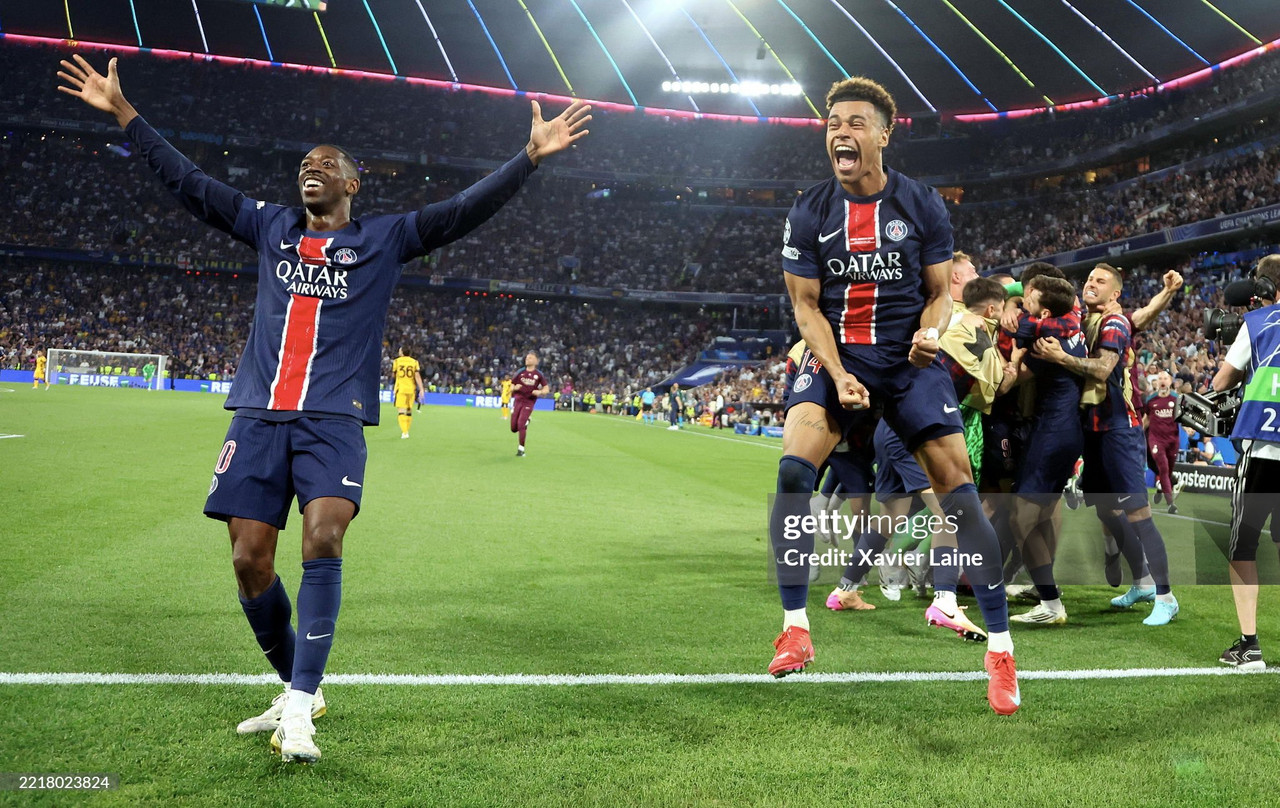

Paris Saint-Germain made history, time and time again, en route to making history.
For the now perennial French champions, the Champions League was the one they wanted more than any other. For the first time in the club’s nearly 55 years of existence, they have their hands on European club football’s biggest prize, but just how they went about winning it on Saturday will be what lives longest in the memory for many.
In what was the 70th edition of the European Cup final, their emphatic 5-0 triumph over Italian opponents Internazionale represented the greatest margin of victory seen in club football’s highest-profile game. And it didn’t flatter them.
Luis Enrique’s side had to progress to the round of 16 via the play-offs but they have, for many, been the best in Europe since around the turn of the year, and that status is now aptly reflected in silverware terms. This completed a 2024/25 quadruple that also includes the Ligue 1 title, the Coupe de France and the Trophée des Champions. They are just the second French side to win the men’s edition of European club football’s premier prize, too, adding to Marseille’s 1993 triumph.
That also came in Munich, as it happens, and Saturday’s result continued the trend of every final of this competition hosted in the Bavarian city producing a first-time winner. Nottingham Forest (1979), Borussia Dortmund (1997) and Chelsea (2012) have each broken their ducks in southern Germany.
They flew out of the blocks in familiar style at the Allianz Arena and barely took their foot of the pedal throughout.
Achraf Hakimi finished a sharp 12th-minute move to give Les Parisiens the lead. Désiré Doué, who teed up the Moroccan right-back’s opener, then doubled the advantage nine minutes later, as the 19-year-old’s deflected drive beat Yann Sommer and concluded a crisp counterattack, which saw him become the youngest ever player to both score and assist in a European Cup final.
Simone Inzaghi’s Inter have so often found a way in this competition this season, but the Milan-based club had no answer here. Doué rounded off what was arguably the move of the night to make it 3-0 17 minutes into the second half in front of the delighted – and typically vocal – PSG supporters, before the electric Khvicha Kvaratskhelia and substitute Senny Mayulu, another 19-year-old, struck in the 73rd and 87th minute respectively to stylishly complete the scoring.
The best team performance in a European Cup or Champions League final to date? It has to be up there.
A result that has the potential to be viewed in the same era-defining manner as AC Milan’s 4-0 dispatching of Barcelona in the 1994 final and Barça’s dismantling of Manchester United in the 2009 and 2011 showpieces.
The 24th different club to win the men’s edition of European football’s premier club prize, this young, exuberant PSG side – such a contrast to many of the previous star-studded on-field incarnations since Qatar Sports Investments (QSI) became majority shareholders in 2011 – look set to be a frightening force for many seasons to come.
Many will, understandably, consider the club's success to be tainted by its ownership, with QSI backed by the Qatari government, whose human rights record continues to draw criticism.
Captain Marquinhos hoisting that famous trophy high into the Munich sky became another of the occasion’s defining images, on a night of so many wide-ranging subplots.
Enrique’s collective approach rewarded
There was a line of thought prior to the final that a PSG win would be good for football, such was both their improvement over the course of the campaign and the quality of their work in the later rounds. That notion has, surely, only been strengthened following a display and result that will have reverberated around Europe like few others in recent times.
It’s a glowing reflection of the squad and culture built by Enrique since he took the reins in Paris in the summer of 2023. This is, very much, a team. It’s hardly been built on a shoestring budget, but this iteration is one whose strength lies in the work every single player does for each other.
There were sprinklings of promise early in the season, with their ability to dictate games clear, but there was also a perception that this team lacked the ruthless streak required to go the distance in the Champions League.
A tough draw in the newly formatted league phase saw them face the likes of Arsenal, Atlético Madrid, Bayern Munich, Manchester City and VfB Stuttgart. They lost against the former three before Christmas but, after the turn of the year, they found a different gear. From 2-0 down early in the second half, they staged an invigorating comeback to beat City 4-2 at the Parc des Princes before emphatically overcoming Stuttgart 4-1 in Germany – and that was still only just enough to earn a play-off spot.
They've hardly looked back since, though. Fellow Ligue 1 side Stade Brestois were beaten 10-0 on aggregate in that play-off before they overcame league phase winners Liverpool on penalties in the round of 16, and saw off the Merseysiders' Premier League colleagues Aston Villa and Arsenal in the quarter-finals and semi-finals respectively.
Winning the trophy in Munich in such style will have had particular poetic value for some, with the Allianz Arena the scene of what was arguably their low point in the league phase – a meek 1-0 defeat to Bayern in which Ousmane Dembélé, prior to his explosion in form, was sent off.
This success comes within an additionally emotional context for Enrique, whose daughter, Xana, died of bone cancer aged nine in August 2019. She had memorably celebrated alongside her father on the pitch at Berlin’s Olympiastadion in 2015 on the previous occasion that he coached a side – Barcelona – to Champions League glory.
The 55-year-old Spaniard, who has now won 11 out of 11 one-off finals as a coach at club level, has proven a transformative figure for PSG.
Stars such as Zlatan Ibrahimović, Neymar, Kylian Mbappé and Lionel Messi have come and gone without delivering a Champions League since the Qatari takeover. They’ve all played a significant role in growing the club’s profile and making it one of world football’s most prominent brands, but the emphasis so often seemed to be on platforming the quality of a few individuals, rather than forming a maximally cohesive on-field unit.
Not anymore. The sight of Kvaratskhelia, signed from Napoli for approximately €70 million in January, racing back in pursuit of Inter’s right wing-back Denzel Dumfries and winning a free kick deep into the second half, spoke volumes.
The 24-year-old Georgian, who is developing into one of the game’s modern icons, simply wouldn’t have been recruited by Enrique had he not been willing to put the hard yards in.
The team is now the star.
PSG’s aggressive, shrewdly executed press, rapid counter-press, and swift, incisive movement of the ball make them such an impressive side to watch – and such a difficult one to face.
There is so little respite. None of these players take liberties or expect their work to be done for them, and that means no opponent has it easy.
The goals felt reflective of their collective excellence. Each was preceded by a flowing move and each, barring the Doué shot that deflected in off Federico Dimarco to make it 2-0, was finished with immense crispness.
Hakimi, Doué and Dembélé reflect PSG's flexibility
While there is a strictness and solidity to the way they operate, particularly out of possession, one of the key components of the Ligue 1 champions’ success this term has been their on-field rotations and adaptability.
Their dizzyingly effective midfield triumvirate of João Neves, Vitinha and Fabián Ruiz so often operates like clockwork. They’ll rotate up, down and across – switching roles yet retaining balance – in order to help their side evade a press and to open up various angles of opportunity.
Their forward line, too. It has regularly felt as though each of the starting triumvirate could slot in anywhere across a front-three. Generally, though, Dembélé–who Enrique said, in his post-match press conference, would be his choice to win this year's Ballon d’Or–has been the one filling the central role since the turn of the year.
The 28-year-old’s shift to a False 9 position has felt as big a factor as any in the acceleration of the Parisians’ development in recent months.
Leading the press out of possession, while also persistently dropping between the lines and asking awkward questions of defenders when his team have the ball, the Frenchman has been a revelation who has helped unlock so much potential within this squad.
That the third goal saw him cleverly role the ball behind him with his studs and into the path of the swiftly advancing Vitinha – nominally the deepest of the midfielders – who ate up the ground ahead of him before playing in Doué to score, was a spellbinding reflection of the positional flexibility of this team.
They are so difficult to pick up.
The same can be said for the full-backs. Hakimi and Nuno Mendes have been outstanding, particularly in the knockout stage. Each have four Champions League goals this term, while the former has registered five assists and the latter has one.
Neither feels a defensive liability, either.
Les Parisiens’ opener saw Hakimi sidefoot into a virtually open net, from what was essentially a centre forward’s position six yards out, after Doué had shifted infield from the right and been found in the inside-left channel of the Inter penalty area by Vitinha.
Dimarco didn’t help the situation for the Milan-based outfit by dropping significantly deeper than the rest of the defensive line, but it was hardly surprising to see PSG’s movement disorientate.
A swift break then led to the second as centre-back Willian Pacho’s impressive prevention of a corner helped release his team down the left flank, before Dembélé’s well-timed switch to Doué allowed the teenager to fire home via a deflection.
Low block, counterattack, high regain? This PSG side manage to look deadly in almost any of these scenarios.
Inter, it ought to be acknowledged, didn’t do themselves many favours – or, in truth, much justice – but their shortcomings were ruthlessly capitalised on from almost every angle.
Sad end to Inter’s promising season
This was a chastening night for I Nerazzurri, at the end of what has been a testing few weeks.
While they came through one of the all-time great Champions League semi-finals as 7-6 aggregate winners against Barcelona earlier this month, this is a campaign that has ultimately concluded disappointingly.
As recently as six weeks ago, they looked to be on for a treble of their own. Since then, though, they’ve been soundly beaten in the Copa Italia semi-finals by city rivals AC Milan, they’ve relinquished their Serie A title to Napoli and they’ve now lost a second Champions League final in three seasons.
Especially at this time of year, elite football can be a harsh tale of fine margins. Unfortunately for Inter, they’ve very much been on the wrong end of those margins in the spring of 2025.
There was a feeling that experience may tell in their favour in Munich. They have been one of Europe’s top sides for several seasons, finished fourth out of 36 in this season's league phase and overcame Feyenoord and Bayern in the knockout rounds prior to that memorable last-four tie. I Nerazzurri also possess a unique, rounded and modern tactical identity of their own courtesy of Inzaghi’s 3-5-2 shape.
Perhaps experience did tell, but to their detriment. The average age of their starting lineup was 30.3 years, compared to 24.8 for the Ligue 1 outfit, and they were made to look like an aging side.
They didn’t have a shot on-target until the 75th minute, by which stage they were 4-0 down, when Marcus Thuram’s low effort brought a sharp save out of Gianluigi Donnarumma following good work from Nicolò Barella. Captain Lautaro Martínez was a peripheral figure, as they were hardly given a chance to build any degree of rhythm or momentum.
German defender Yann Bisseck coming on in the 54th minute but then being forced off through injury in the 62nd felt typical of their evening.
Thuram and Francesco Acerbi each sent decent headed opportunities from corners off-target in the first half, but those moments were about as close as the Italian side came to getting any kind of foothold in the game. Perhaps set-pieces are an area where PSG can be got at, with Donnarumma still seemingly a tad erratic when it comes to dealing with crosses. It hardly feels a glaring vulnerability for Enrique’s side, though.
In fairness, the Parisians have made several teams appear comparatively immobile in recent months.
Another chance to secure the club’s fourth European Cup – with Inter having previously won it in 1964, 1965 and 2010 – may have gone begging, but this side still deserve considerable respect. This may have been a very different defeat to the narrow 1-0 one suffered at the hands of Manchester City in Istanbul two years ago, but they’ve regularly been reflective of the exciting tactical diversity that Serie A now houses and have been the most consistently strong Italian outfit of the last five years.
A rebuild does appear to be in the offing, however. That may have been the case regardless of Saturday’s result, but the way it played out certainly did a good job of making it feel like the end of an era.
Whether Inzaghi will be in situ to oversee it looks set to be a point of discussion over the coming days, too, with the 49-year-old reportedly receiving a sizeable offer to become manager of Saudi Arabian club Al Hilal.
It may take a while for Inter to get back to a Champions League final, given the transition their squad looks to be in need of – and the potential changes in the dugout – but there is a sense that the stability now present within the club ought to allow for a good performance level to be sustained in the coming seasons.
PSG primed for years to come
In relative contrast to their opponents, there appears to be every reason to believe that Les Parisiens are just getting started. That aforementioned average age of 24.8 years speaks volumes, as does the fact that they brought two more 19-year-olds off the bench, in the form of Mayulu and Warren Zaïre-Emery.
Mayulu’s superbly taken goal – a close-range left-footed effort from a seemingly unfavourable angle that found the net via the inside of the near post – was teed up by a clever pass from fellow substitute Bradley Barcola, who is himself only 22.
Within the starting XI, it is only 31-year-old Marquinhos and 29-year-old Fabián Ruiz who may require succession plans in the not-too-distant future. 28-year-old Dembélé, having been a prominent top-level operator for the best part of a decade, perhaps could be included in that group too.
Every other player within that lineup is under 26. A scary proposition for the rest of Europe, in many ways. An enticing challenge may be a better way to view it. It feels like they’ll take some stopping in the coming years, but things do have a way of shifting quickly in football.
Teams will evolve. The sport itself will evolve. There could be some genuinely astounding match-ups involving this PSG side in upcoming seasons. Hopefully, ones shaped by footballing battles rather than those that lean too far into the perceived dark arts.
This night in Munich had the feeling of one where football was again shifted forward tactically, technically, and physically.
Because it was this iteration of PSG that made this piece of history, football was, in many ways, the winner. It can continue to be if they and others continue to push the boundaries in such invigorating ways in the coming years.
