


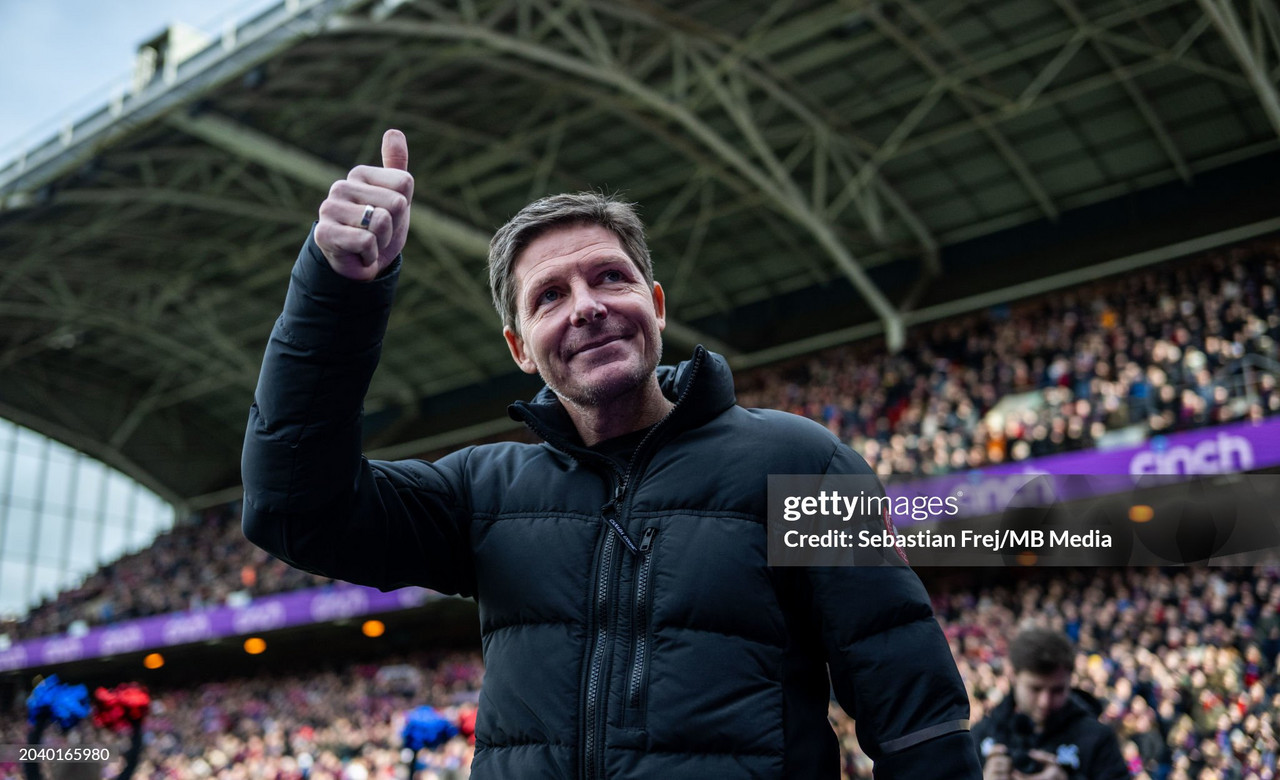

When Crystal Palace hammered Burnley 3-0 last Saturday, it displayed a professional performance that asserted the Eagles intent to remain in the Premier League. Goals from Chris Richards, Andre Ayew and Jean-Phillipe Mateta elevated Palace to 13th, now eight points away from the drop.
The first match under Oliver Glasner showed the change that needed to happen at Selhurst Park. A philosophy built around scoring goals, and winning games that had to be won. And for the first time since early November, Palace kept a Premier League clean sheet, limiting the Clarets to just two shots.
This encouraging performance has led fans to ask what awaits them under the Austrian's management. Could the new appointment can bring exciting football back to South London, or was this display just part of the "new manager bounce," a modern day cliche in football.
We take a look at the history of Glasner, and what tactics and style of football he will bring to Selhurst Park.
-
From Reid, Austria to Croydon, London
Glasner, now 49 years old, began his managerial career when offered an opportunity with SV Reid in 2015, after being a successful assistant coach, under Roger Schmidt, for two years at Red Bull Salzburg. The year after, he joined fellow Austrian side LASK as sporting director and head coach.
After getting his team promoted, and up to 2nd in the Austrian Bundesliga, Glasner was offered the helm at German side VFL Wolfsburg. In his two seasons with them team, he guided them to seventh and fourth, as well as the Europa League round of 16 in 2019. Yet at the end of his second season, he left Wolfsburg to join fellow Germans, Eintracht Frankfurt.
Despite hacing Frankfurt in a relegation fight for the first half of his inaugural season, Glasner helped his team recover and finish eleventh. He found success in Europe, however, with Frankfurt defeating Rangers 5-4 on penalties to win the Europa League, and hand Glasner his first European trophy.
VICTORIOUS: Frankfurt defeat Rangers in the 2022 Europa League season.
Despite a seventh placed finish last season, a poor end to the season urged Glasner not to renew his contract, and look for opportunities elsewhere. When Roy Hodgson handed in his resignation to Crystal Palace two weeks ago, it gave Glasner to perfect shoes to fill, and a Premier League project worth taking.
With a European trophy under his belt, as well as a track record to get teams climbing up their leagues, the Eagles should be encouraged by this appointment as it stands. But let's take a look at how, tactically, the Austrian sets up his team.
-
Tactical Masterclass: What can we expect under Glasner?
A system Glasner has followed since his early days is utilising a 3-4-2-1, utilising wider wing-backs and central attacking players to push his team forward. The use of three centre-backs also allows defensive solidity if his team were to lose the ball, remaining compact whilst the ball finds the wider wing-backs.
Ball playing midfielders are also used in the centre of the park to break lines, meaning the opposition loses track of the wider players and are hit on the cross. The striker used in the system has to be pacy and clinical, meaning the likes of Andre Silva and Rafael Borre became critical as their pace allowed them to feed of crosses and progressive passes placed into the box.
The use of this system allowed some Frankfurt players to shine. Serbian wing-back Filip Kostic shone as he was allowed to exploit the left wing, with his remarkable delivery clocking up 43 crosses into the penalty area in 2021-2022, and 9.2 expected assisted goals. Also racking up 87 key passes, this playmaking ability was crucial to Frankfurt's path through the Europa League.
Djibril Sow and Daichi Kamada also thrived, with their elite ball control and vision allowing Frankfurt to be deadly on the counter attack, especially if the striker used their raw speed to find space in an attacking area. With the ideal creativity of the wing-backs involved, Glasner had created one of the most explosive counter attacking styles in Germany.
One element that Glasner may want to improve in England is his defensive stability. With a system built on pressing, and successful pressing it shpuld be said, the rigid back three often found themselves isolated on transition, meaning that Glasner's teams often concede the same that they score. With the intensity of the Premier League, defensive stability is definitely required to keep the Eagles flying.
But with the quality of the squad he has inherited, there should be excitement about the potential way Crystal Palace can play in the future. Glasner's history promises clinical, counter-attacking football, so let us have a look at the potential players who can have an impact under the Austrian.
-
What assets do Palace have in order to replicate Glasner's style?
Defensively, Glasner is not short of suitable options to form a rigid, linear back three. Both his goalkeepers, Sam Johnstone and Dean Henderson, are fighting for a ticket to the European Championships with England this summer, and are likely to be on top form ahead of the summer, alongside fellow countryman Marc Guehi.
Guehi has impressed elite level teams with his ability to play out the back, and alongside Danish partner Joachim Andersen, are both likely to start as part of the tactic. Alongside them, either Chris Richards, Joel Ward, Rob Holding or James Tomkins could find themselves fighting for a spot, with the former two getting the nod against Burnley.
One issue may be the wing-backs. Tyrick Mitchell has started 25 matches at left-back this season, and was deployed at LWB last Saturday in the "Kostic" role. However, his alarmingly low progressive numbers, ranking in the bottom 1% for progressive carries per 90, suggest he may not be the creative mastermind, instead leaning towards a defensive machine, ranking in the top 18% for blocks, clearances and tackles per 90.
Instead, Glasner may look to the right side of the defence for Daniel Munoz. Arriving from Genk this January, the Columbian defender may find himself being the new Kostic, as in the last year, he ranks in the top 1% for progressive passes per 90 (7.56) and top 18% for progressive carries per 90 (2.77), marking himself as one of the most creative full-backs available,
Also ranking in the top 7% for shots and top 9% for shot-creating actions per 90, Munoz has a clear eye for goal whilst also balancing his attack with a strong defence, ranking in the top 5% for interceptions per 90, and top 11% for tackles. If deployed correctly, Munoz could be incredible for Crystal Palace under Glasner, especially if attackers find themselves on the end of his creativity.
In terms of midfielders, Glasner started Jefferson Lerma and Adam Wharton in the centre of the park. Lerma is more defensive in the way he plays, ranking in the bottom 40% for passes or take-ons, but lost 15 duels on Saturday. Partnered with Wharton, who averaged 6.41 progressive passes per 90, Glasner will hope that a more proactive midfield partnership can begin to take shape.
Despite the Frenchmans season long injury, Cheick Doucoure signed a new deal with the club yesterday, who expertise in his ball winning ability in the centre of the park is clear to see. Brazilian wonderkid Matheus Franca will also be looking for a spot in the team, and his short cameos have resulted in Franca ranking in the top 7% for successful take ons and 13% for progressive carries, shaping into the line-breaking midfielder Glasner desires in his tactic.
With Eberechi Eze and Michael Olise still yet to return from injury, we are not going to see the full picture until the start of next season, when Glasner is able to use the summer window to his strength. But until then, using the assets he has to form his identity could see Crystal Palace rise up the league and secure their Premier League place, marking the start of a new exciting era at Selhurst Park,
-
When can the Eagles begin to soar again under Glasner?
Crystal Palace next travel over the Thames, to the Tottenham Hotspur stadium, to play Ange Postegoclou's Tottenham side. The game kicks off at 3pm GMT on Saturday 2nd March.
(All metrics and stats used are from fbref.com)
