


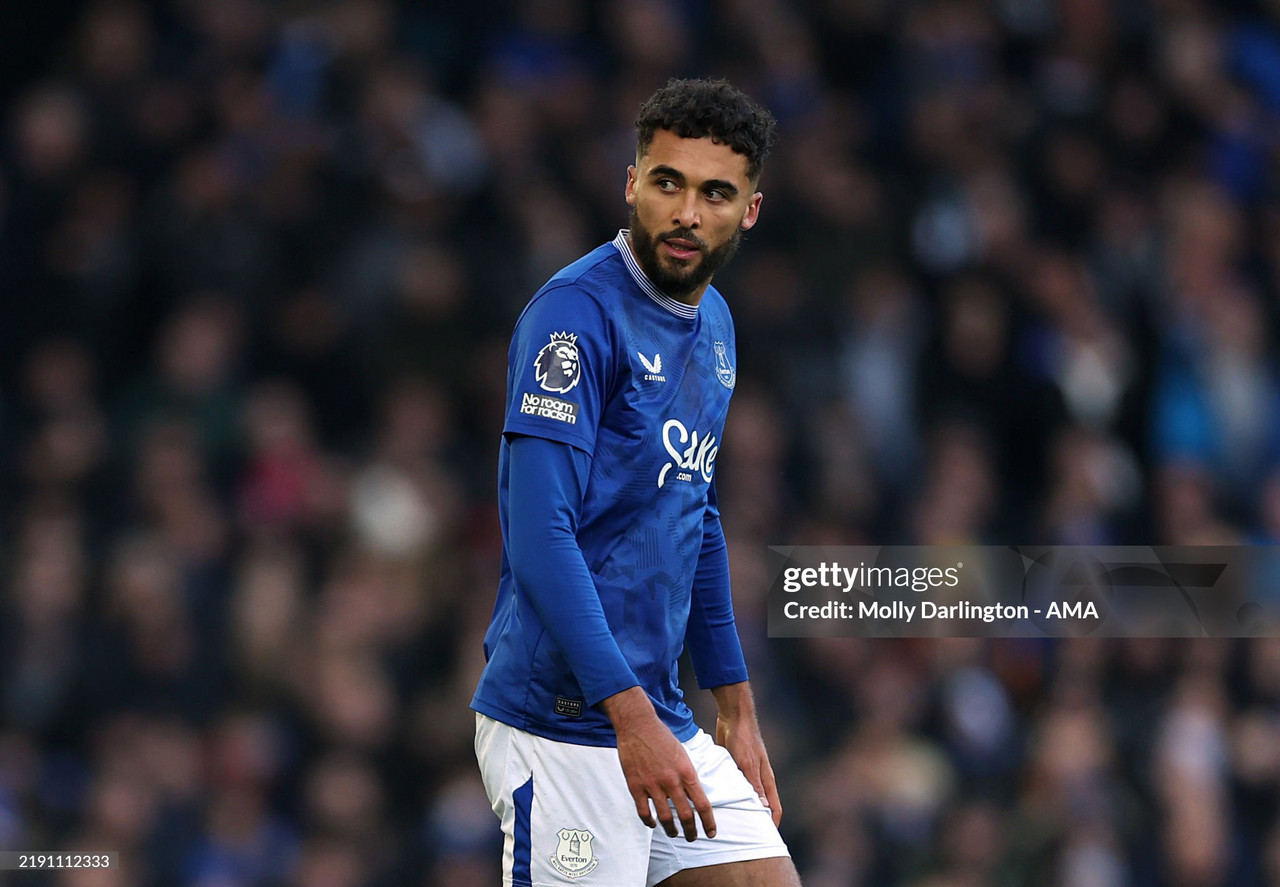

Dominic Calvert-Lewin has always been talented. Talented in a way your dad may enjoy, with his all elbows and shoulders style, but talented nonetheless, always knowing where the back of the net is, displaying all the traits of a natural finisher.
This was demonstrated in the 2020/21 Premier League season when a then-23-year-old Calvert-Lewin, under the stewardship of one Carlo Ancelotti, scored 16 league goals in 33 games.
It gave Everton fans a glimpse into the future; they saw a player who had the potential to lead their line for years to come, and if not that, someone who would command a huge transfer fee and generate the club a lot of money.
Instead, Calvert-Lewin would never hit the heights of the 20/21 season again, and that, in large part, is due to his constant injuries, with the forward, since that impeccable campaign five years ago, being sidelined for over 500 days, much to the chagrin of many of the managers who have graced the Goodison Park dugout over the past few years.
Particularly Sean Dyche, who was so frustrated by the striker's injuries, he decided to inspect both Calvert-Lewin’s car seat and mattress to see if he could make any changes.
Managers would not do that for any old player; it is clear that when fit and healthy, Calvert-Lewin is one of the most dangerous forwards in the entire division, and even through all the injuries, Everton fans stood by him, waiting patiently for him to exercise his injury demons and become the player the they know he can be.
But as last season drew to a close, a season that saw the 28-year-old muster up just three goals in 26 league appearances for the Toffees, it was clear that both parties needed a clean break from one another, and Calvert-Lewin announced he would be leaving Everton once his contract expired at the end of June.
-
Last Chance Saloon?
He was not short of suitors, with many sides viewing him as a potential backup option to their main forward, or even the backup to the backup. But Calvert-Lewin, even now, after all the poor luck with injuries and form, still views himself as a first-choice Premier League number nine; he still feels he has more to offer. And with that in mind, it seems that the England international has decided to join newly promoted Leeds United.
A move that, from the outside looking in, appears to be Calvert-Lewin willingly taking a step down the ladder in order to find gametime and regain form.
But the question is: could this be Dominic Calvert-Lewin’s last chance to deliver on the potential he once showed and become the striker that so many think he can be?
It would certainly appear so, as the man from Sheffield is no longer a kid; he is 28 years old, and with the barrage of injuries he has suffered over the years, he cannot have too much time left playing at the top level.
-
Career retrospective
As mentioned earlier, the towering forward was viewed by many as a player with an exceptionally high ceiling and someone who could make a real charge to be England's starting striker. But that hype does not come exclusively from his time with Everton.
So, with Calvert-Lewin entering now-or-never territory, it is a good chance to look back at his career and examine what it is that made him so special.
Calvert-Lewin was born and raised in the Steel City and supported the Blades as a young boy. He joined the club’s academy in 2005, and for the most part, in the youth setup, he operated as a midfielder, presumably before his growth spurt.
In January 2014, at the age of 16, he was included on the bench for Sheffield United in an FA Cup third round tie against Aston Villa. And while he would not make his debut that calendar year, he certainly impressed people in the club and earned a chance to further impress them with a loan move to Stalybridge Celtic.
The move played a significant role in the then-teenager's development, as he was up against seasoned, tough part-time footballers, and they did not take it easy on him; Calvert-Lewin received a black eye against Hyde United. But he bounced back quickly, scoring in the same game. He would make just five appearances but scored six goals, showing that even at 17, he was ready to play at a higher level.
In April 2015, he would make his professional debut for Sheffield United, coming off the bench against Leyton Orient. He would be an ever-present on the Blades bench for the remainder of the season, before moving to Northampton on loan for a season. His manager at Sixfields Stadium? One Chris Wilder.
He would enjoy his first consistent taste of first-team football, scoring five goals over 20 league games, although only seven of those were starts. But it was here that people began to truly notice the talent he possessed, and despite still being incredibly raw, that there was a real player in there.
He would return to his parent club in January 2016 and again reside predominantly on the bench. Although he never scored a senior goal for Sheffield United, that did not deter teams, as both Everton and Manchester United vied for his services.
He would ultimately end up in Merseyside.
When Calvert-Lewin arrived at Goodison Park in August 2016, he spent his first few months with the under-21 side and scored four goals in nine games before being formally promoted to the senior squad, where he made his debut against Arsenal in December 2016.
It had been a quick rise up the English pyramid for Calvert-Lewin; he had started the year in League Two with Northampton, and he was ending it playing against and beating an Arsenal team managed by Arsène Wenger.
He would score his first goal for the Toffees in a 4-0 win over Hull City, and despite having only joined the previous summer, he was granted a new five-year contract by Everton, a recognition that they had a seriously talented player on their hands, and wanted to ward off any potential admirers.
The next campaign would see Calvert-Lewin start exactly half of Everton’s Premier League games, and while the goals were not exactly free-flowing for the youngster, it was clear he was working hard and developing every game.
But it would not be until the 2019/2020 season that we would see the Sheffield native
really step up a level. Everton had started the season poorly under their new manager, Marco Silva, and when the Portuguese coach was sacked in early December, the Toffees were in the market for a new manager, and my word, did they find one.
Enter Carlo Ancelotti.
Prior to the Italian’s arrival at Goodison Park, it was clear that while an incredibly hard worker, Calvert-Lewin was not showing those killer instincts in front of goal, but when Ancelotti arrived, that all changed.
Calvert-Lewin hails the former Real Madrid boss as someone who helped simplify the game for him, saying on the High Performance podcast, “Stay between the 18-yard box and finish on one touch, that was my only instruction, and it just went like that.”
And went like that, it did indeed. Calvert-Lewin would score the first, second and third goals of the Ancelotti regime, hitting a run of form we had yet to see from the striker. Scoring nine of his 13 Premier League goals that season under the watchful eye(brow) of the Don.
Ancelotti had taken Everton from relegation candidates to a comfortably mid-table position, drawing improved output and performances from Calvert-Lewin. However, the next season, 2020/21, would be where it went into overdrive.
Everton would start the new season like a house on fire, picking up 13 points from their first games, including a win against Tottenham Hotspur and a draw against Liverpool, and that was, predominantly, thanks to the goals of Dominic Calvert-Lewin. Who in that same five-game period picked up seven goals, including a hat-trick against a 10-man West Brom side, earning him his first call-up to the England squad.
His fine run of form would continue, even as his team’s wobbled, continuing to pick up goals at an incredible rate. After 11 games, he had 11 goals and was comfortably leading the goalscoring charts.
And while he was unable to maintain that run of form throughout the entire season, he still managed a remarkable 16 league goals, a campaign that, to date, remains his best.
The next season is where we really begin to see the downward curve in Calvert-Lewin's career. It began with the manager, whom he had grown so attached to that he left to return to Real Madrid. He was replaced by the former Liverpool manager Rafael Benítez, in a move that was doomed from the outset.
And although the striker scored in each of his side's first three games of the season, he suffered an injury against Brighton in the Toffee’s third game of the campaign against Brighton. Not only that, but during the rehabilitation process, he suffered a setback, meaning an even lengthier spell on the sidelines. While Calvert-Lewin had suffered injuries before, he had not been out for as long as this. It would turn out to be the genesis of his injury issues; he just did not know yet.
By the time Calvert-Lewin returned to the team, the side was in turmoil, with his absence cited as a major reason why the club had been drawn into a relegation battle. Defeat against Norwich City in January spelt the end of Benítez’s reign in charge of Everton. One that a large portion of the Everton fans would rather forget.
Frank Lampard was brought in to replace the Spaniard, a move that certainly raised eyebrows, and did not bring instant success for both the team and Calvert-Lewin, with the injury he suffered earlier on in the campaign clearly plaguing him and playing on his mind.
Despite this, he was still crucial in Everton’s survival bid, and without him, the Liverpudlian side would have almost certainly been relegated.
It was the penultimate game of the season, at home to Crystal Palace, and Everton knew that if they lost the game, they would be in for a nervy last day of the season; a win would secure their safety for another year. And when Everton went 2-0 down after 35 minutes, the atmosphere at Goodison Park was reaching a level of toxicity that had not been seen for some time.
But through sheer will and determination, they managed to draw level with just five minutes to go, but a draw would not be enough to seal their Premier League status.
In the game’s dying embers, Demarai Gray whipped a free kick into the box, and in typically Calvert-Lewin style, the big man threw himself at the ball and managed to connect with a diving header. Cue pandemonium. The goal sparked a pitch invasion and instantly entered Everton folklore.
It was a moment that Calvert-Lewin himself described as “The most euphoric thing I’ve ever felt playing football.”
However, this would not reignite Calvert-Lewin’s career; instead, the forward would manage only 17 appearances and two goals the next season. It was a combination of hamstring and knee injuries that halted Calvert-Lewin. Once again, Everton found themselves in a dogfight for survival, and once again, they sacked their manager midseason. Once again, they survived by the skin of their teeth. This time, without the help of Calvert-Lewin, who spent most of the season watching on from the stands.
The next season was a slightly better one for both Everton and Calvert-Lewin. The Toffees, now under Sean Dyche, came 15th and were not quite as involved in the relegation battle as they had been, and Calvert-Lewin suffered less from injuries, and managed to play 32 Premier League games, his most since Ancelotti’s last season, Although, he did not quite managed to have the same output that he had under the Italian, scoring only seven.
His last campaign with Everton saw him start 19 of the club’s first 22 games of the season. And while he was not scoring as many goals as he once did, he was serving a purpose, first for Dyche and then for his new manager, David Moyes. But once again against Brighton, Calvert-Lewin picked up an injury that would see him miss a big chunk of action and lose the place he had fought so hard to regain to Beto.
His last few appearances for the club, where he had become a cult hero, were entirely forgettable, as he came off the bench with minutes to go and had no time to make an impact.
It was a sad way for his relationship with Everton to come to an end, rather unceremonious.
Over the past decade or so, Everton fans have had little to enjoy. But Calvert-Lewin’s performances during the beginning of the decade, in particular, are viewed as some of the happier moments that the Goodison faithful have had.
-
His Legacy at Everton?
When it’s all said and done, and Calvert-Lewin hangs up his boots, his time at Everton will be fondly remembered by those who stood on the terraces. He will be viewed as a player who, despite not fulfilling the high potential that many had for him, worked incredibly hard and overcame a lot of physical adversity.
His season under Ancelotti in 2020/21 will be remembered as one of the best by an Everton striker in the Premier League era, and gave fans a glimpse of what could have been.
But mostly, he will be remembered as a loveable lad, who endeared himself to the Everton fans, with his affable demeanour. He always had time for the people who believed in him, and no doubt, when he travels to Everton’s new stadium with Leeds for the upcoming season, he will be greeted with nothing but love and a warm reception.
Nothing less than he deserves.
