


International tournaments. For everyone: fans, players, and coaches, this is the pinnacle of football.
The purists might scoff at that assertion. It is no secret the quality of the football pales in comparison to the elite level of club football, this summer's EURO and Copa America showed us that.
The reliance on individual moments of magic can be maddening to watch at times, and it's comforting to know that we are not permanently subjected to watching baron extra-time periods and constant penalty shootouts as we search for the ultimate winners.
But we don't watch for that.
We watch for the spectacle of it all, and to applaud the clashes of colour and culture that serenade our beautiful game. These tournaments are designed as a celebration of the differences between us, but they equally serve to show that really we are all just people who love football.
As FIFA constantly reminds us, “football unites the world”.
And so often it does. There have been not so distant times where the idea of a ‘World’ Cup might have seemed unimaginable to people. Despite this, the game has always struggled with the opposite side of this coin: homophobia, racism and sexism are all too frequently seen in the stands and even the pitch.
This week, it was racism that reared its ugly head in a rather public way.
To paint a picture: Argentina's racist victory song
Argentina had just defeated Columbia 1-0 in the Copa America final, with a 112’ minute winner from Lautaro Martinez - their 4th major trophy in 3 years and continuing a remarkable run of success. The players, expectedly jubilant, took their celebrations to the bus to continue the party.
Here it gets messy. In an Instagram live video from Enzo Fernandez, the Argentinian players can be heard chanting: “Listen, spread the word, they play in France, but they are all from Angola, they are going to run well, they like to sleep with trans people, their mum is Nigerian, their dad is Cameroonian, but on the passport it says: French”.
Aimed partly at the personal life of Kylian Mbappe, the chant ridicules the African origins of many of the French players, which both the national team and the country itself is famed and celebrated for.
It is blatantly racist and transphobic, and an incredibly hard watch. The Argentines are revelling in the moment, so much so it makes you wonder if the ecstasy on their faces is just unfortunately misplaced and misunderstood.
It is heartbreaking; role models for so many young people, enjoying reaching the summit of their professional careers by winning an international tournament, choosing to celebrate by reciting harmful and divisive speech.
It is a dark mark against what the celebration of these competitions is supposed to be. By winning a Copa America or a World Cup Argentina haven’t defeated the cultural identities of the French or the Columbians. Rather, it is their own chance to extend their cultural differences outwardly and celebrate the richness of their own identities - not this.
Inevitably the clip was hugely viral within hours, prompting Fernandez’s Chelsea team mates: Wesley Fofana, Malo Gusto and Axel Disasi to all unfollow him on Instagram.
Fofana went on to post a personal response, captioning the clip with the words, “uninhabitable racism”.
Fernandez issued his own apology late that day, claiming he had been overwhelmed by the “euphoria of our [Argentina] Copa America celebrations”.
Sure, it is difficult to imagine the excitement of bringing home an international trophy, especially in such dramatic fashion. But it is equally hard to imagine that most people’s natural response to that would be to sing racist songs.
In a way it is refreshing to see Fofana calling this sort of thing out for what it is. As hollow as it feels to be praising players for challenging such overt racism, they mustn't stop. But more soberingly, the incident and following exchange shows just how needed education on such issues is, and how that is not so much the prerogative of the players, but football bodies such as FIFA and acting governments.
Fernandez has clearly made a catastrophic error and he should be punished accordingly, but it would be disingenuous to just label him as a blunt, cold racist. We can accept that he is young, inexperienced and prone to foolishness. But if, during his rise to international fame and being an ambassador for the Premier League, he has escaped an education on such topics, something has gone disastrously wrong.
Fernandez’s and Fofana’s club - Chelsea - had an official response to the incident, which was that they would “use the incident as an opportunity to educate”, and that the club would be launching an internal investigation.
Using the incident as an opportunity seems highly counterintuitive. There is an opportunity to educate before such incidents occur, and we are missing it.
What is the Premier League doing to combat racism?
The Premier League has explored initiatives for equality awareness. In 2013, the Kick it Out campaign announced it would be working closely with the professional game to challenge racism. For the 2022/2023 season, Kick it Out had 242 reports of racist abuse in grassroots football, and 484 reports within the professional game.
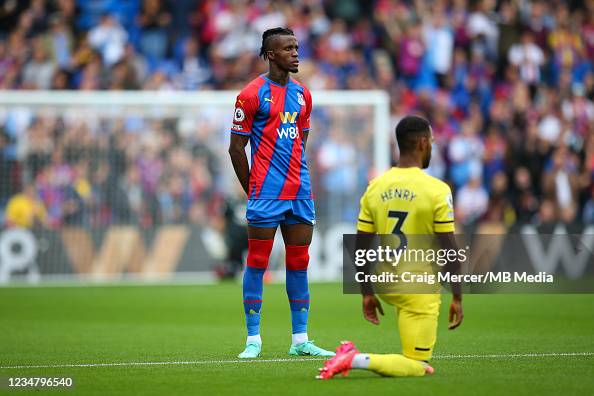
Another initiative, albeit briefly, explored was the taking of the knee - inspired by American football player Colin Kaepernick. The gesture caught great momentum after the murder of George Floyd in 2020 and the Black Lives Matter movement.
The gesture was met with extreme hostility in English stadiums by some fans, perhaps most memorably at the Riverside stadium when the England national team hosted Austria in 2021.
Other backlash was motivated by angered people who were desperate to ‘keep politics out of football’. Though given the context of the gesture, it felt like deliberate hostility to black players. However you dress it, racism is some form of politics, and not one that is welcome in any context, especially in something so diverse as football.
More significantly, there were notable examples of black players who discarded taking the knee. Wilfried Zaha was the first; saying, “unless action is going to happen I don’t want to hear about it”, whilst Ivan Toney protested that players were, “being used as puppets” by footballing bodies.
This brings forward a question of if governing bodies like the Premier League and FIFA really are so concerned about these issues, so long as the football - and the product - is being sustained.
Clearly there is a sizable gap between the expectations players have towards equality initiatives, and the satisfaction with their progress.
With the particular example of Fernandez, the Premier League’s silence has been deafening.
So why is that?
One reason could be that for football to embroil itself in an all out siege against racism and homophobia, the game would simultaneously be admitting to a deeply harmful and systemic issue that has plagued it for decades. In turn of course, the brand is damaged. If these problems are never properly confronted, there is a good chance many will see it as a non-issue, and things can continue seemingly normally.
Another is the lack of presence ethnic minority groups have in positions of power within English football. Almost half the league’s players are black, at 43%. Yet only 4 black managers started the 2023/2024 season in the EFL, there has only ever been one black referee in the Premier League, and there is only one black board member at a Premier League club. A gross underrepresentation, and an easy way to see how issues like racism can be frequently disregarded.
There’s also the finances of it all. We all know money talks, but in football money doesn’t just talk, it screams with a megaphone. The investment and the cashflow has made the Premier League into the juggernaut we see today.
Take Enzo Fernandez for example. He cost Chelsea 105 million pounds in January of 2023. A staggering amount of money for anything, let alone just a man who kicks a ball, and especially one that has massively flattered to deceive since arriving in the league. Since signing for Chelsea, Fernandez’s value has dropped to around 70 million pounds.
The investments made from clubs into these players are enormous and they expect fruitful returns. For the people calling the shots at the tops of these clubs, negative PR is bound to be a secondary concern to financial security. Let’s just say it is difficult to imagine Todd Boehly suspending his man on the 8 year, 300,000 pound a week contract over this.
A tarnished brand: How money has blurred football's morals
We have seen how money impacts the supposed morals of football on far greater scales too. You only have to look back to the last two World Cups. The sports washing projects of Russia 2018 and Qatar 2022 proved to the world that when it came to state terror, corruption, migrant labour and homophobia, FIFA weren’t so interested in uniting the world of football as much as they were in lining their own pockets. There are no better examples of politics being firmly rooted within football.
And these are the real politics of football.
The tragedy of it is that by these instances occurring and recurring without sufficient reprimand, they are slowly legitimised. Not just within football, but globally.
You only have to see the comments from Argentina’s vice president, Victoria Villarruel, after the French Football Federation lodged their official complaint. “No colonialist country is going to intimidate us for a football song or for telling truths that they do not want to admit. Stop feigning indignation, hypocrites. Enzo, I am with you”.
Leveraging the argument of colonisation to defend abject racism is a hugely backwards step. Villarruel used the incident to propagate her political party’s own far right beliefs, undermining the severity of the issue and intensifying a racial skirmish by antagonising a painful history for many black French people.
This is no defence of colonialism, but there are far more constructive ways to approach these topics. For example, Ghanaian born, French footballing legend Marcel Desailly. Desailly has long been an ambassador for Ghanaian football, and has repeatedly spoken about his desire to bridge the gap between African and European football and affairs.
These African origins are hugely important to French players, and they make up such a large portion of French culture. Their heritage should be celebrated and remembered, whilst serving as an education and a reminder of the brutality before. If these players feel French as much as they feel African - who is anyone else to say otherwise?
Maybe nobody said it better than legendary French right-back Lillian Thuram, born in Guadeloupe. “When we understand history, we understand that racism has always been a scam. It has always been a political construction designed to smash the ties of solidarity between human beings in order to exploit certain people so that a minority can get rich”.
Considering the state of bodies like FIFA and the Premier League, this feels extremely relevant. Football, but really the people at the top of the organisations, make more money than ever before, and black players are a hugely contributing factor to that success. It should not even be a question that they are respected and valued on equal terms in the game.
If football really does “unite the world”, then prove it.
The longer that cases like this are allowed to occur and give time to breathe, the more we begin to see what the true politics of organisations like FIFA and the Premier League really are.
We must hold them to a higher standard.
