


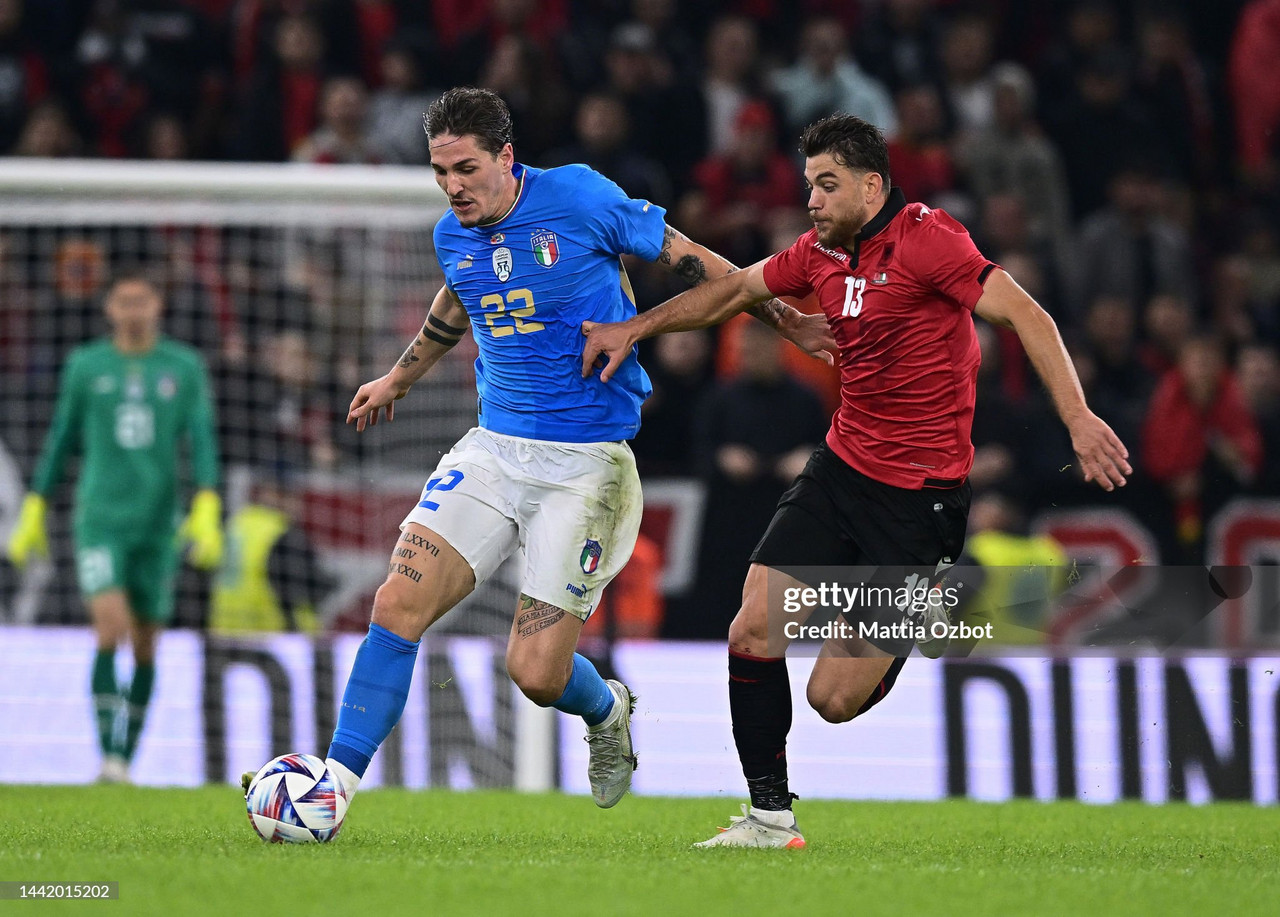

Despite taking home the title three years ago, Italy return to the European Championships with very little expectation of repeating the glory.
Having only taken over in September of last year, manager Luciano Spalletti is still imprinting himself on the side in his first international management role.
With just ten games at the helm, the former Napoli boss continues to search for a consistent formation, personnel and tactical identity.
In contrast, their opening match day opponents, Albania, have enjoyed unprecedented success under Sylvinho, topping their qualifying group ahead of Czech Republic and Poland, with a hard-working and counterattacking style.
-
Battle on the wings
Though it could change, even mid-tournament, Italy will probably start with a 3-4-3 with wing backs. Euro winner Roberto Mancini previously utilised the formation going forward, but reverted to a 4-3-3 when defending.
These are both options that Spalletti has as well, though is more likely to change plans pre-match than implement those formation changes within a game.
Whichever line up Spalletti chooses, width will be key. Not necessarily for stretching the pitch and making it a wing-based, crossing affair, but rather making links ups and garnering space in those areas.
Midfielders Nicolo Barella and Jorginho may drift out wide to orchestrate passing moves with one of the wing backs, offering some more space to the wide man on the opposite side.
The prospective wing backs - Andrea Cambiaso, Giovanni Di Lorenzo and Federico Dimarco - are all very capable of creating and attacking, which can allow the three forwards to focus on being central presences.
“[He] has a very attack-minded style of football and we push hard," Dimarco said of Spalletti. "The coach gave us lots of great indications."
Albania, meanwhile, are comfortable in their rigid defensive shape, commandeered by Atalanta's Berat Djimsiti. It is not a back four that will look to get forward at most opportunities.
Moreover, Sylvinho has been known to increase on defensive duties for wingers against stronger opponents, which will have to come into play again against Italy (and perhaps Group B at large).
Djimsiti, Ardian Ismajli and right back Elseid Hysaj all have a wealth of experience in the Italian league system too, and will be joined by Juventus-linked youngster Mario Mitaj.
When not doubling up in defence, wingers Jasir Asani and Taulant Seferi will be crucial in spearheading attacks. However, like Italy's wide players, they will look to invert and play narrower.
This will be harder to do against a back three containing Alessandro Buongiorno and Alessandro Bastoni, with the likes of Gianluca Mancini, Riccardo Calafiori or Di Lorenzo filling the third spot.
With the wide areas congested, finding space as well as quality will be one of the names of the game on Saturday.
-
Transitions
Even in their rampant qualifying campaign, counterattacking was crucial to Albania.
Long balls from the centre backs and deep in midfield have been a marker of their chance creation since Sylvinho took the helm.
Having the physically imposing Armando Broja enables them to have a linchpin up top to aim for, and Asani and Seferi able to cut in to provide more options in the middle.
With Spain, Croatia and Italy all set to have dominance in possession over Albania, utilising their strength in quick transitions will be vital for any success in these Euros.
They will be boosted by the fact that Italy have been caught out on occasions through these methods. England were able to exploit their high line to devastating effect back in October, though that was only a month into Spalletti's tenure.
In the aftermath of the 3-1 defeat at Wembley, Spalletti said “Too often, we are conditioned by the result, but it should be normal to allow counter-attacks if we want to play a European and physical style of football, the kind shown by the best clubs.”
However, as recently as the 0-0 encounter with Turkey at the beginning of June, La Nazionale were caught on the break a number of times, getting fortunate with some imprecise finishing from the visitors.
This is how Albania will get most of their joy.
Though there is something to be said of the aerial ability of Italy’s central defenders to prevent long balls, or even getting up to speed again after the mini-break from the end of the league season, the recurring issue of stopping counters cannot be looked past.
-
Long shots and box strikers
Another aspect Albania can draw from is their prowess in long distance shooting.
A remarkable five of Albania’s twelve goals in qualifying came from shots outside the box, and once more, it is something that could be exploited against Italy.
After breaking the chains of concentrated wing play, Turkey were able to utilise space Spalletti’s men left between the back three and midfield two, with space opening up on the edge of the area – exactly where Sylvinho’s side thrive.
It may seem odd to focus on using long shots, given they are generally less likely to produce goals, but with almost half of their qualifier efforts coming from that, it would be stranger not to hone in on.
These moves would have to be fast, due to the engine on Barella when getting back. The aforementioned height of the defence, and goalkeeper for that matter, means crossing will not be high on the agenda as well.
Launching long strikes will certainly be a useful additive.
Italy, on the other hand, will want to have as much of a box occupant as possible, where strikers Gianluca Scammaca or Mateo Retegui can thrive despite both not being known for having a clinical nature.
Lorenzo Pellegrini has some stature in that regard too although he would be better suited to the more mobile contingent that will surround the penalty area and drop to aid the midfield. Federico Chiesa will also be key in this regard.
On paper, it is a tall order ahead for Sylvinho. The reigning champions may still be settling into life under Spalletti, but they have plenty of competition know-how remaining from UEFA Euro 2020.
It is far from a given for Italy though as some of Albania’s strongest advantages directly play into their weaknesses. Making good of exploiting those will be integral in causing an early Group B upset.
