



Since the days of classical antiquity, Greece has been the cradle of human development in the Western world.
The foundations of mathematics, chemistry, astronomy, philosophy and politics were all made on shores of the Mediterranean nation, whose population has rarely surpassed ten million inhabitants.
The Ancient Greeks were also pioneers of theatre. Aristotle surmised that replicating life through comedy, tragedy and, in between those, drama was cathartic and key in strengthening emotional stability.
And as any fan would know, those three facets can all be found on the football pitch too.
Though live sport provides countless instances of unscripted brilliance year upon year, it can also become predictable. At times, even stale.
Big teams with the best players often win a lot. And, for the most part, that is fine. But some of the most memorable moments come when those unfancied few rupture that apparent predictability.
The underdogs.
Leicester City in 2015/16, Iraq in 2007, Denmark in 1992. These names are synonymous with glory against the odds.
As is Greece in 2004.
Coupled with a homecoming of the Olympic Games in Athens that same summer, it was very much Anno Graecorum (year of the Greeks).
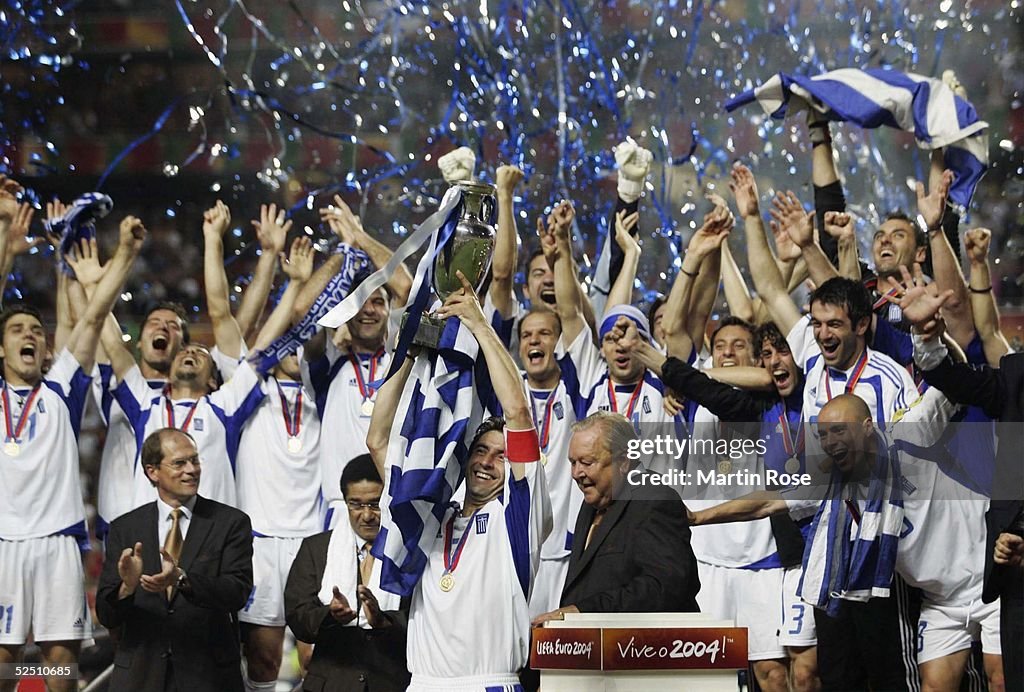
A story fit for any ancient amphitheatre, this is how they defied the footballing world to lift the UEFA European Championship.
-
The Group
Starting in the pot four, Greece were drawn in Group A alongside Russia, Spain and hosts Portugal.
Despite their lowly pot number, they had topped their qualifying group coming into the tournament, winning six of their eight matches but losing their opening two to Ukraine and Spain.
Still, they claimed a reverse victory in Zaragoza on their way to going the entirety of 2003 unbeaten. Though friendly defeats to the Netherlands and Poland did not dampen the optimism ahead of the Euros.
Midfielder Giorgos Karagounis recalled, "Our main goal for the tournament was to enjoy taking part. It was the first finals for all of us: coach and players alike."
Greece had previously only partaken in two major international tournaments - UEFA Euro 1980 and the 1994 FIFA World Cup. On both occasions they had not won a game.
They opened the championships in Lisbon against the host nation. Portugal's firepower struggled to find a way through a steely defence as Karagounis and Angelos Basinas put Greece 2-0 ahead. Cristiano Ronaldo pulled back an additional time consolation.
A strong start was followed up by a hard-fought 1-1 draw with Spain, meaning a point against Russia would be enough for them to progress.
However, a 2-1 loss later and Greece were now reliant on Spain tripping up at Portugal.
Fortunately, a solitary Nuno Gomes goal led to the Portuguese topping Group A and Greece joining them in the knockout stages.
Not on goal difference, which was level on zero, but on goals scored, with Greece's four beating Spain's two.
-
The Knockouts
If navigating the group stage was a minor shock then the expectation was for Greece to eventually fall by the wayside in the last eight as they faced the reigning European champions France.
An Angelos Charisteas header soon dispelled any talk of the run coming to an abrupt end, with Greece's tenacity sending the likes of Thierry Henry, Fabian Barthez and Zinedine Zidane packing.
"The greatest win in the history of the Greek national team," Karagounis said. "The game against France was the one which made us believe we could go all the way."
Next up in the semi final was the Czech Republic, a side that came ever so close to its own success story eight years prior. Euro 1996 saw the then newly formed nation finish runners-up to Germany.
This Czechia team were nothing to sniff at either. Petr Cech, Tomas Rosicky and Karel Poborsky made up a solid spine whose cherry on top was 2003 Ballon D'Or winner Pavel Nedved.
The toughness of the tie was evident on the pitch too. The game was level at 0-0 at the end of ninety minutes, with extra time needed to separate them.
A set piece once again proved pivotal as Traianos Dellas nodded in the silver goal winner to send Greece into their first major final.
Awaiting them was Portugal, plotting their own dream. Dispatching England and the Netherlands meant they were now also one victory away from lifting their first international honour in their homeland.
Under the tutelage of World Cup winning manager Luiz Felipe Scolari, it really became a battle of destiny. Was this a step too far for the Grecians?
Yet again, aerial power put Greece ahead just short of the hour mark. Yet again, through Charisteas. Yet again, Greece had to rely on defensive stubbornness to make it over the line.
And, yet again, they did.
The greatest victory in the history of Greek football was complete. Cue jubilance across the country and in the ripples of the diaspora around the planet. An odyssey to end all Hellenistic odysseys.
Their third consecutive 1-0 win meant Greece had triumphed against odds of 250/1 and beaten heavyweights along the journey.
Aristotle may have been unaware of the existence of association football, but this story would have met his remit for drama perfectly.
-
The Manager
"We always had good players," goalkeeper Antonios Nikopolidis later explained. "What was missing was a man to inspire and to create a team and lead the country to success. That man was Otto Rehhagel."
Otto Rehhagel was an experienced coach in his home country of Germany, having led the likes of Bayern Munich, Borussia Dortmund and Werder Bremen.
Even in his club career, he was usually one for disrupting the established order, claiming two Bundesliga titles with Bremen during his fourteen year stint with the typically midtable outfit.
His work at 1. FC Kaiserslautern was even more impressive, gaining promotion and winning the Bundesliga in successive seasons.
It was clear that, upon taking the role at Greece, Rehhagel had a knack for improving players, overperforming and forging team spirit.
While his teams in the German leagues were capable of putting up high attacking output, he became renowned for a steely defensive unit, perhaps inspired by his own playing days as a no-nonsense centre-back.
Greece were certainly in that mould. Darting counter attacks and connecting with crosses became a staple of the 2004 campaign. Years later, Rehhagel would explain how he operates.
"At the risk of being labelled old-fashioned, I like to work on the premise that football essentially is a simple game. Naturally you have to be set up as well as you possibly can.
"When facing opposition with more weapons than you, the answer is not to give them a free shot."
There were critics that derided Greece's approach. They were labelled as boring and uninspiring due to their pragmatism.
Rehhagel, however, was always undeterred, saying how his reputation as a park the bus coach never bothered him.
"Not in the slightest ... My mentality is to win and in order to do so, you base your team selection and tactics on the players you have available to you."
As well as a firm tactical model, Rehhagel's other secret weapon was installing a tremendous amount of belief.
"We have the togetherness and unity of purpose of a club side," Rehhagel stated. This sort of bond, coupled with the enthusiasm, fighting spirit and modesty, they always display, can take you a long way."
Karagounis attested to the chemistry the German created, "He stuck to his guns and he turned the national team into a true team, functioning like a club side – something that’s very hard to achieve."
"He always gave us examples of how smaller and weaker teams could beat much bigger opponents," Nikopolidis added. "It was hammered home and, in time, we all grew in confidence. No one was afraid of anyone. There was respect but not fear."
He would be crowned 'King Otto' in the wake of the victory and possibly his most remarkable upset in a career full of them.
Meanwhile, football idealists would get their joy in the next two tournaments through Spain's iconic Tiki-Taka teams, but the story of the underdog is just as powerful.
-
The Star Player
Captain Theodoros Zagorakis exemplified the Greek team. Playing on the right hand side of the three man midfield, he was the composed operator at the heart of the eleven.
A successful time at PAOK led to a spell at Leicester City, where he won the League Cup. He soon became surplus to requirements and returned to the Greece capital with AEK Athens.
With the importance of the unity and confidence to Rehhagel's plan, it was crucial to have a formidable leader on the pitch.
Zagorakis was the perfect embodiment of that. Then 33-years of age, he was largely defensively-minded and able to harry opponents expertly, as well as offering an assured presence and skilled passing.
His assist against France comprised of a lovely flick over Bixente Lizarazu that allowed him to find space on the wing and calmly pick out Charisteas for his powerful header.
He was named player of the match in both encounters against Portugal and would also claim the player of the tournament award.
Later in the year, he would finish fifth in the Ballon D'Or, behind Henry, Ronaldinho, Deco and Andriy Shevchenko.
An integral cog in the success of the system, Zagorakis has played a further part in Greek football even in retirement.
-
Twenty years later
Since the glorious summer of 2004, Greek football has been marred by corruption allegations and fan violence.
In between serving as a member of the European Parliament, Zagorakis became president of the Hellenic Football Federation in 2021 in the hope that he could inspire a sea change in the culture.
He resigned after only seven months citing a toxic atmosphere propelled by leading clubs that refuse reformation.
Panathinaikos president Giannis Alafouzos told Sky Sports that continued domination of Olympiacos has meant his club and others have struggled to compete financially, resulting in trouble attracting European players.
Olympiacos did not win the league this season, though they did become the first Greek side to lift a continental trophy upon beating Fiorentina in the UEFA Conference League final.
Further rays of optimism shone on the national teams fortunes as they came a whisker away from reaching UEFA Euro 2024.
They placed third in their qualifying group and defeated Kazakhstan 5-0 in the first round of their play-offs. They would eventually fall short to Georgia, who qualified for their first finals, on penalties.
However, problems have continued.
In December of 2023, domestic matches were played behind closed doors because to the persistence of hooliganism, which has led to, in its darkest moments, deaths.
Twenty years on, the miraculous achievement of Rehhagel's men remains a beacon of light in the country's footballing history, and a shining example to the world of what collective belief can produce.
Luck certainly played its part, but you would hard pressed to find any tale of mythology without some extraordinary influence from otherworldly sources.
Greece may not be gracing the tournament this time round, but the legacy of the 2004 team continuously serves as a marker of international accomplishments.
And if there is anything that Greek football needs, it is to remember and continue to be inspired by their heroics.
