


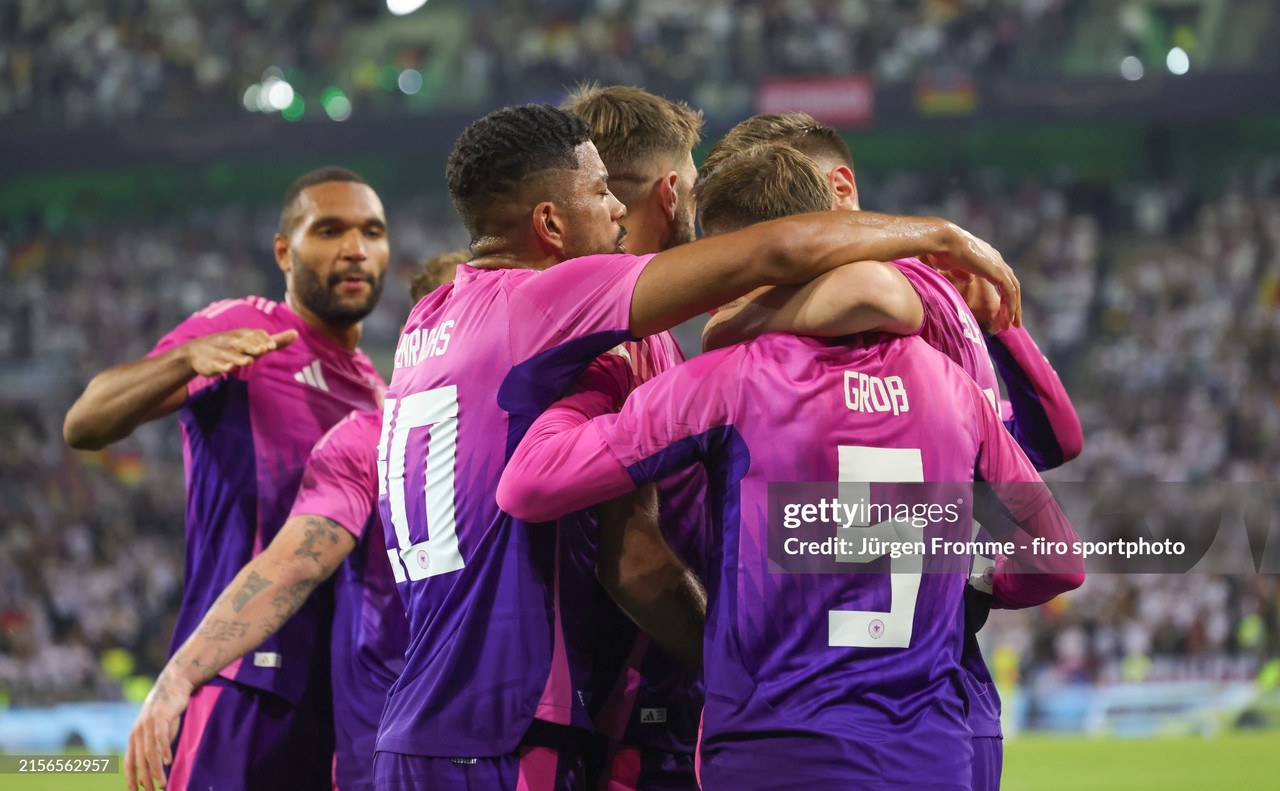

Hosts Germany kick off their highly anticipated Euro 2024 campaign when they face Scotland on Friday evening.
Die Mannschaft are bidding to lift their first European Championship since 1996 and will be desperate to put their poor performances at recent tournaments behind them.
The dismissal of Hansi Flick has given rise to a new era for DFB, stewarded by the former Bayern Munich manager Julian Nagelsmann.
It took a while for Germany to get going under the 36-year-old when he was appointed in September 2023; however, three international camps later, he seems to have settled on a starting line-up and style of play.
Victories over World Cup Finalists France and one of the favourites for the Euros the Netherlands have caught the headlines in recent months. What’s more, a spirited comeback against Greece in their penultimate warm-up match before the finals was also admired.
While Germany has never been about the stars and more about the collective, this new-look Die Mannschaft boasts a mixture of youth and experience, players who have played major roles in the 2023/24 Bundesliga renaissance.
Much has been made of it but the change of approach from the DFB to select on form as opposed to reputation has almost made them a bit of an unknown entity heading into the tournament.
Scotland enjoyed a stellar qualifying campaign, defying expectations and finishing second in Group A, above Erling Haaland’s Norway and four points behind 2012 winners Spain to secure a place in the finals.
The Tartan Army had a magnificent 2023, with a historic 2-0 victory over Spain at Hamden Park following two goals from Scott McTominay and edging past Norway 2-1 after two extremely late goals.
Steve Clarke built on the success of qualifying for their first World Cup in 24 years by making sure they competed in their fourth European Championships. However, Scotland failed to win at Euro 2020 and have not registered a victory at the tournament since 1996.
Clarke’s side suffered defeats to the Netherlands and Northern Ireland earlier this year and will instead take the momentum of the 2-0 win against Georgia and a respectable draw versus Finland into Friday.
Germany and Scotland have faced each other 17 times, and last met each other during the 2015 European Championship qualifiers, where the World Champions at the time won by the barest of margins 3-2.
The Tartan Army last played the hosts at the Euros in their first-ever appearance at the tournament in 1992, a team captained by Richard Gough lost 2-0 in their second group game.
In total, Scotland have won four and Germany have won eight.
Clarke could be without Andy Robertson and Lawrence Shankland who both limped off during Monday’s training camp.
Nagelsmann is expected to have his full squad at his disposal.
Heavy emphasis on full-backs
Scotland manager Clarke deploys the Tartan Army in either a 5-4-1 or 3-4-3 formation; no matter how they set up, wing-backs Andy Robertson and Ross McCrorie are key to their attacking threat, particularly on the left side.
It seems the former St. Mirren manager is onto a winning formula with the Robertson and Kieran Tierney conundrum, which has plagued the national team for many years.
Even though the Liverpool full-back is the wingback on the team sheet and Tierney is the left centre-back, the pair rotate and underlap one another to devastating effect throughout games.
For example, in the Cyprus match, the former Celtic Academy product found himself out wide in the attacking transition, Robertson underlapped him, and the centre-midfielder dropped in to receive the ball, and provided a defence-splitting pass in behind as the wing-back gave chase.
Following that, in the surprise 2-0 victory over Spain, it was a similar pattern of play that enabled Robertson to tee up Scott McTominay for the opener.
Injuries to Nathan Patterson and Aaron Hickey have also paved the way for uncapped McCrorie to feature as the right wingback.
A bit of an unknown entity at this level, the 26-year-old's versatility will be valuable, and his previous experience playing in right midfield should mean he has the offensive qualities to fulfil Clarke’s demands.
In not too dissimilar fashion, Germany also places a heavy amount of responsibility on their full-backs in the attacking transition.
Under the stewardship of Nagelsmann, Joshua Kimmich is no longer applying his trade in midfield but rather back at right back, while Maximillian Mittelstadt is a relatively new inclusion at left-back.
Nagelsmann sets up in a 4-2-3-1; the fullbacks are high up the pitch and provide the width in attack; the wingers and the No. 10’s flood the middle, awaiting a cross.
By giving the width, the front four can occupy and overload the middle as the back five are stretched.
However, you may also see the full-backs inverted in order to leave the wide man free in space.
All in all, the full-backs will play a crucial role in carrying the attacking threat on Friday evening for both sides.
Goalscoring midfielders
The way Scotland attack teams relies on Che Adams making the runs to drag the defence out of shape, while the midfielders come from deep to stretch and open up the opposition, and it is fair to say the Tartan Army have become very good at it.
McTominay was the nation's top goal scorer in qualifying, he netted seven times and finished narrowly behind the likes of Harry Kane and Kylian Mbappe.
Die Mannschaft will need to be aware of the threat posed by the Manchester United midfielder.
The 27-year-old’s well-timed runs into the box from deep during the attacking transition secured him a brace against one of the favourites for the tournament, Spain, in March.
For the first goal, Lyndon Dykes created the space for McTominay to run into and slot home. The second came from his tenacity to make up a large amount of ground and latch onto an attempted clearance in the penalty area.
John McGinn has also become effective at making these extremely long runs into the final third to arrive late on the edge of the box and add an extra goal threat. The Aston Villa player scored three goals on their journey to qualifying.
Germany’s front four possesses three midfielders who have all enjoyed wonderful goal-scoring seasons for their clubs.
Florian Wirtz’s stellar campaign for Bayern Leverkusen has been well documented, with 18 goals in all competitions. What’s more, Jamal Musiala and Ilkay Gundogan have netted 17 times between them for Bayern Munich and Barcelona, respectively.
However, all have struggled to translate these tallies to the international stage, with four goals in qualifying for the midfielders.
Nagelsmann’s side squandered a number of chances to score against Ukraine last Tuesday with Gundogan and Wirtz missing golden opportunities.
Die Mannschaft will require the goals to be shared among the front four if they are to be successful; it cannot just be the burden of the lone striker, Kai Havertz.
The hosts are sure to create a lot of chances in this fixture, but for them to be converted and not squandered, the three No. 10’s will need to be clinical in front of goal, which is something the visitors seem to have mastered.
Unconvincing forwards
Even though Dykes struggled for goals in the Euro 2024 qualifiers, the Queens Park Rangers (QPR) striker netted four times in their pursuit of 2022 World Cup qualification and achieved the same tally in the Nations League.
Dykes was ruled out of the finals owing to injury, which leaves Adams and Hearts striker Shankland as the two remaining options up front for the visitors.
Despite boasting 15 goals in the Championship for Southampton, Adams’ last goal for the national team came in September 2022.
Shankland, on the other hand, registered 31 goals in all competitions in 2023–24 and has scored twice in six games for Clarke’s side.
Having said that, Scotland’s concerning lack of goals up front needs rectifying, even if the midfielders are firing.
Naglesmann confirmed on Friday that Havertz would lead the line for the hosts, with Nikolas Füllkrug reduced to the bench.
The 24-year-old aligns with how the former Bayern Munich manager wants to play. An attacking midfielder by trade, the Arsenal player will feature as a false nine for DFB, getting in behind as much as possible.
In four starts in this position, Havertz has a respectable return of two goals; however, doubt remains as to his ability in front of goal.
Naglesmann is blessed with an array of attacking talent. Do not be surprised to see Füllkrug or Deniz Undav introduced early if the former Bayer Leverkusen starlet cannot find the net.
Scotland’s low-block
The Euro 2024 warm-up matches have seen Clarke experiment with how Scotland set up when out of possession.
The Tartan Army attempted to press against the Netherlands in March, having some success as they won the ball high up the pitch on a few occasions. However, upon doing so, the forward players lacked the necessary clinical edge to convert the chances, and Clarke’s side lost 4-0.
In Scotland’s final game before Friday, they reverted back to playing a low block with a 5-4 behind the ball, focusing on defending the box and restricting the opposition to crosses along with shots from range.
The biggest concern for Clarke and his staff ahead of Germany is how poor his team have been defending areas from crosses. For example, in matches against Spain, Georgia, and Norway they conceded as a result of deliveries into gaping areas and the defenders failing to react quickly enough.
Die Mannschaft will likely look to target this weakness and utilise the pinpoint accuracy of Mittelstadt and Kimmich, who both have a mean cross.
The Tartan Army’s secret weapon?
There is no denying the importance of set pieces for a team like Scotland at a major tournament; they can be the difference between progressing to the knockout rounds or exiting at the group stages.
While every team wins several a match, there have been few more formidable in recent years than the Tartan Army.
Clarke boasts arguably the best set-piece coach in the business, Austin MacPhee. The 44-year-old was a part of Unai Emery’s backroom staff this season at Aston Villa, under his mentorship, 25% of the Villeins goals in 2023–24 came from set-pieces.
Meanwhile, for the national team, MacPhee has installed a series of unique set play routines that have led to Scotland having one of the highest percentages for corner-to-goals in international football, above the club average by some distance.
As well as that, Scotland are very good at defending set pieces, the only corners they have conceded in two campaigns have come to France and Holland, both with weaker starting elevens.
Having said that, Germany are tough to break down from set plays. The hosts tend to have everyone back in the box to defend from a corner; the protection of the keeper is also prioritised.
When defending free kicks, they are typically set up in a low block, which could nullify the threat the Scottish pose from set pieces.
Expectation
Germany are likely to have a lot of the ball and put Scotland under an intense amount of pressure, dominating possession.
The full-backs will be high and wide, while the three No. 10’s and false nine combine centrally, looking to break down a resilient Tartan Army defence and get in behind.
Another avenue the hosts will look to exploit is putting crosses into dangerous areas for the front four to latch onto, fully aware of the spaces that open up in the Scottish defence.
On the other hand, Scotland will sit in a low block and soak up the pressure. Once they win the ball back, the Scots will counterattack at pace when Mittelstadt and Kimmich are high and the No. 10’s are narrow to combine.
Clarke’s side will attack the fullback areas that are now unoccupied, and McTominay and McGinn will want to make sure they are unmarked by covering large amounts of ground quickly to capitalise on Die Mannschaft’s slower-recovering midfielders such as Toni Kroos and Robert Andrich.
It will be pivotal for Germany to avoid squandering their chances because Scotland will look to punish them on the break.
