


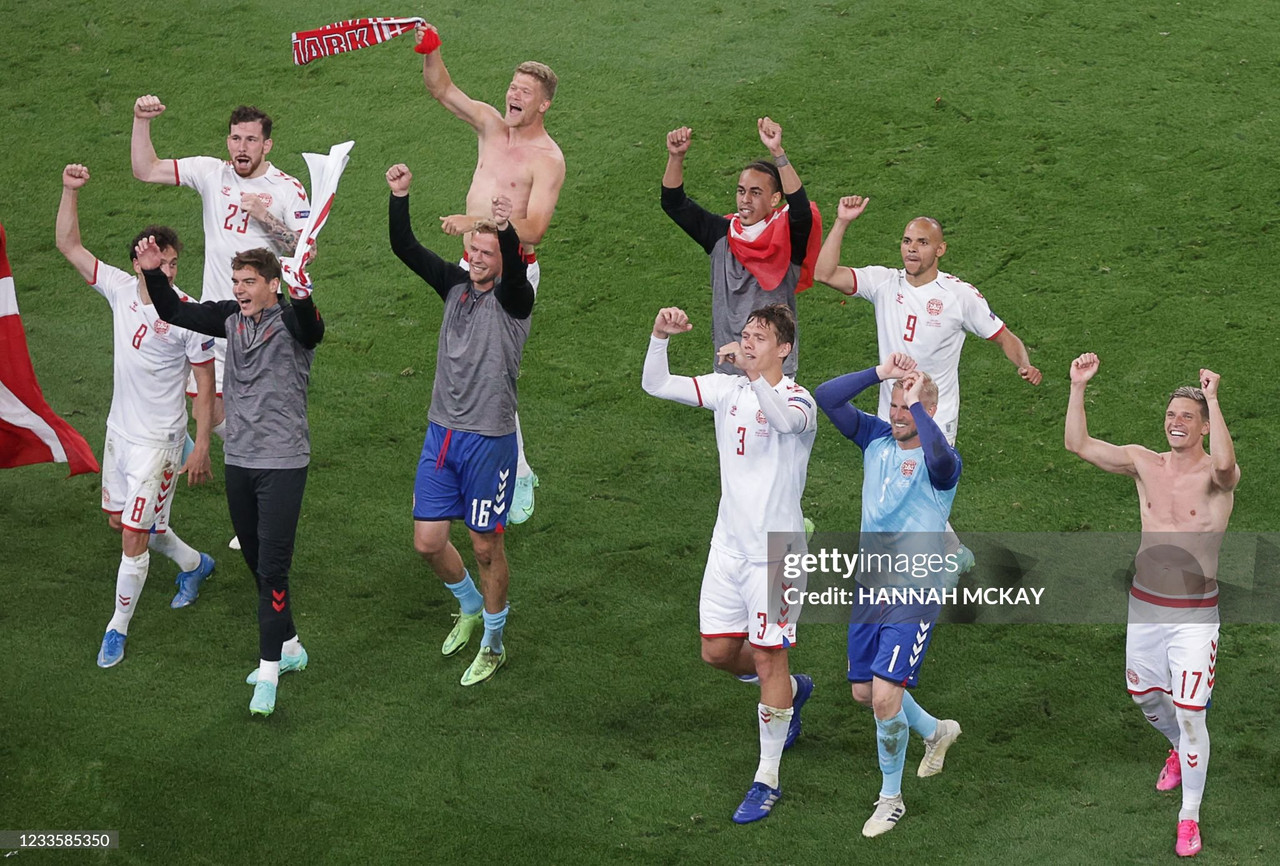

The delayed Euro 2020 that actually took place in 2021 was a special tournament. Delayed because of COVID-19, the tournament took place all over Europe with 11 cities in 11 UEFA countries each providing venues for the tournament.
There were two extra subs per team and this was the first Euros that used VAR. Denmark went in hopeful but the tournament was much more than football for them.
What ended up being their most successful international tournament since they won the Euros in 1992 started with one of the darkest days in Danish footballing history. The story of the Danish 2020 Euros campaign can only be contextualised in the emotional rollercoaster of what happened to Christian Eriksen.
-
The Group
To set the scene, Denmark were unbeaten in qualification, coming runner-up to Switzerland in their qualifying group. Their reward for qualifying second was a group with Belgium, Finland and Russia.
The team had real talent. The leaders in the squad were Kasper Schmeichel, captain Simon Kjær and Eriksen. There was the solid midfield duo of Pierre-Emile Højbjerg and Thomas Delaney and offensively, young talents Kasper Dolberg and Mikkel Damsgaard represented the future of the team.
They would expect to get out of this group, being the second strongest after the Golden Generation of Belgium - Romelu Lukaka, both Eden and Thorgen Hazard, Thibaut Courtois, Jan Vertongen, Yannick Carrasco and Kevin De Bruyne. A menacing team however they always came up short. An article itself should be devoted to the perceived failings of the Belgium National Team in tournaments in the past 10 years.
Both the Russians and the Finns came in optimistic but both teams were on the decline. Buoyed by their performance in their 2018 home World Cup, Russia believed they could get out of the group with the likes of Aleksandr Golovin and Artem Dyzuba always providing an attacking threat. The Finns had an attacking threat of their own in Norwich City striker Teemu Pukki who was in the form of his life.
-
The Manager
The manager then - and still the manager now - was Kasper Hjulmand. Hjulmand had previously managed Danish teams Lyngby where he won the Danish first division in 2007 and Nordsjælland where he won the Danish Superliga in 2012. He had an unsuccessful time in charge of Mainz 05 being fired after eight months before returning to Nordsjælland for another spell in charge.
He became coach of the national team in 2020, replacing Åge Hareide as manager which was supposed to happen after the Euro 2020 tournament when Hareide’s contract would expire. However, since the tournament was delayed because of COVID-19, Hjulmand went into his first tournament earlier than expected.
-
How did they do?
They started against Finland in dramatic and scary circumstances. In the 43rd minute, off the ball, Eriksen collapsed. He had suffered a cardiac arrest at only 29. Immediately players and staff rushed to his aid, with the image of his teammates creating a human shield for his privacy a lasting image from the tournament.
There was a moment when Eriksen was gone, he was technically dead for five minutes. The medics continued to work on him and luckily one defibrillation brought Eriksen back.
After 15 minutes of treatment, he stretched off the pitch to chants from both sets of fans and was rushed to hospital for further treatment now conscious. The game was eventually resumed a couple of hours later, agreed to by the Danes, which the Finns won 1-0.
However, it was agreed to under pressure. The players said they were put into a position they didn’t want to be in, forced to either finish the game immediately or return the following day to play it in an empty stadium. Martin Branthwaite was reported as saying they chose the "least bad option" they were presented with by UEFA because players were not in the right mindset.
That could have been the end of everything for the Denmark team then and there, but they instead rallied. Eriksen’s plight sparked something in the team, something even more to get behind and fight for. Schmeichel pledged to Eriksen that they would win it for him when he visited the hospital.
In the next game against Belgium, the Danes got off to the best start, scoring the fastest goal in Euros history with Højbjerg teeing up Yussuf Poulsen to slot in after 39 seconds. In a heartwarming moment after 10 minutes, a moment of applause was observed by all in the stadium for Eriksen.
The Danes had continuous chances in the first half but could not capitalise and eventually lost the game 2-1, the Belgians inspired by Kevin De Bruyne’s introduction at 55 minutes. Two games down, zero points, bottom of Group B.
In the final game of the group stage, the Danes needed to beat Russia and hope that Belgium beat Finland to progress. In a raucous Parken Stadium in Copenhagen, where they had lost two games and seen their teammate collapse, the Danes channelled their emotion to play one of their greatest games.
Mikkel Damsgaard scored a beauty, Poulsen was handed a gift, Andreas Christian Thundered home a first-time strike and Joakim Mæhle put the cherry on the cake. 4-1 Denmark and with the Belgians winning too, the Danish were through.
Every goal was celebrated with pure, unbridled emotion for the nine days they had been through. The skies rained beer as the fans shared in these celebrations. Delirium.
In the round of 16, they dispatched Wales 4-0, in the quarter-finals they edged out the Czech Republic, and then in the semi-finals they came up against England. The Danes were the neutral’s favourites to win the whole tournament, they had won the hearts of the world for their courage to continue. They were doing it for Christian.
Sadly, it all came to an end in dubious circumstances. With the game into extra time level after Damsgaard’s amazing free-kick and a Simon Kjær own goal, England were awarded a soft penalty. Whether it should or should not have been given it was. Despite Harry Kane having his initial penalty saved the rebound was scored and the game finished 2-1 England.
-
The Star Player
There were several standout performances. Kasper Dolberg was their top scorer with three, Mikel Damsgaard proved why he was one of the hottest young talents, and Kasper Schmeichel showed that he was still a top-class keeper.
However, the player who really stood out was Pierre-Emile Højbjerg. The Tottenham Hotspur midfielder made three assists in a position further forward than usual. When Eriksen left the team, Højbjerg played in a midfield two that allowed him to press forward. This meant he won the ball forward regularly, recovering it in an advantageous position higher up the pitch.
He turned up everywhere and led the team from the middle putting in displays that showed why he was such a lauded midfielder. Since Euro 2020, Højbjerg has stayed at Spurs, being key under previous managers up to Ange Postecoglu. The midfielder has played a bit part under Big Ange and has faced a number of criticisms during the most recent campaign.
He looks set to leave N17 this summer, possibly hoping that a good Euros will see his suitors line up in the plenty.
-
How did their 2024 Qualifying go?
In short, well. They topped their qualifying group winning seven of 10 games. Rasmus Højlund bagged seven goals in qualification and they had a draw and win against Slovakia who will be in Group C with them at these Euros.
The Danes are in a competitive Group C with Serbia and England finishing off the teams. They hope to get through but tournament football can be unpredictable.
Eriksen is in the team again, fitted with a pacemaker. The footballing world will cherish to see the talented midfielder back in this tournament.
