


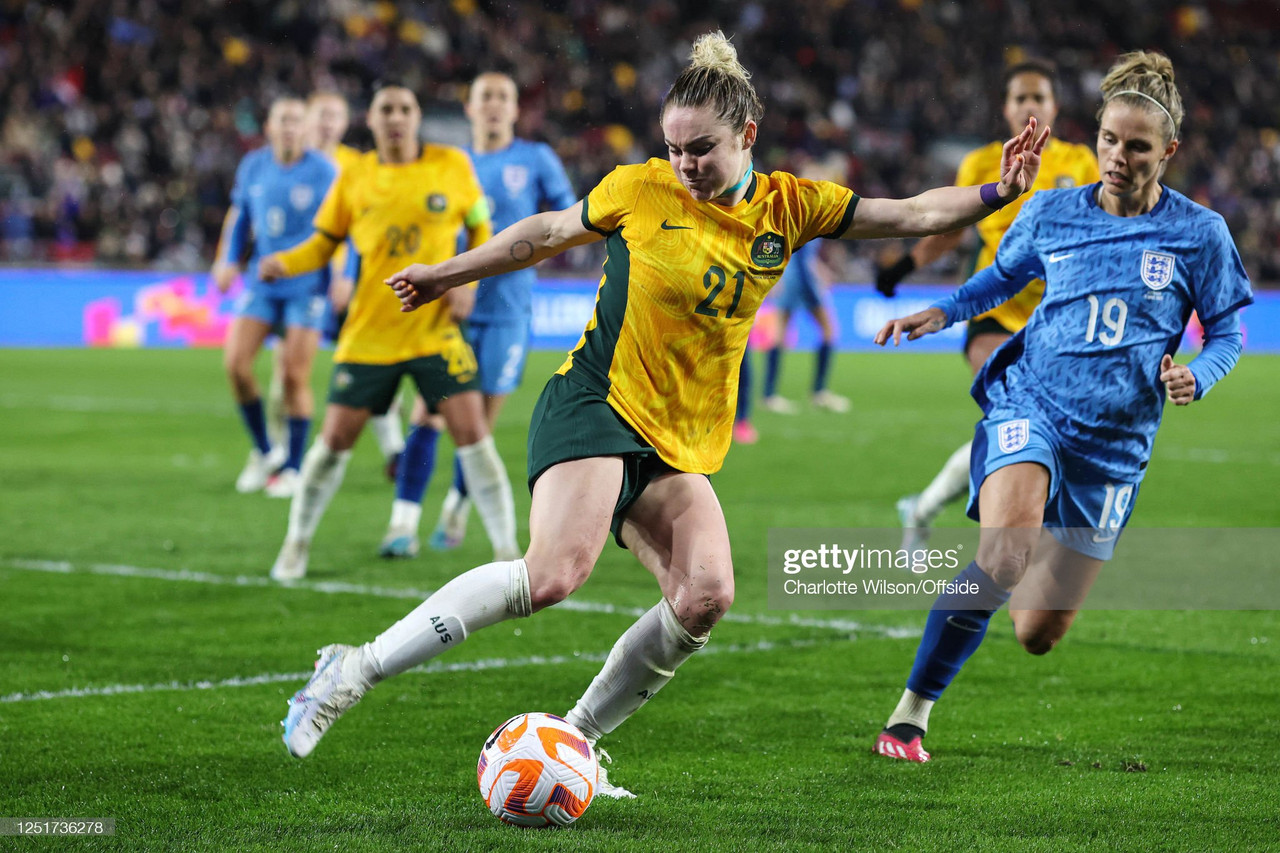

Saturday proved to be a nervy day for both sides, with the Matildas narrowly progressing following a game of endurance against France in Brisbane that was eventually decided by a shoot-out of 20 penalties.
The Lionesses on the other hand didn’t need as long a game, but this didn’t stop the nerves from flowing as they had to come from behind to defeat Colombia 2-1 in Sydney, with goals from Lauren Hemp and Alessia Russo cancelling out Leicy Santos’ initial effort.
Of course now however, the weight of the world will be on Australia to once again defeat England and progress to their first-ever final, something that many people favour them to do in front of a large and very partisan crowd, a factor that could potentially throw the English off and make it a difficult night for Sarina Wiegman’s side.
However, the European champions have become known as a frustrating side to watch throughout this tournament, with a valid question being whether or not they can turn this into a positive for themselves and frustrate the Matildas to the point where they can squeeze out another victory and set up an all European final against Spain.
-
Time for a tactical change at the back?:
Throughout the knockout stages of the tournament, England have typically opted for a three-at-the-back formation for their defenders, a tactical decision that gives pretty much perfect cover in the middle and is a vital asset in stopping the strikers.
However, it also leaves the wingers with much more space, something that with the likes of Hayley Raso and Caitlin Foord taking up those positions for the Australians, could be a real problem for England.
This begs the question of whether or not Wiegman should opt for a return to the four at the back that helped deliver victories over Haiti and Denmark in the group stages, albeit these victories were far from pretty.
Whilst this option could help limit the creativity of players such as the ones mentioned, this could also result in Rachel Daly being moved back to the left-back position for the second time this tournament, something that could majorly affect the Lionesses’ attacking options, even if she hasn’t been overly clinical.
This could also bring back many of the problems that plagued those group-stage games, something that many people believe that had they been against stronger and more clinical opposition, could easily have resulted in defeats.
The decision on whether or not to revert to this tactic is simply up to the manager, and all we can do is wait and see what she does.
-
The critics will be watching:
An odd sensation that affects this England side is that they’re seemingly immune from intense media and fan scrutiny, something that couldn’t be further from the truth for the men’s side.
Whilst some journalists and critics haven’t been afraid to speak out and question areas such as Wiegman’s tactics or the Lauren James incident in the Round of 16, they’ve been met by a barrage of optimistic counter-arguments from other outlets.
Another case of this happening came during Saturday’s quarter-final after Mary Earps’ goalkeeping left a lot to be desired in the build-up to Colombia’s opener, a factor that many critics weren’t afraid to point out, even if the English did equalise just minutes later.
Much like other issues during the tournament however, these critics were met with a barrage of abuse from other critics and fans that seem afraid to admit and bring to light the problems with the Lionesses’ campaign.
This shows that many people are still riding high following last summer’s Euros success and perhaps aren’t used to seeing the team struggle in the manner they have, but quite simply, the criticism is needed in order to show the team that they aren’t invincible and can’t be complacent, especially at this late stage of the tournament.
-
Time to start Kerr?:
Since the beginning of the tournament, one of the biggest talking points as a whole has been the fitness of the Matildas’ poster girl, captain and star striker Sam Kerr, who picked up a calf injury just before her team’s opening game.
Despite this however, Australia have still put on some impressive displays throughout the competition and have looked like a more than capable side, with Raso leading the team’s scoring charts with three goals, whilst Arsenal’s Steph Catley has two of her own.
The extent of Kerr’s injury and fitness has been a tightly kept secret, even since her return to playing as she came off the bench against Denmark and France, leaving many to wonder if she’ll start a game at all.
However, especially given the level of ability and determination in the England side, it is clear that if she is fit and ready that Kerr should probably start the game, particularly given how well she broke down the same opposition back in April.
Because of her impressive showing in that game and especially given it was on English soil, there is every reason to believe that should she play this time, the backing of the home crowd and the stakes surrounding the game leaves her in prime position to put in one of her greatest performances and guide her country to their first ever World Cup final.
Explore more stats, standings and news on VAVEL Data: Womens Football
