



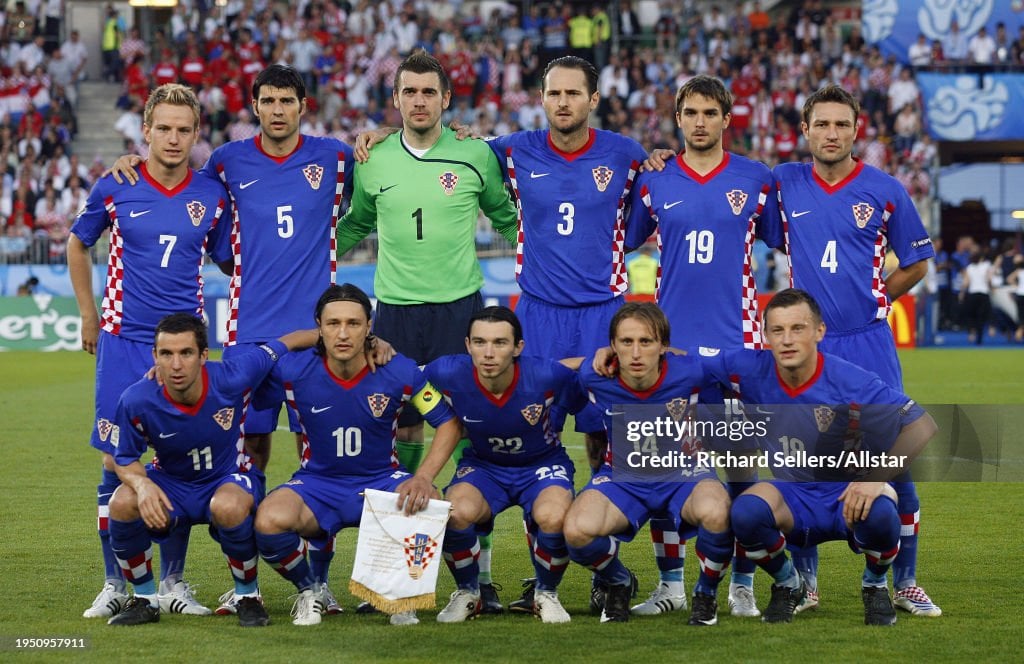

Croatia arrive in Germany this year knowing it will be the last tournament for a handful of iconic players who have guided the nation to unthinkable international highs, poignantly in the World Cup.
A country with a population of under four million has no right to compete at the business end of these tournaments. It might surprise many that Croatia is yet to progress past the quarter-final stage in any European Championship.
This is the time for Hrvatska to make a mark in Deutschland. A tricky draw in Group B with champions Italy, Spain and Albania means it will not come easy.
Either way, captain Luka Modric is surely entering his last dance in the chequered red and white. Internally, motivation will be high in the squad to send off their greatest-ever player appropriately.
Sixteen years and four European tournaments ago, Modric made his debut in the European Championship. This was the beginning, and a new hope for Croatia in terms of actually making a mark in tournaments rather than just making it there.
After a group-stage knockout in the World Cup two years prior, it was time to turn a page in 2008.
-
The Group
Identically to Euro 2024, Croatia was drawn in Group B. The opposition this time consisted of co-hosts Austria, Germany, and Poland. Unquestionably a challenging group, the expectation was not that Croatia would sail through to the knockout stages.
Germany were favourites in this group without a doubt. A third-place finish in the World Cup beforehand meant they were one of the favourites. Legendary names such as Jens Lehmann,, Miroslav Klose and Michael Ballack were ready to tear through this group.
Austria and Poland were beatable sides for Croatia, but with the former hosting, it could prove to be a difficult away game of some description. Croatia had a blend of experienced, yet ageing players with a mix of exciting youngsters.
The Vatreni had a handful of recognisable names, particularly from one Premier League side. Three soon-to-be Tottenham Hotspur players were regular starters. Full-back Vedran Corluka and midfielder Luka Modric moved to North London after the tournament, with Niko Kranjcar in the squad but at Portsmouth under admirer Harry Redknapp at the time.
Ivan Rakitic was also in the squad but at Schalke at the time. Brothers Robert Kovac and Niko Kovac were also featured in the selection. Niko was the captain aged 36, and briefly managed Bayern Munich in 2018-19 after spending two years of his playing career at the club.
The blend of youth and experience certainly made Croatia one to watch in Euro ’08.
-
The Manager
After managing Hajduk Split and the Croatia under 21s, the well-known Slaven Bilic was handed the job in 2006 to turn the fortunes around for Croatia. His career in England afterwards was well documented with West Ham, West Brom and Watford as recently as last year.
The Croat currently manages a Saudi Arabian club, Al-Fateh. Bilic made 44 caps for the national team and is well-revered for his tough, no-nonsense management style.
Slaven Bilic succeeded Niko Kranjcar’s father, Zlatko who passed away three years ago. It was the time for Croatia to step up in tournament football with a young manager and an exciting squad growing.
Bilic continued to manage Croatia until 2012 after the tournament, a testament to his impact.
-
How did they do?
When your first game is against the host country the difficulty level rises. An inexperienced Croatia team walked out to a packed Ernst-Happel Stadion in Vienna with Austrian flags waving from all four sides of the ground.
This was an away game at a European tournament with the atmosphere aggressively pro-Austrian. However, Croatia did not wait to leave their mark.
Only three minutes in, Ivica Olic was taken down by Austrian centre-half Emanuel Pogatetz in the box and Croatia had a chance to silence the crowd.
Baby-faced Luka Modric stepped up with authority. Boos serenaded him as he waited for the referee's whistle. Nothing too glamorous, the midfielder waited for goalkeeper movement and rifled it home straight down the middle. Croatia lead, and the pocket of away fans erupted jubilantly.
Truthfully, the rest of the game was not a thriller with both teams missing plenty of half-chances. Croatia survived some late scares and celebrated relievedly after taking a crucial opening three points.
That feeling of relief was likely because of the intimidating encounter against Germany next up. With big names and fierce competitors, Deutschland would not mess around.
Croatia wanted to make history in Klagenfurt. Darijo Srna bundled in a delicious back-post cross and put the Croats in the lead in the 24th minute. The chances kept arriving, and Slaven Bilic could scarcely believe the performance he was watching.
The second half arrived, and Croatia maintained their dominance. A deflected cross bounced off the post and fell perfectly to Ivica Olic, who tapped in and wheeled away in disbelief that his home nation was about to sink the titanic Germans.
Croatia nervously but heroically defended their two-goal advantage. A bleach-blonde-haired Bastian Schweinsteiger came close to reducing the arrears, but Germany struggled to unlock a stoic Hrvatska.
Lukas Podolski eventually did with a powerful strike, but it was too little, too late for Germany. Bastian Schweinsteiger was sent off for a shove as the losers appeared sore. Slaven Bilic could not contain his excitement at full-time, jumping up like a child on Christmas. Croatia had qualified for the knockouts for the second time.
Croatia did not need to win their final group stage game, and therefore rotated but still did. Ivan Klasnic scored in a 1-0 win to secure a perfect nine points out of nine and first place in the group.
The quarter-final against Turkey was brutal for Croatia. A handful of blatantly missed chances saw the game go to extra time. Luka Modric excelled in this game and weighted a fantastic cross to Klasnic who nodded home in the 119th minute.
The commentator's words: “It’s Ivan Klasnic who sends Croatia surely into the semi-finals”.
120+2. In the final minute, Turkey broke Croatia and scored sending the tie to penalties. Inexperience showed as the Vatreni missed three of four penalties and were knocked out.
It was a sad, yet proud day for Croatia, who had come a long way.
-
The Star Player
Luka Modric had no right to carry his country on his back at the age he was. The signs were on display of a future star, and he delivered a masterclass, particularly in the Turkey fixture despite missing his penalty.
There were experienced players in that squad but from watching the moments of the tournament he was already showing that age was just a number to him.
He was evidently ready for a big transfer at that point, and the rest of his career was a footballing dream lived out. Most recently winning his sixth Champions League for Real Madrid, his influence and impact on Los Blancos has been remarkable.
-
How did their 2024 qualifying go?
Croatia finished second in a group which contained Turkey and Wales as their primary competitors. They kept up a streak of qualifying for every Euros since 2000.
Most label Croatia as a dark horse before each tournament, but truthfully, they are obvious contenders on each occasion nowadays following their recent record.
