



During the first half of the year, there was a great deal of uncertainty surrounding football in Wales.
Rob Page and Gemma Grainger, long-term coaches of the men’s and women’s sides respectively, left the managerial posts having guided the country to places previously unforeseen by the Red Wall.
Page led the men’s team to a first World Cup in 64 years after reaching Qatar but failed to build on such a feat, eventually losing his job after a series of disappointing results - not least the penalty shootout defeat to Poland in March, which ended hopes of qualifying for a third successive European Championship.
Near misses also proved costly for Grainger and the women’s team. On the cusp of reaching the 2023 Women’s World Cup and a major tournament for the first time, they conceded a 120th-minute winner at the hands of Switzerland in their second leg playoff.
Now having completed another year of international fixtures, both of the senior sides are in hugely promising and record shattering territory.
So how did Welsh football turn itself around within mere months?
-
Craig Bellamy's front-footed revolution
While Page achieved something remarkable in taking Wales to football’s biggest stage, the lack of a cohesive playing identity and tactical shortcomings ultimately proved too much of a hurdle in the way of progress.
Gareth Bale hanging up his boots was always a dilemma Wales would have to face at some point, but the immediate aftermath of his and midfielder Joe Allen’s absence was marked by inconsistency.
Though only a shootout victory shy of qualifying for their third consecutive tournament under Page, the writing was seemingly on the wall by June following a goalless draw with Gibraltar and 4-0 humbling in Slovakia.
The Football Association of Wales (FAW) were linked with a slew of managers in the wake of Page’s sacking - from former assistant Osian Roberts to Steve Cooper to Thierry Henry.
The eventual pick was former captain Craig Bellamy, who had been quietly developing a strong coaching CV since being passed up for the top job in 2018, working as part of Vincent Kompany’s setup at Anderlecht and Burnley.
The assumption was that he would either follow the Belgian to Bayern Munich or take up the reins at Turf Moor himself. Though the opportunity to fulfil his “ultimate dream” of becoming Wales manager was too good to miss.
Being under the tutelage of Kompany, - whose tactics stem from Pep Guardiola - the intent to make Wales a possession-dominant, high-energy outfit was evident even in his opening game against Euro 2024 quarter-finalists Turkey.
There were some teething problems in converting chances but it was clear his vision revolved around core principles of aggressive pressing and dictating the game - something quite alien to the Dragons given how stretched out and disjointed they were on the ball during the tail end of Page’s tenure.
Half a year into the job and it has been a dreamlike beginning to life as a head coach for Bellamy, having gone unbeaten in six outings and earning promotion to the top tier of the UEFA Nations League.
There is a boldness with the ball and an acumen without it that sets Bellamy's side apart from Page's. A real belief that this style of play suits this current crop of players and can push the nation even further into major tournament territory.
There have been sprinkles of good fortune on the way, such as a missed penalty from Kerem Aktürkoğlu to keep the score level in Turkey last month and some wayward Montenegrin finishing in Nikšić.
However, this has been paired with struggles too. The loss of defensive midfielder Ethan Ampadu was an unfortunate miss given how integral the Leeds United captain looked to Bellamy’s initial plans.
Oli Cooper and Aaron Ramsey’s injuries also left further holes in the middle, but the performances of Josh Sheehan and Jordan James, as well as star player Harry Wilson dropping deeper at times, have meant this issue has been largely navigated soundly.
Keeping to Bellamy’s vision for a full 90 minutes is another new challenge this squad has had to adapt to quickly, with some wobbly moments coming in the matchups against Montenegro and the 2-2 draw to Iceland as a result. The latter of which is perhaps the only blot on Bellamy’s showings so far.
A surprise Turkey defeat away at Montenegro may have paved the way for promotion, but that was not without a 4-1 hammering of Åge Hareide's men on home turf. A stylish way to end a rewarding campaign.
Group 4 provided a good mixture of opposition to test Wales and the same can be said of their World Cup qualifying group. Winnable matches against Liechtenstein and Kazakhstan are coupled with tougher propositions in Belgium and North Macedonia.
Though with the form they have displayed thus far, and the confidence they can take from past victories against the Red Devils in particular, it is a group the Dragons should be aiming to win. And it appears Bellamy is buoyant about their chances too.
“I’m happy, I have to be honest. It’s a good group," he said after the draw in Zurich. "We’re going to have to do our homework really well, and hopefully try and attack and finish top of the group.”
-
Rhian Wilkinson reaches the promised land
Earlier in the year, Wales Women were at a similar crossroads. Grainger resigned after three years at the helm to take the head coaching role at Norway having been a whisker away from leading the side to Australia & New Zealand for last year’s World Cup.
Canadian Rhian Wilkinson was appointed two months prior to the beginning of the Euro 2025 qualification campaign.
Similar to Bellamy, Wilkinson had amassed years of experience in youth and assistant coaching before taking the Wales job. Unlike Bellamy, she had already earned herself a trophy as a head coach before arriving in Cardiff, having led Portland Thorns to the 2022 National Women's Soccer League title.
An impressive start saw her side go unbeaten through the qualifying group stage, only tripping up with two draws against Ukraine but eventually topping the group with relative ease and a +15 goal difference.
However, the real target for Wales was always going to be overcoming the playoff hurdle that had inflicted so much pain on them in the past.
Losing long-time captain Sophie Ingle to a knee injury was an unwanted set back before any playoff ball had been kicked, although the question over who would replace her with the armband had been answered with Angharad James-Turner leading her country into these decisive final months of the year.
The playoff semi-final proved to be an immediate obstacle. Going 2-0 down to Slovakia during a lacklustre display in Poprad bore unwanted feelings of unease. Wales were expected to make light work of a side twenty-two places below them in the FIFA World Rankings, and their first leg struggles suggested maybe it would once again be a step too far.
Mercifully, Ffion Morgan latched onto a threaded ball from Jess Fishlock, curling in a crucial goal back in the final minute of normal time. The second leg in Cardiff was also far from straightforward, but was perhaps the ideal performance in galvanising a run to the Euros.
As so often the case, Fishlock was key, adding to her record goal scoring tally with a deft chip over the goalkeeper in the first half before looping over a key pass for the eventual winner in the depths of extra-time.
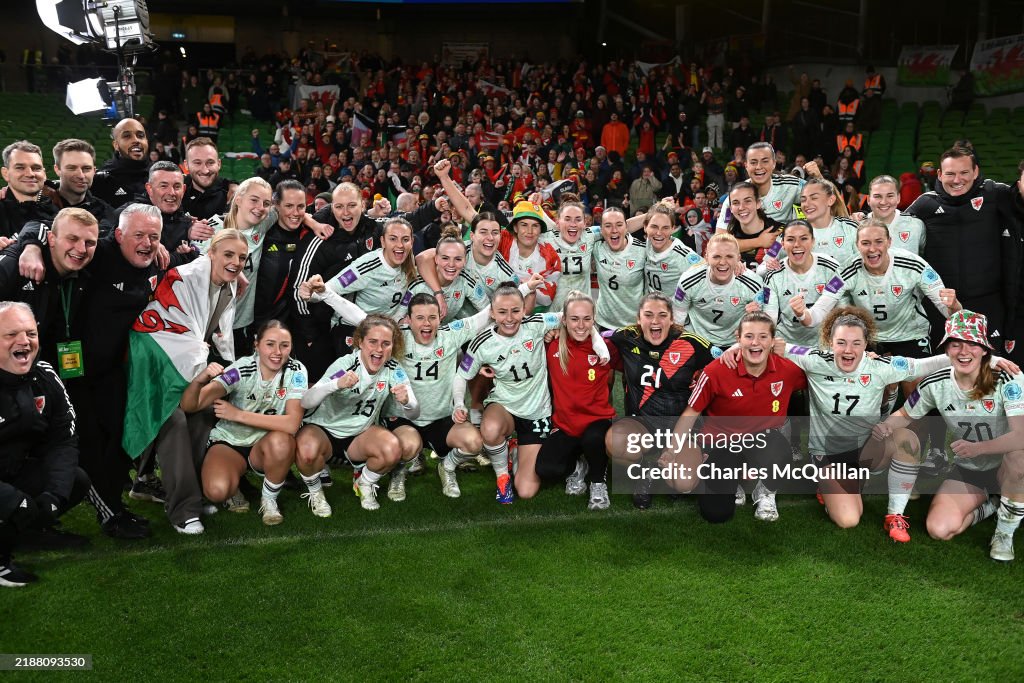
Ceri Holland buried a rebound from Kayleigh Barton’s post-rattling shot to eventually send the Cardiff City Stadium into delirium and Wales into the playoff final.
Their opponents were the Republic of Ireland - a side who have had a similar upward trajectory in recent years, having qualified for their first major tournament at the last World Cup.
The 1-1 draw in Cardiff was another instance of Wales not quite setting out their best selves in the first leg. Despite going ahead through talented full-back Lily Woodham,, a misfortunate own goal saw Ruesha Littlejohn’s speculative effort deflect off the bar and onto goalkeeper Olivia Clark before crossing the line.
Trepidation emanated from both side’s performance, but Wales not making the most of home advantage was potentially another reason to think the Dragons’ long-held ambition would go amiss. Though if there was anything to learn from the playoff semis, Wales weren’t ones for floundering second time round, as James-Turner attested to prior to the crunch game in Dublin.
“We know we'll be better for Tuesday. We have got a lot to work on and they haven't seen anything yet,” the 30-year-old told the BBC. “We'll give it everything for the red jersey and hopefully we can get over the line.”
As it would come to pass, Wales would go 2-0 up with twenty minutes to go in the reverse match. An energetic yet goalless first half swept by, with Ireland coming closest through Denise O’Sullivan smashing the crossbar.
It was followed by a second that burst into life for Wales after Hannah Cain slotted home a penalty. An especially cool conversion in the circumstances, and given the Leicester City forward's lengthy spell on the side lines after multiple hamstring and ACL injuries.
A counter-attack finished by Carrie Jones later and Wilkinson’s women were in dreamland.
A final eighteen minutes of arresting tension saw Ireland grab a goal back through Anna Patten and the hosts pushed valiantly for an equaliser, but would fall short.
It was Wales’ night. It was Wales’ time.
A journey that began fourteen years prior with the recruitment of Jarmo Matikainen, the team’s first full-time manager, and had continuously tried to build on the work of each head coach.
Now they will be flying to Switzerland for next year’s Euros, with a baptism of fire awaiting them in Group D: neighbours and reigning champions England; 2017 winners the Netherlands; 2022 bronze medallists France.
-
2025
Welsh football has had an almost complete 180° from this point last year.
New coaches bringing fresh ideas, rejuvenating styles of play, and the motivation needed to take that next step.
2025 is going to be a bumper year, with the Women’s Euros and the challenge of reaching a second consecutive men’s World Cup for the first time in history - both of which could prove to be further instigators in the development of Welsh football.
That is certainly the case for the women’s team, whose overcoming of the major tournament barrier will hopefully be the catalyst for more fandom and attention akin to the men’s side - something that Wilkinson commented on recently.
"I think I'm probably going to start getting people annoyed and angry at me because I love Wales and I've talked at length about how much this country means to me … but culturally we're behind, we are behind and it's a frustration," she told BBC Sport.
"We broke an attendance record, I want more. And that's a frustration for me, because I think it's this weird idea that people have in their minds here.
"It is just taking longer than I would like for it to, for people to recognise what's right in front of them. They are missing this incredible generation of players."
Success at Euro 2016 prompted waves of support for the men’s team, with the ‘Red Wall’ being coined to describe the ardent followers that emblazon the stands at any Wales game since.
Though reaching the semi-final, as Chris Coleman did, is unlikely, especially given the tough group they have been drawn into, the aim is that finally being at an international tournament will spur on a similar surge in ticket sales and national notoriety. The record 16,845 fans attended the first leg against Ireland, however, that is still some way short of the 33,000 capacity.
"I hate this men versus women argument, I've spoken to Craig [Bellamy] at length about it. I am as big as supporter of his, as he is of mine, and there's no need for comparison," Wilkinson noted.
"We are Welsh, we are proud of being Welsh, we are proud of Welsh sport. Your Welsh women's team is on the world stage. Come and support them.
"Get rid of all this other story you've got in the back of your head. It's time to step forward and just support our female and male athletes equally."
This level of excitement surrounding both teams simultaneously is something Wales has not yet experienced, but these watershed moments are required if the Dragons are to become a major footballing nation. After all, 'Together Stronger' has been the tagline for the team for nearly a decade.
"I don't want us to just be a good national team, I want to be one of the top international teams," Bellamy said after achieving Nations League promotion.
"We don't just want to go to major tournaments, we want to have a big impact at major tournaments."
2025 will be an even more pivotal step in attaining that goal. And given how 2024 began, Welsh football fans can look ahead with a great deal of optimism.
