


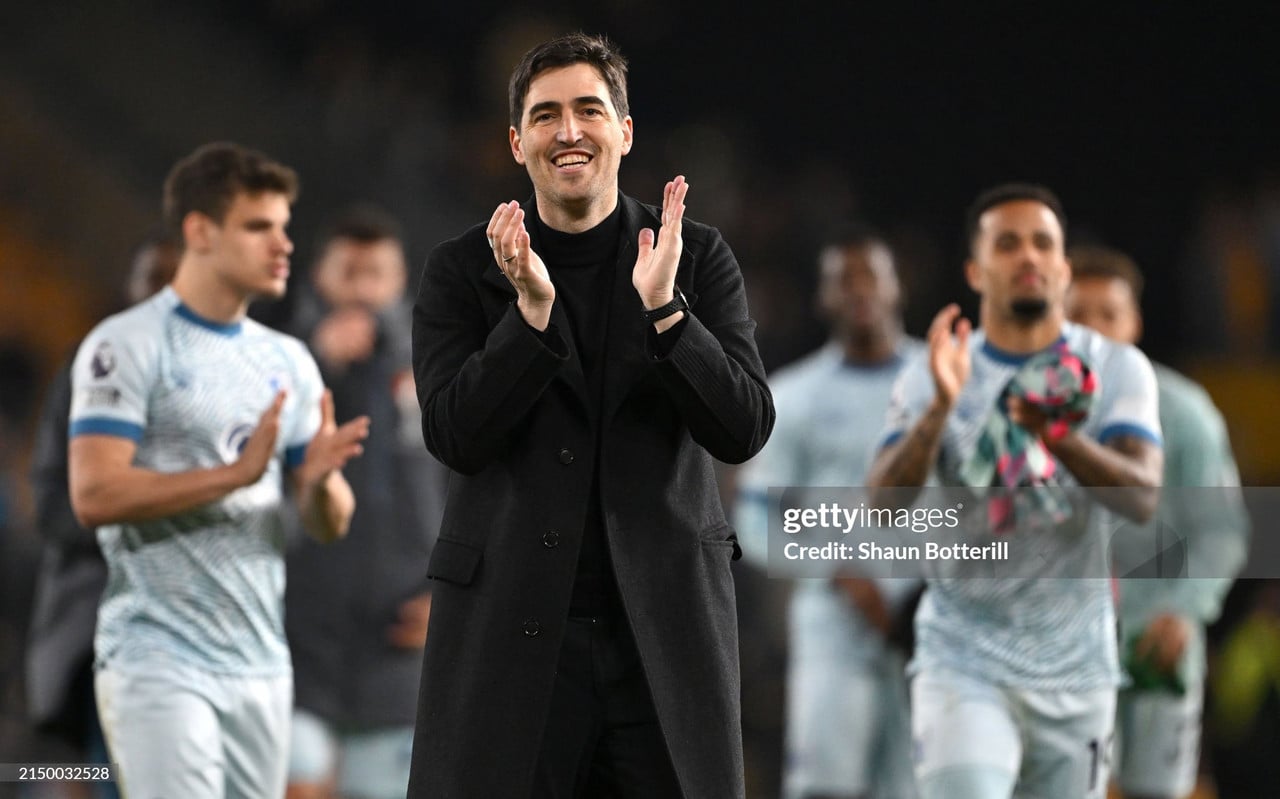

After amassing a record Premier League points tally and staking a claim to have one of the hottest strikers in England right now, it is fair to say that Bournemouth fans have never had it so good.
Andoni Iraola’s ‘organised chaos’ style of football has left Bournemouth fans yearning for the next fixture all season with impressive results and performances against the likes of Manchester United, Brighton, Newcastle and an amazing four-goal comeback at home to Luton Town.
With an ambitious owner, an up-and-coming head coach, a team full of hardworking potential and a full-throttle style of football, Bournemouth fans are in dreamland with where their club is going and that is not to mention the new stadium plans and world-class training facility currently under development.
With all this having taken shape in the last year, there is a buzz around the town, with fans indulging in conversations about the club’s future rather than looking back at what once was under club legend, Eddie Howe.
-
The Eddie Howe legacy
To understand what Eddie Howe means to Bournemouth, we should head back to 28 December 2008.
Sitting 23rd in League Two, having only just entered positive points after a 17-point deduction, Bournemouth hosted fellow relegation rivals Barnet at Dean Court in a tense affair.
The performance was poor and the mood was glum as a fresh-faced Albert Adomah scored twice to hand Barnet all three points in a 2-0 win.
Wondering where this would all end, Bournemouth fans feared the worst, knowing that relegation to non-league would almost certainly mean an end for their debt-ridden club.
Acting fast, the board decided to sack manager Jimmy Quinn and appoint former player and current youth coach Eddie Howe as caretaker manager for the foreseeable future.
Howe lost his first two games as caretaker but that did not stop him from eventually becoming Bournemouth manager and writing himself into club folklore, saving the Cherries from non-league oblivion in their penultimate game of the season against Grimsby Town, where club legend Steve Fletcher smashed home the winning goal.
From there, Howe took the club from 23rd in League Two in 2009 to 9th in the Premier League just eight years later in 2017 - Bournemouth’s highest-ever league finish to date.
Howe managed Bournemouth for ten years and 458 games, achieving three promotions and five consecutive seasons in the top flight - an unthinkable achievement, even for the most optimistic Cherries fan.
The Amersham-born but Verwood-raised Howe became everything Bournemouth was and his influence reached into every area of the club, captivating the town.
The football was fast and attacking, with two strikers and relentless overlaps, runs and through-balls, often completely overwhelming teams.
It was addictive to watch with a sense of consistency in tactics, staff and players making it seem as if the dream would never end - until it did.
Howe left Bournemouth after their relegation to the Championship in 2020 and without being able to say ‘goodbye’ to the fans due to Covid-19 restrictions.
It left a gaping hole in the club’s leadership and a huge sense of loss amongst the fans, who were unable to thank their hero for what he had achieved during his ten years.
AFC Bournemouth had abruptly entered a new era and needed to adjust to life beyond Eddie Howe.
-
A managerial merry-go-round
On the back of relegation and Howe’s resignation, Bournemouth searched for some stability amongst the fallout.
Not only had the club’s long-serving manager left, but so did a whole host of top talent and key players like Nathan Ake, Aaron Ramsdale, Callum Wilson and Harry Arter. Everything changed in an instant.
As a result, the natural replacement appeared to be former assistant manager Jason Tindall, who had not left with Howe.
But a lack of managerial experience and a much-changed squad led to frustration with results and performances from the fans, and Tindall’s reign ended as soon as it started just six months later in February 2021.
First team coach, Jonathan Woodgate, took interim charge of the side for the remainder of the season, which ended in disappointment as the Cherries lost to Brentford in the Play-Off Semi-Finals.
What was clear by this point was that the club could no longer live off legacy, and had to find a way to move on from Howe.
-
Enter Scott Parker
Parker’s appointment was lauded by fans and the football community alike - a young manager who coached possession-based football.
Bournemouth fans were certainly hopeful for what could be.
In his first season, Parker led Bournemouth back to the Premier League, but enthusiasm waned in his second term with transfer complaints and public criticism of the squad, especially after a 9-0 defeat to Liverpool.
Relations strained with the club, players and fans, leading to his swift departure.
Moreover, ‘Parkerball’ was often criticised for being slow and uninspiring, out of sync with Bournemouth’s typical fast, attacking football.
Bracing themselves for a very long Premier League campaign, Bournemouth turned once again to a coach as caretaker manager - Gary O’Neil, who was given the position permanently and kept Bournemouth up.
O’Neil was praised for picking up the team and leading them to safety in his first managerial job.
But whilst this achievement was acknowledged and appreciated, the fans yearned for something more.
They yearned for the return of thrilling, fast, free-scoring attacking football, like they knew under Howe.
-
Football under Iraola
After the appointment of Andoni Iraola on 19 June 2023, expectations were high.
Iraola had played football under Marcelo Bielsa during his days at Athletic Bilbao, which is said to have heavily influenced his style of play as a manager - thrilling, fast, free-scoring attacking football or as others put it, ‘organised chaos’.
And these expectations turned into reality as the season progressed with pundits and fans praising Bournemouth for their brave, direct attacking style of play.
The Cherries finished the campaign with 54 goals - just two off their record Premier League tally and 17 more than in 2022-23.
Iraola’s influence on the squad was clear to see.
Big chances were almost double that of O'Neil's season in charge at 60, goals per game were up 42% and, overall, the team managed 184 more shots when compared with 2022-23.
And all of this occurred with roughly the same amount of passes per game, showing how much more efficient Bournemouth are at creating chances during games.
-
But what does this mean to Bournemouth fans?
Put simply, Iraola's impact on Bournemouth means everything.
After just one season, Iraola has managed to give fans something the previous four managers could not give after Eddie Howe - excitement and hope.
This has led to fans not looking at ‘what once was’ but rather ‘what could be’.
Fans reminisce about the Charlie Daniels and Marc Pugh partnership, no more out of longing but rather out of remembrance, knowing they are able to turn up on a Saturday and watch something just as exhilarating.
This, of course, does not mean that Bournemouth fans have forgotten about Howe and his astonishing achievements at the time.
Nor do they seek to disrespect the managers in between.
But after setting such a standard at the club and entertaining the fans weekly, Howe created a legacy very difficult to move on from - a situation that many clubs have struggled with like Arsenal, Manchester United, and now perhaps, Liverpool.
Under Iraola, there is a sense of a fresh era and that the club is entering a new phase of its existence, once again with a young manager and an exciting style of play, so it is needless to say that it is a promising time to be a Bournemouth fan.
The mood is optimistic, cheerful and full of excitement.
It will take a lot to beat a man who currently holds the freedom of the town, but Andoni Iraola is certainly on his way even after his first season and the fans back him one hundred per cent.
