



Manchester United were able to block out some of the noise that arose from their embarrassing defeat to Spurs last weekend with a convincing win against a spirited Nottingham Forest, who made life instantly difficult for the United players after scoring two rapid fire goals inside the opening five minutes.
The two goals from Forest came as such a shock due to the fashion in which the goals were conceded by United. United started the game in dominant fashion, with Antony testing Forest's goalkeeper Matt Turner with a shot on the edge of the box inside two minutes.
However, in a style that may have had many United fans flashback to just a few weeks ago in pre-season, as well as a few years ago in a Champions League group stage game against Istanbul Basaksehir, United managed to concede a hilarious goal from their own corner to an in-form Taiwo Awoniyi, who became Forest's first player ever to score in seven consecutive Premier League games.
Forest's second goal came two minutes after Awoniyi's and this time was a result of a Forest set-piece rather than a United one. The goal in totality was rather simple, as Willy Boly himself seemed bemused that he'd managed to head the ball into a helpless Andre Onana's net.
The United players were able to lift themselves regardless and found themselves a goal down after some very positive wing play from Marcus Rashford, who confidently brushed past Serge Aurier to assist Christian Eriksen, who was brought in for the recently injured Mason Mount.
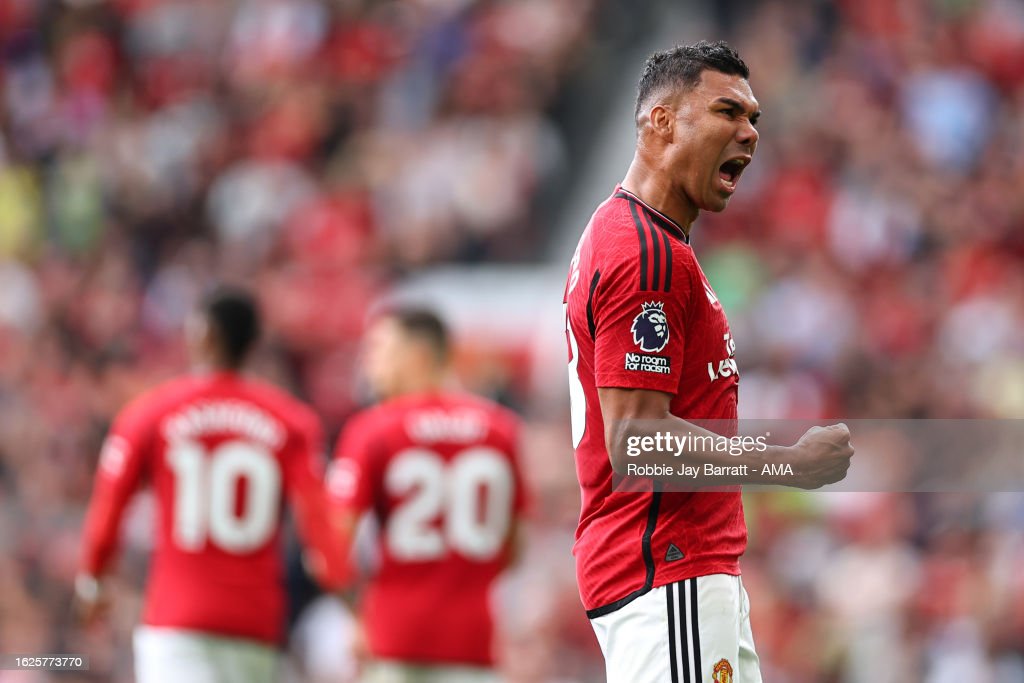
The second half was practically symmetrical to the first as United came out of the blocks firing, not repeating the mistake they made in North London of allowing their opposition to grow back into the game. United's efforts were eventually rewarded through goals from Casemiro and the skipper Bruno Fernandes, who put away a penalty after Joe Worrall was sent off for denying a goal-scoring opportunity.
After what was, above all, a highly energetic and entertaining game, here are the four things we learnt from today's game.
Rashford on the wing benefits the whole team
The first two games of the season had only reinforced the fact that Rashford is largely uncomfortable playing as a striker, especially against blocks that are tough to break down. He offered very little against Wolves on opening night and in the second half against Spurs he was virtually nonexistent.
Rashford played like he had an immense weight lifted off of his shoulders today, with the majority of his actions being positive and meaningful. The assist for Eriksen came as a result of Rashford taking responsibility and driving at Aurier.
Playing on the wing also appeared to give Rashford more license to be fairly nomadic in the positions he took up on the pitch, as multiple points in the game saw him drift infield and even swap positions with Antony permanently for the final minutes of the first half. This subsequently allowed him to get on the ball more.
It was obvious how much Rashford being wide benefited the team's overall attacking play, as his freedom to roam the final third provided players like Fernandes and Eriksen with a useful outlet to give more players the opportunity to storm the box for chances.
Ten Hag's second half tactical switch helped United effectively sustain pressure
In the first half United's buildup was nuanced. For the first ten minutes or so United built up in a two (Lisandro Martinez and Raphael Varane) with three receivers in front of them because Diogo Dalot was inverting and Aaron Wan-Bisssaka for the most part was staying wide. This structure helped in overcoming the density of Forest's low block.
As United became more threatening though (leading to Eriksen's goal), Dalot began returning wide to aid Rashford on the left whilst Fernandes and Eriksen for the most part became the main receivers for Martinez while Varane remained deep. This tweak likely happened as a result of growing confidence from the United players that they would score, as there became more of an overload on the wings, rather than the centre.
In the second half however it became evident that Casemiro was already beginning to struggle in keeping up with the intensity of the game. As a remedy, United started building up in a three (Martinez, Casemiro and Victor Lindelof) and had only one receiver in the mid 3rd (Dalot or Eriksen). Again, this 3-1 buildup structure was a result of United's growing confidence in equalising.
With Casemiro dropping deep as the CCB in the three (covering zone 14), it put more of an emphasis on his passing rather than his ball-carrying. The tactical switch evidently alleviated the Brazilian of some buildup pressure, and allowed him to focus mainly on his vertical and diagonal passing to feed the multiple attackers flooding the final third. He completed 85% of his passes (he completed 81% of his passes against Spurs).
Forest were too reliant on Awoniyi to score
It was difficult for Forest to win the ball back for most of the game, especially when United were circulating possession with relative confidence. This helped in seriously limiting any chances for Awoniyi to score, and this proved to quell any supposed threat Forest would've been banking on particularly in the second half.
For most of the first half Awoniyi was Forest's out-ball, which in one vein was understandable as Awoniyi was a willing runner throughout the game, not just the first half. However, this also speaks to how poor Brennan Johnson was, because whenever he tried to become an outlet he failed to do anything worthwhile with the ball at his feet.
United's rest defence also played a significant factor in nullifying the influence of Awoniyi and Morgan Gibbs-White. In the rare instance that United lost the ball to Forest, Martinez would immediately drop a few yards deeper to aid Varane since Dalot was so high up. Awoniyi was intentionally targeting Martinez to pin for obvious reasons, but Martinez was up for the fight and refreshingly aggressive in his duels.
Forest were very poor in and out of possession
It was always going to be immensely painstaking to hold onto a 2-0 lead for 85 minutes at Old Trafford, but Forest made it rather simpe for United to move the ball around their final third and create chance after chance.
Forest didn't have the required qualitative profiles to be able to withstand United's pressing structure, and it showed with the evident lack of tempo controllers in the Forest midfield. Perhaps the Forest player most affected by this was Morgan Gibbs-White (arguably their best player currently). Due to Forests lack of care in possession, he was restricted to only 54 touches, roughly half of the touches Bruno Fernandes had, even though they both do their best work in the final third.
The cohesiveness of United's pressing structure as well as their buildup structure proved too well-oiled for Forest to be able to counteract, as the Forest players at times even looked rather confused when it came to consistently tracking United's players. The addition of Andrey Santos on loan from Chelsea could help alleviate some of Forests issues when defending well-structures presses, as stylistically the young midfielder's profile is very similar to that of Casemiro.
