



“The managers who were good to me were the ones who just let me do my stuff. You give me the ball and I do the rest.”
At times it really was that simple.
From the second he touched down on English soil, joining Newcastle United in 1995 to become only the second Frenchman to grace the Premier League after Eric Cantona,it became clear that with a football David Ginola could make magic happen.
Within four games he had captured the Player of the Month award for August; within four years he had captured the hearts of adoring fans from Tyneside to Tottenham and beyond. With a face and torso sculpted by angels and two feet, equally-imbued with a divine brilliance, the man Johan Cruyff would go on to describe as the best footballer on the planet, was a superstar right from the start.
Ginola’s arrival to the English game coincided with the notorious Bosman ruling, which opened the floodgates for a whole wave of exciting foreign imports to dazzle our shores in the years that followed.
When Kevin Keegan flew him in to be the icing on the cake to his famous ‘Entertainers’ side, Ginola would make history as the Magpies’ first ever Frenchman.
There was something of a culture shock on both sides. “When I arrived there”, Ginola told TalkSport in a 2012, “I realised, well, they don’t speak English in this part of the world”.
As if acclimatising to the Geordie accent wasn’t enough to digest, Ginola has also since spoken of his bemusement upon being made to watch Only Fools and Horses (before learning to love it) while Rob Lee recalls Ginola smoking on the team coach or sipping red wine while all his teammates chugged at their pints after matches.
The long hair, the designer outfits, the thick accent – he could not have been any more aggressively French without slapping you in the face with a baguette. Delboy and David might be the cross-channel collaboration we never knew we needed, but Ginola wasted no time forming lucrative partnerships on the pitch at St. James’ Park. He hit the ground flying and, within a matter of weeks, it was clear Newcastle had a star on their hands.
After starting life out as a more central player in France – a second striker or number 10 type – Keegan had stuck him out on the left wing in what was politely called a 4-4-2 but was unapologetically a 4-2-4 in execution.
It was a position he would embrace with both arms and never let go. With Newcastle screaming into the first half of the season with a devil-may-care brand of attacking football that delighted spectators, Ginola was at the heart of it and epitomised its exciting, free-flowing nature.
His swashbuckling dribbles down the wing, his jaw-dropping trickery on the touchlines and an ability to dumbfound full backs with either foot thrust him to the forefront of the English game and, in an instant, he was the talk of the Toon.
But it so nearly never happened at all; just weeks before his £2.5 million move, Ginola got a call from his childhood hero, Johan Cruyff, to discuss a move from PSG to Barcelona.
Unsurprisingly, the prospect of playing under the man whose poster adorned his wall as a boy and whose shirt number he wore as well as sharing the pitch with the likes of Luis Figo and Hristo Stoichkov was more than a little appealing.
Unfortunately, in the pre-Bosman era though, Barça had already maxed our their quota of foreigners and were unable to offload enough in time to make space. After talks with Inter, Bayern and Celtic, Ginola decided Keegan’s Newcastle showed the most ambition and off he went.
Ginola's 'Assassination of French Football'
Wherever he had ended up that summer though, it was clear his destiny laid outside of France. Just a couple of years prior, Ginola had been scapegoated by fans in his homeland for his role in France’s failure to qualify for the 1994 World Cup – thanks, in no small part, to a strangely melodramatic rebuke from manager, Gérard Houllier.
With qualification all but secured, Ginola – always with attack on the mind – overhit a cross to Cantona, deep into stoppage time against Bulgaria, rather than running the ball into the corner. This allowed a counter attack from which Bulgaria scored a late, late winner to end Les Bleus’ dreams of World Cup glory before they even began.
Houllier described the night as “the most catastrophic scenario imaginable”, going on to single out Ginola for further criticism:
“He sent an Exocet missile through the heart of French football and committed a crime against the team,” alleged Houllier in a bizarrely specific, almost poetic assassination of Ginola’s international career.
This virtually confirmed the end of Ginola in a France shirt at the age of just 26.
The French media would go on to dub him ‘the assassin of French football’ in the coming days to add further histrionics to the proceedings.
Football fans in England of a certain generation will likely remember the witch-hunt that unfolded against David Beckham in the aftermath of his France ’98 World Cup dismissal against Argentina – sensationalist headlines, burning effigies and the rest.
Ginola’s treatment wasn’t far off, only crucially without the heroic redemption arc that Beckham was allowed to etch into his script in the following years. “It is something which will haunt me for the rest of my life,” he wrote in his 2000 autobiography; “I believe a weaker person would have been destroyed.”
The parallels with Beckham continue; both players were ascending to the top of the English game at a time where the footballer and the celebrity were fusing together as one. Suddenly Premier League stars were the new movie stars.
With his Hollywood looks and modelling contracts flying in from all angles, Ginola, like Beckham, was thrown centre-stage in the blossoming tabloid circus of the mid 90s. From Cerruti suits on the catwalk to those infamous L’Oréal adverts, money, glamour and girls were everywhere he looked and Ginola could have easily succumbed to any number of distractions.
Teammate Keith Gillespie recalls Ginola ordering double amarettos at Julie’s nightclub in Newcastle while women were “queueing to drool over him”, and cult hero Tino Aprilla has spoken of how he and the lads would tell groups of local ladies that yes, Ginola would be at his house, to improve the chances of them going back.
Naturally, as with Beckham, the unprecedented levels of fame and attention called into question just how committed the Frenchman was and where his priorities lay, but for those who knew him well, they knew the football always came first.
Ginola’s Director of Football at Spurs, David Pleat summed it up well, remarking how “He [Ginola] would undertake extra training and was never in a hurry to leave – the cynics remarked that it was because he was standing in front of the mirror combing his hair for 30 minutes after other players had left, but that was not so. He loved the game.”
Ginola as an 'entertainer'
Newcastle’s explosive start saw them sit top of the Premier League table at Christmas, with Ginola on one wing and the prodigal Keith Gillespie on the other.
Both combined brilliantly with Peter Beardsley and fellow Summer recruit, Les Ferdinand, up front to produce a style of football that got the whole country talking, earning them the nickname ‘the Entertainers’.
Colombian cult hero Tino Asprilla soon followed, along with midfield general, David Batty. By late January, the Entertainers had a starring role in the nightmares of just about every Premier League defender in the country and had generated a seemingly insurmountable lead at the top of the table with 12 points separating them from second-placed Manchester United.
What followed was a capitulation that has gone on to define that team almost as much as the beautiful attacking football they played.
A resurgent Man United side started chipping away at the Magpies’ lead, galvanised by the return of their own Frenchman, the talismanic Eric Cantona, back after a lengthy suspension, having shown a spectator at Selhurst Park his very best Chuck Norris impression nine months earlier, his only regret being - ‘not kicking him harder’ in King Eric’s own words.
A lone Cantona goal was enough to take all three points as well as Newcastle’s unbeaten home record at St. James’. Shortly after, a famous Stan Collymore winner rounded off a 4-3 loss at the hands of Liverpool in an Anfield classic considered by many to be the Premier League’s best ever.
Cantona’s heroics and Alex Ferguson’s world-class mind games combined to shake the foundation of the runaway league leaders, eventually leading to a now iconic Sky Sports outburst by boss Kevin Keegan – “I will love it if we beat them” and so on. Sadly for Keegan, beat them they did not, as back-to-back draws to see out the season saw Newcastle hand the title to the Red Devils right at the death.
What Keegan may have lacked in nerve, he made up for in a willingness and ability to let attacking flair flourish and in getting the best out of players like Ginola.
Cruyff's desire for Ginola at Barcelona
Perhaps that’s why when Barcelona came knocking for a second time the following summer with a big bag of money (reportedly £12 million), Keegan put his foot down and insisted that he simply could not let him go. The previous year Ginola had flown out to Spain to play a round of golf with his hero Cruyff before the Dutchman took Ginola back to his house, sat him down and told him, in no uncertain terms, “you are my priority”. Cruyff even talked about having to ship out megastars like Gheorghe Hagi or Hristo Stoichkov to make way for him to give you some idea of the esteem in which he held his talents.
“Cruyff was my idol.” Ginola told The Chronicle in 2010, “his was the only poster I had on my bedroom wall as a kid. He was sitting opposite me saying, “You remind me of me, when I was playing”…”.
A few years later Cruyff would go on to describe Ginola as the most exciting player in the world – this at a time where he was sharing the world’s stage with talents such as Ronaldo, Zidane, Bergkamp and Weah to name just a few.
This time around it was Bobby Robson leading the charge to secure his services in what Ginola, then aged 29, recognised as realistically his last chance to join the Calatans.
However, history was to repeat itself and once again he was denied his dream move to the Spanish giants. It was to prove the last time they came calling and so with Keegan having been so adamant that he form part of his plans the following season, Ginola was understandably let down when Keegan left the club only the following January.
Showing that Houllier was perhaps not the only one with a penchant for melodrama, Ginola later claimed he felt like he had been ‘stabbed in the back’ by Keegan, having been denied his final shot at a move to the Camp Nou.
Keegan was replaced by Kenny Dalglish and suddenly efficiency had leapfrogged entertainment in the pecking order. Crucially, it became clear early on that the team would not be built around Ginola and his brilliance – in fact the Scot seemingly didn’t even see him in his plans at all.
As it would transpire in the years that followed, pragmatic managers like Dalglish would become something of a recurring nemesis for Ginola throughout his career. With the Barcelona window having now shut for good and Ginola deemed surplus to requirements, after two great years in the North East he was on the move again, this time to the blue and white side of North London.
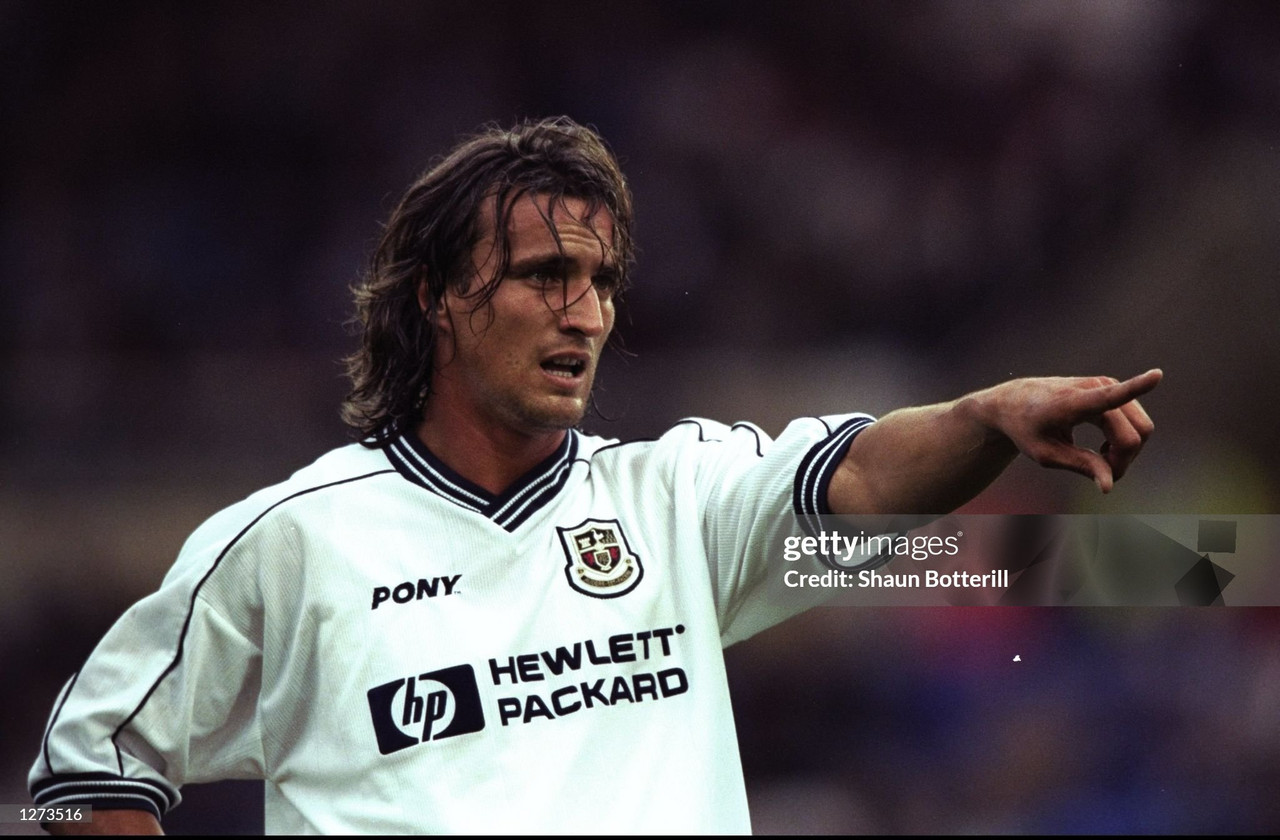
David Ginola at Tottenham
After hitching a ride on a friend’s speedboat off the shores of the South of France, Ginola sped off to join Alan Sugar for dinner on his luxury yacht, putting the finishing touches on his move to the capital, where he would be joined by teammate Les Ferdinand.
If he had been the jewel in a sparkly crown at Newcastle, at Tottenham he was better-described as a diamond in the rough. Before billion pound stadiums, title challenges and Champions League finals, Tottenham Hotspur in the late Sugar era were a picture of uninspiring mediocrity, living in the distant shadow of their ‘91 FA Cup Final win.
The squad was virtually unrecognisable from those who had left Wembley that day and had been on a steady decline ever since.
Captain and club legend Gary Mabbutt remained but it’s fair to say his best years were behind him. The rest of the squad was littered top-to-bottom with unglamourous water-carriers, has-beens and nobodies (with some exceptions).
Team talisman, Teddy Sheringham had joined Man United that summer after a highly-publicised saga and the few bright sparks that remained seemed to be past their peak or perennially plagued by injury. All this was overseen by the well-intentioned but ill-fated Gerry Francis in what was to be his final season in charge.
The season started as poorly as many had feared it would. Rather than push on from their mid-table finish the year before, Spurs found themselves staring down the barrel of a relegation battle by November, leading Francis to hand in his resignation.
Swiss coach Christian Gross came in to steady the ship and, in his first window, brought back a Spurs hero on loan – Jürgen Klinsmann – for a swan-song outing before hanging up his boots. Thankfully for Tottenham, an ageing, well-past-his-prime Klinsmann was still a force to behold and his goals were a huge part of why Spurs were able to claw their way back to a 14th place finish that year. The other huge part was, of course, David Ginola.
Much like he did at Newcastle, Ginola wasted no time in endearing himself to the fans at White Hart Lane. The Spurs faithful had been largely starved of the sensational arguably ever since the days of Gazza, so they welcomed any and every opportunity to be coaxed out of their seats and on to their feet – to stare in wonder at a moment of magic unfolding before them on the left flank.
Ginola and Klinsmann netted nine times each that season to ensure that Spurs finished just four points clear of the drop zone. Football is never an exact science, of course, but it would take a brave man indeed to suggest that they might have still avoided relegation had Ginola not climbed aboard Alan Sugar’s yacht that day.
It was Ginola’s second season however that will forever hold the fondest place in the hearts of most Spurs fans of the time and for which he is most celebrated.
The backdrop to the season for him personally was a bittersweet one.
Just weeks earlier, he had had to watch on from the BBC studios as a pundit, while his native France lifted their first World Cup on home soil – without him. Gary Lineker has since spoken about Ginola visibly having to hide his disappointment at having missed out, and Ginola himself has spoken about his conflicting emotions that night. “It was like stealing a dream from a kid. They stole my dream. Simple as that,” he said, adding that it is something he still thinks about every day.
The fact that Stéphane Guivarc’h immortalised himself in history as a World Champion while a fully fit Ginola, in the prime of his career, had to watch on holding a microphone might be one of the biggest crimes in modern football.
When the 1998/99 campaign rolled around, he was a man with a point to prove.
For a second season running (and in a developing Spurs tradition) an awful start to the year saw an early managerial change with Gross being replaced by the controversial appointment of Arsenal legend, George Graham.
Unlike Francis or Ardiles before him, Graham was viewed as a pragmatic disciplinarian with a reputation for putting defence first – to great avail it must be said. At the second club in a row, Ginola found himself answering to a manager who, it was expected, would demand such horrors as wingers tracking back to protect their full backs and one who might have the audacity to not build a team around him and his genius.
On paper, it looked like a match made in hell and, for many, spelled the end of Ginola at Tottenham. As it would go on to unfold, it was exactly that, but also, it very strangely wasn’t.
Divisive as the announcement may have been, the Scot delivered the bounce Tottenham needed to steer them safe from back-to-back relegation dogfights.
They would finish firmly mid-table in the end and reach the semis of the FA Cup that year, but critically, the ex-Gunner also helped to deliver that so elusive of treasures to White Hart Lane – a trophy.
As Alex Hess, writing for The Set Pieces, brilliantly put it:
“The Tottenham teams of that era largely functioned as a reminder to their fans that the word “passion” comes from a Latin word meaning torture and suffering. Aside from the football fan’s masochistic sense of duty, Ginola was all that kept the White Hart Lane faithful coming back each week.”
It’s hard to overstate quite how impressive an achievement it was to win double player of the year while dragging up a mediocre side and winning a cup, in a season that saw one of English football’s greatest ever sides make history.
Against the odds, Ginola had flourished under a manager so many had expected would hold him back. His relationship with Graham was a complicated one – listening to him reminisce over his time in his team, it evokes the trope of a perennially unimpressed parent and a child futilely seeking their approval.
“If I want to see an entertainer I’ll go to the circus” said Graham in response to questions about Ginola’s playing style. Ginola has admitted that he felt challenged by Graham and that, despite never really seeing eye-to-eye, his harsh treatment probably motivated him somewhat to put in the extra work.
Ginola would remark: “He would always look for the negative things to say about me, trying to put me under pressure. I tried my hardest but Graham would always give me hassle. He would single me out and criticise something in my game”.
Things started to turn sour just a season later and, though Graham himself has since tried to refute Ginola’s version of events, the Frenchman and his fans have always blamed Graham for effectively forcing him out of White Hart Lane.
The wideman said: “George Graham didn’t want me anymore…I think I had become too big for him, I had just been Player of the Year. I wanted to end my career at Spurs…I didn’t want to leave.”
Ginola’s Premier League journey continued at Aston Villa and finally at Everton but he never quite recaptured the wonder of his White Hart Lane days.
The most notable moments from Villa and Everton respectively were probably removing his shirt to celebrate a goal, revealing a chiselled physique and flexing his muscular arm in response to John Gregory calling him fat and fellow ex-Tottenham hero Gazza showing up to training in a long wig to greet him, saying “because I’m worth it” in his best French accent.
Much like Houllier had pulled the plug prematurely on his France career years earlier, George Graham had effectively killed his love for the game to which he had given so much.
“I would have loved to do more and give more, for every single person at the club” he said.
Ginola added: “When I left Spurs at 31, I knew it was probably the end, inside me, as a passion. I gave so much passion to the club that I didn’t see myself giving as much to any other club.”
These are heartbreaking words for any Tottenham fan to read.
Elio Pyliotis on David Ginola at Tottenham
It’s here where I’d like to tag in the man who I both credit and blame for making me endure three decades of Spurs and the only person I know who loves Ginola more than I do – my friend, podcast colleague and long-time season ticket holder, Elio Pyliotis.
Here he is to give you his first-hand account of the glory and the heartbreak of having watched Ginola come and go from the stands.
“From 1997-2000, as I entered my teenage years, I sat in the West Stand Upper at White Hart Lane with a perfect view of the one reason to watch Spurs, David Ginola. Every second half it was as though he was playing just for me, riding challenges easily and lighting up a stadium that otherwise had to endure insipid displays from a Spurs side lacking in any other real ability.
"For three years this magician, via the Player of Year award and our second to last trophy as a club, taught me what football was. He taught me that football was entertainment, that it was flair and that it was nothing without style. He put chance after chance on a plate for strikers who didn’t deserve him, and he took more kicks than any player I’ve seen since at Spurs. His talents belonged at Barcelona not N17, but I accepted this blessing gleefully.
"When in the summer of 2000 he was discarded by George Graham, a manager who held none of the values I’ve cited above, I learnt one more lesson – that with football there is no bigger heartbreak than losing the players you love most. What is left is that player’s legacy though, and anybody growing up in the '90s and witnessing the worst Spurs side since promotion at the end of the '70s will always at least be able to say that they saw one of the game’s truest, purest entertainers up close for the best years of his career.”
Thanks, Elio – just like your idol, you have once again stolen the show!
A tale of what could have been
When you listen to David Ginola talking back over his career, while he clearly loves football on a visceral level and seems sincerely grateful for everything he had, there’s often the faintest undertone of poignancy – a sense of what could have been.
From watching his international teammates lift the World Cup from the sidelines to twice being denied his dream move to Barcelona and the various ideologically opposed managers he had to contend with, there is a running theme of missed opportunity that punctuated his career.
Speaking as a Tottenham fan, I can only be eternally grateful that he never got his move to Barcelona and instead we got to enjoy his best years, but it’s hard not to take a step back and wonder what he might have achieved had he never joined us, had he never fallen out with the France team.
It was as if the sliding doors of fate had conspired to put a ceiling over the talents of someone who could, and perhaps should, have been talked about in the same breath as the generational greats of his era, like Zidane and Figo.
In the same way as it’s hard not to look at the already glittering career of someone like Michael Owen, or even the original Ronaldo, and not wonder how much more incredible their careers could have been, had they not been plagued by injuries, it’s tantalising to imagine a parallel universe where Ginola had just run the damn ball into the corner against Bulgaria and got his move to Cruyff’s Barcelona dream team.
The difference of course being, Owen and Ronaldo, despite injuries still won a Ballon D’Or each, played for European giants and, in Ronaldo’s case, lifted the greatest prize of all – the World Cup.
Maybe it’s a tad generous to compare Ginola to ‘O Fenômeno’ – even he arguably didn’t quite have the sheer explosive power or prodigious, almost otherworldly technique of the Brazilian, but what you can say about both is this: boy could he play, but just think how good he could have been.
In this modern, social media-ruled world of tiny attention spans and the need for instant gratification, the armchair experts of the internet too often fail to look past the goal and assist tallies of attacking players and judge them almost entirely on a cursory glance at Wikipedia – and their trophy hauls of course.
Iniesta’s elite pedigree might suddenly be called into question should they learn that he ‘only’ ever scored 35 league goals in 15 years at Barcelona – and heaven forbid anybody ever finds out that Didier Drogba only averaged about 12 goals a season in his time at Chelsea.
We can blame Messi and Ronaldo of course for warping all contemporary perceptions of statistical success, but anyone old enough to remember, or with even a fleeting understanding of football in the 90s, will know that Ginola was a special talent.
It’s worth noting that the winger of the 4-4-2 era was a different animal to the inside forwards we see in today’s game, yet you can’t help feeling Ginola would flourish in a Bale/Robben/Salah role. Even still, he is rarely talked of among the upper echelons of players of his era, when on talent alone, perhaps he deserved to be – Cruyff for one certainly didn’t need any more convincing.
Fans of the FIFA Ultimate Team series will be well acquainted with Ginola’s recent addition to the database as a ‘hero’ card, in which he is one of the most expensive and sought-after players on the game, deservedly boasting the coveted combination of ‘5 star’ skill moves and a ‘5 star’ weak foot.
This has, sadly, led to numerous comments and tweets, either from gamers claiming to have never heard of him, or from teenage edgelords boldly declaring him ‘average’ or ‘overrated’, despite never having watched him play a minute of football.
There’s a certain charm to having a player that’s yours. You can embrace the siege mentality that forms when you have to assemble as a fan base to fight the corner for one of your own and stand up to other teams’ fans daring not to see them the way you do.
It’s unifying when Spurs fans come together to quietly recognise among themselves just how good Mousa Dembélé was, or to wax lyrical about another great ‘what if’ man in Ledley King. While it’s nice to exchange a knowing mutual understanding among the confines of your own team’s bubble and while the ‘streets won’t forget’ players like Ginola, when they were that good, it hurts just a little when the whole world isn’t unequivocally aware and in agreement.
The best I can do it seems, short of shouting it from the rooftops, is to write an excessively long article trying to give the great Frenchman a fraction of the credit he deserves and hopefully raise awareness of his only partially-realised, but nonetheless profound brilliance. After all, as he would surely tell you himself, he is worth it.
For more Spurs-related content, please check out the Spurs Plus Dave Podcast – available across multiple platforms – and follow us on Twitter @PlusDavePodcast.
