





Germany arrive in the Southern Hemisphere off the back of a tumultuous year, and Martina Voss-Teckelenburg’s side will be keen to make amends for the disappointment felt by millions across the country last summer.
The DFB-Frauenteam famously fell to England at Wembley Stadium, having taken the Lionesses to extra time in the postponed EURO final. This tournament will likely mark a transition of power for the Germans, as it is expected to be Alexandra Popp’s last appearance at the World Cup - and the forward will want to bow out gracefully.
Germany’s future is bright though, with a plethora of promising youngsters already rising through the ranks in a bid to cement themselves as Popp’s readymade replacement.
Voss-Teckelenburg’s side has been drawn in Group H for this summer’s tournament - meaning they’ll face competition from Morocco, Colombia and South Korea as they vie to seal progression to the knockout rounds.
Of course, as two-time world champions, Germany are clear favourites to win their group; though the same could be said for the country’s male side at the 2018 FIFA World Cup. They famously finished fourth in their group - which also contained South Korea. Could it be a bad omen?
Germany has fought to secure some impressive results since the turn of the year, with a goalless draw against Sweden and a win against the Netherlands. Both sides are envisaged to perform strongly this summer, and Germany will undoubtedly take confidence from these two matches - despite suffering defeat against Brazil.
Qualification
Germany lost just one of their ten qualifying games for the 2023 FIFA Women’s World Cup - a record that saw them comfortably top their six-team group.
Their journey to this summer’s tournament began almost two years ago, as the DFB-Frauenteam hosted Bulgaria in September 2021. Lea Schüller, Lina Magull and Linda Dallmann were able to bag a brace each - Tabea Waßmuth had to settle for just the one goal in the second half.
Yet things looked to take a sour turn next time out, as Nina Matejić’s early opener handed Serbia a half-time lead. Schüller took matters into her own hands after play resumed, netting four times before Melanie Leupolz added the fifth to wrap up a dominant display.
Svenja Huth’s strike was the difference as Germany battled for a narrow win against Israel on October 21, 2021. Just five days later though, Germany hit the same opponents for seven - Jule Brand scored twice, with Sara Däbritz, Laura Freigang, Lina Magull, Tabea Waßmuth and Felicitas Rauch all scoring once each.
The Germans had certainly demonstrated relentless ruthlessness in front of goal, netting twenty goals from their opening four games. That trend continued as they stunned Turkey in Braunschweig - slotting eight unanswered goals past a dismal defence. An early own goal didn’t bode well for the visitors, who then had to endure a quickfire Schüller brace. Not content with the 3-0 scoreline, the forward added another in the second half; Brand, Freigang, Sjoeke Nüsken and Klara Bühl also added one apiece.
Portugal was also forced to taste defeat at the hands of Germany, losing consecutive qualifying games. In Faro, Schüller, Huth and Leupolz all found the back of the net within the opening half hour - though a Merle Frohms own-goal cost Voss-Teckelenburg’s side a clean sheet.
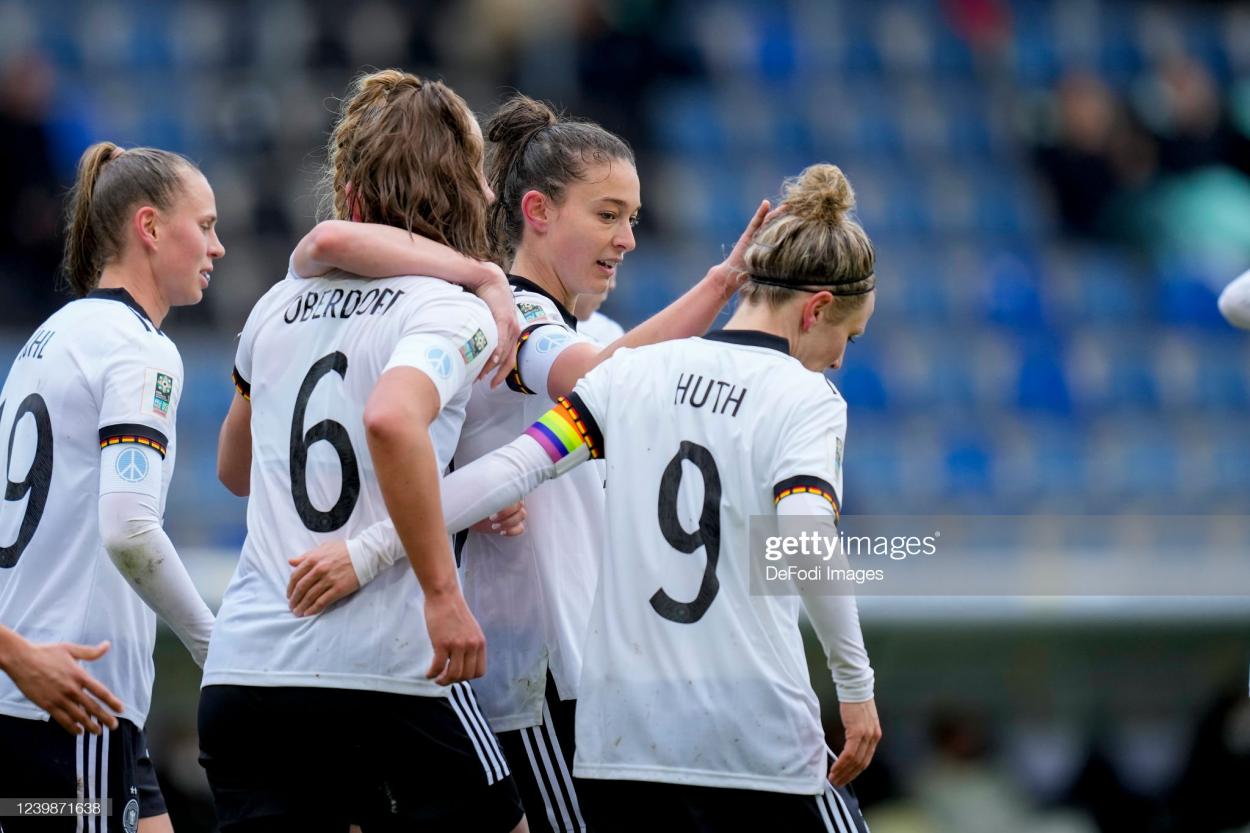
The task was a little simpler in Bielefeld, as Lena Oberdorf, Klara Bühl and Felicitas Rauch scored to secure a comfortable 3-0 victory over the Selecçao das Quinas.
Germany’s sole defeat in the qualifying campaign came at the hands of Serbia in April 2022. Allegra Poljak’s first-half opener handed the hosts the momentum required to further extend their advantage - and that’s precisely what Jovana Damnjanović did, bagging a brace in the second half. Despite their best efforts, a goal each from Schüller and Waßmuth meant that the Germans ultimately succumbed to their first - and only - loss.
Yet the Germans weren’t deterred by their shock defeat at the hands of Serbia and recovered well to claim another 3-0 win despite a goalless first half in the Turkish city of Bursa. Rauch opened the scoring from the penalty spot, before Bühl added the second in quick succession. Schüller rounded off a dominant performance in the 77th minute.
Keen to further extend her lead as Group H’s top goalscorer, Lea Schüller scored thrice against Bulgaria, as did Laura Freigang. Driven to finish their qualifying campaign with a bang, Sydney Lohmann joined Svenja Huth on the scoresheet - resulting in a comprehensive eight-goal victory.
Previous Women’s World Cup appearances
Germany managed to reach the final four in the inaugural 1991 FIFA Women’s World Cup, topping their group to seal progression to the knockout rounds. They saw off Denmark, but fell to defeat against the United States - and then lost the third-place playoff against Sweden.
Four years on, Germany bettered their debut performance by reaching the final. Having secured the top spot in their group thanks to their superior goal difference, the Germans then faced England. A 3-0 win saw them progress to the semifinals, battling to a narrow 1-0 win against China to seal their spot in the final. Goals from Hege Riise and Marianne Pettersen ensured it was Norway’s name engraved on the trophy, as Germany was forced to settle for second.
But Germany’s 1999 campaign wasn’t quite as impressive. For the first time, they failed to top their group and progressed as runners-up, bowing out in the quarterfinals after suffering a 3-2 loss to the tournament hosts - the United States.
Yet that proved to be a turning point, and Germany is now recognised as one of the most successful sides in Women’s World Cup history, having lifted the elusive trophy on two occasions.
Tina Theune’s side emerged victorious for the first time in 2003, having won every match at the tournament. A 7-1 thrashing of Russia in the quarterfinals set up a semifinal tie with the United States, where the Germans successfully sought revenge for their 1999 elimination. The final was full of drama, though ultimately Germany prevailed as Nia Künzer scored the golden goal in the 98th minute against Sweden.
Four years later, Germany became the first side to win the tournament on two successive occasions. Now under the management of Silvia Neid, the Germans progressed as group-stage winners once again. They then toppled both North Korea and Norway by a three-goal margin to set up a mouthwatering final encounter against Brazil. Second-half goals from Birgit Prinz and Simone Laudehr guided Neid’s side to victory - and they certainly made history in doing so.
Germany hosted the tournament in 2011, as they looked to secure their third win on the bounce - but a disappointing campaign saw them bow out in the quarterfinals at the hands of Japan, who went on to lift the silverware.
While they topped their group in 2015, Germany failed to reach the final once more. For the first time, the tournament featured 24 teams - meaning an extra knockout round would be required. A convincing win against Sweden secured progression to the quarterfinals, setting up a dramatic tie against France. Despite winning that encounter on penalties, Germany bowed out in the semifinals against the United States once again; they went on to lose the third-place playoff against England.
2019 was a year to forget for Germany. Having topped a group featuring Spain, China and South Africa, many expected the Germans to progress to the latter stages of the tournament. A 3-0 win against Nigeria in the round of sixteen seemed to affirm those expectations, but Martina Voss-Teckelenburg’s side was eliminated by Sweden in the quarterfinal.
Who’s the player to watch?
Alexandra Popp is Germany’s player to watch. She’s arguably her side’s best player but was forced to sit out of the EURO final last summer as Germany fell to defeat against England.
It’s not been the best season for her club side either, as VfL Wolfsburg threw away a two-goal lead at half-time in the final of the UEFA Women’s Champions League.
This could be Popp’s last chance to secure major silverware, and it’ll be interesting to see how she performs with the weight of the country on her shoulders.
Of course, an honourable mention should go out to Lea Schüller - fifteen goals in ten qualification matches is a very respectable return.
Expected lineup
Merle Frohms (VfL Wolfsburg); Felicitas Rauch (VfL Wolfsburg), Kathrin Hendrich (VfL Wolfsburg), Sjoeke Nüsken (Eintracht Frankfurt), Sophia Kleinherne (Eintracht Frankfurt); Lena Oberdorf (VfL Wolfsburg), Lina Magull (Bayern Munich); Klara Bühl (Bayern Munich), Alexandra Popp (VfL Wolfsburg), Lea Schüller (Bayern Munich)
Prediction
Germany has, without a doubt, got what it takes to go far in this tournament. They reached the final of last summer’s EUROs on merit and came incredibly close to toppling England.
I don’t think this will be their year though. Coming second in Europe is one thing, but they’ll face fiercer competition at the World Cup - the likes of the United States, Australia and Canada will all be vying to etch their names on the trophy.
Explore more stats, standings and news on VAVEL Data: Womens Football
