

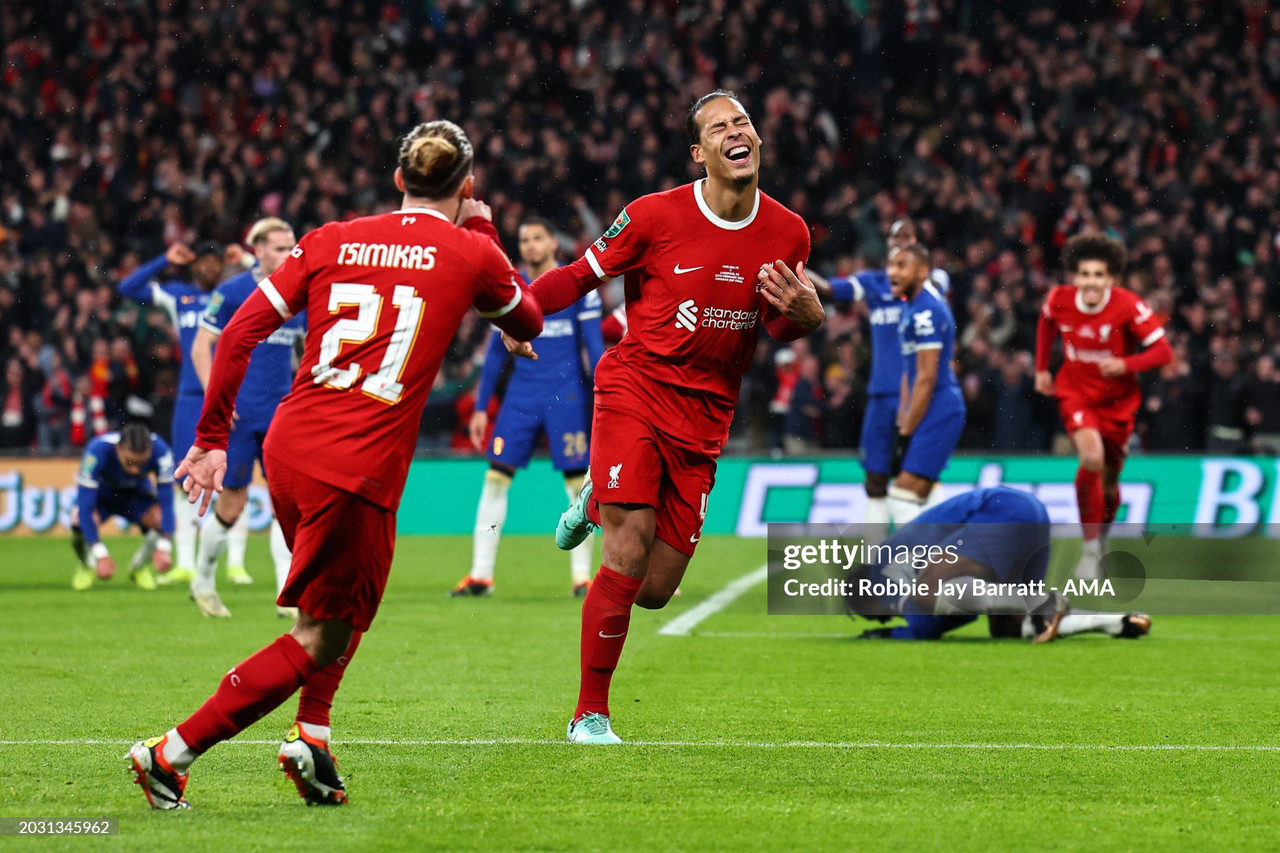

Virgil van Dijk’s 118th-minute extra-time header secured a record-extending 10th League Cup triumph for Liverpool after a gripping encounter at Wembley Stadium on Sunday afternoon.
Both Chelsea, in search of their first trophy under the ownership of Behdad Eghbali and Todd Boehly and with Mauricio Pochettino as head coach, and the Reds hit the post and had a goal disallowed within the 90 minutes before extra-time saw the increasingly youthful Merseysiders increasingly dictate the contest and eventually notch the winner.
Jürgen Klopp’s side, who came into this match with a considerably depleted squad, suffered another injury blow within the first half when midfielder Ryan Gravenberch had to be stretchered off after a Moisés Caicedo challenge rolled the Dutchman’s ankle.
The Merseysiders – who currently lead the Premier League, face Southampton in the FA Cup fifth round on Wednesday and take on Sparta Prague in the Europa League round of 16 next month – fielded seven players aged 21 or younger over the course of the afternoon, including teenage substitutes Bobby Clark, James McConnell and Jayden Danns.
They had to work hard and ride some luck to hold off the West Londoners in spells – goalkeeper Caoimhín Kelleher made brilliant saves from Cole Palmer and later Conor Gallagher – but the collective spirit and durability instilled by Klopp and those around him was evident as they plotted their way to a dramatic success.
This was also, of course, a victory made all the more pertinent by Klopp’s announcement a little over four weeks ago that he would leave the club at the end of the season after more than eight years at Anfield.
Chelsea lack ruthless edge
This did feel a notable missed opportunity for the Blues, who presently sit 11th in the Premier League and have now lost their last six Wembley finals. Any final defeat tends to come with such emotions, but the circumstances around this one added to that notion.
The chances passed up and the cast list painted the picture of a day that could have been made considerably more of.
Liverpool’s strength in depth has been clearly demonstrated on several occasions this term but, with so many regulars currently absent through injury and an immensely youthful bench, this was arguably about as favourable a context as the Blues could have wished for.
The average age of their starting lineup, at just under 24 years, was, admittedly, nearly two years younger than that of the Merseysiders.
The balance of genuine youth and considerable experience did appear to be a key ingredient for the Reds. They retained an assurance throughout the 120 minutes that Pochettino’s charges seemingly lost.
This was, perhaps, the area where Thiago Silva’s absence was most noticeable, even if the team have performed consistently well without the veteran centre-back in recent weeks.
The Blues still created plenty. After they endured early Liverpool pressure, Palmer, who again caught the eye, saw a point-blank attempt brilliantly kept out by Kelleher in the 20th minute before Nicolas Jackson’s rebound was superbly blocked by Wataru Endo.
Soon after, the offside flag correctly denied Raheem Sterling an opener after he converted a Jackson cross, with a VAR check confirming that the latter had been just ahead of Ibrahima Konaté as he was played in behind.
Gallagher sharply steered Palmer’s precise cross against the left-hand post in the 76th-minute and was then superbly denied by Kelleher when Palmer played him in 10 minutes later.
This was the spell when Chelsea were most in the ascendency, and their momentum looked set to tell in the second minute of stoppage time at the end of the 90.
Somehow, though, a succession of close-range efforts from substitute Christopher Nkunku, Palmer and the impressive Malo Gusto were kept out by a combination of blocks and Kelleher saves.
The West Londoners appeared likely to build on such pressure in extra time, particularly given their lineup was still packed with regulars.
It was Liverpool, though, looking increasingly youthful, who took a hold of the game from there.
Pochettino's team were kept deep for much of the extra 30 minutes, with Noni Madueke and Palmer efforts from distance representing the extent of their threat within what proved to be the decisive period of the contest.
Experience that Blues must harness
As the heat turned up at Wembley, Chelsea did have the look of a side yet to truly build a durable collective spirit and culture.
Understandably so, it could be said. Substitute Trevoh Chalobah was the only member of the matchday 20 who also featured in the penalty shootout defeat to the Reds in the 2022 final of this competition.
Over £1 billion has been spent assembling the Blues' squad since Eghbali and Boehly's takeover later that year.
This remains a largely young group of players, led by a head coach within his first season at the club, who haven’t been genuinely stress-tested together on too many occasions.
It did seem that they lacked direction, leadership and belief when the stakes were highest.
Did this reflect well on them? No.
Does it, though, represent an experience that can be utilised in the future? Almost certainly.
It’s crucial, therefore, that, in time, it is used productively. Learn lessons tactically and in terms of mentality, and this could actually forge a closer bond within a squad that currently looks like it is searching for its soul.
Fail to do so, though, and there could be significant problems pretty quickly if this day becomes a source of finger-pointing and division, as opposed to shared accountability.
Getting the immediate future right feels all the more important given the signs of progress there have been in the three weeks since the 4-1 defeat at Anfield and 4-2 home reversal to Wolverhampton Wanderers in the league.
Wednesday’s FA Cup fifth-round meeting with Leeds United at Stamford Bridge now arguably takes on additional significance.
Liverpool rise to the challenge
This day proved a glowing, raucous, reflection of what Klopp has built over the course of his tenure on Merseyside.
It also felt another notable marker of the rapid progress of "Liverpool 2.0" as the German boss labelled this current iteration following the significant changes in playing personnel during the summer of 2023.
Yet again, they took a potentially tough context and made wonderful use of it.
Gravenberch’s first-half withdrawal saw him join an injury list that already includes Alisson Becker, Trent Alexander-Arnold, Joël Matip, Stefan Bajčetić, Thiago Alcântara, Dominik Szoboszlai, Curtis Jones, Ben Doak, Diogo Jota, Mohamed Salah and Darwin Núñez.
Szoboszlai, Salah and Núñez are seemingly each close to returning to action, but it is quite the collection of absentees.
Klopp and assistant manager Pep Lijnders, though, have, in recent weeks, been determined to emphasise their desire to make the best of the situation rather than use it as an excuse.
The actions within this final didn’t half enhance the words.
20-year-old Conor Bradley, who started at right-back and moved to right-wing when Joe Gomez replaced Gravenberch, continued to look at ease at this level.
Teenage substitutes Clark, McConnell and Danns, meanwhile, took to this most sizeable of stages with admirable comfort and character. What a priceless experience this could prove to be.
Harvey Elliott, still only 20 himself, was familiarly unrelenting in his work rate and desire to take responsibility from both the right of the front three and midfield triumvirate.
Endo was typically combative and clever at the base of the midfield. What a signing the Japan captain has been.
Cody Gakpo, who hit the post with a first-half header, and, in particular, Luis Díaz, who saw a low effort well saved by Đorđe Petrović early on, kept going and going as the senior attacking figures.
Kostas Tsimikas, who was introduced for Andy Robertson and played his first minutes since dislocating his shoulder against Arsenal nine weeks ago, teed-up a good chance for Elliott in extra time that brought a great save out of Petrović, before the Greek left-back’s corner was decisively converted by Van Dijk.
Konaté and then Jarell Quansah were such strong presences alongside the immense Van Dijk and in front of the brilliantly proactive Kelleher.
So many opportunities grasped.
Van Dijk and Kelleher stand tall
This was such a collective effort, but these two led the way in so many senses.
Captain, match-winner and player of the match Van Dijk offered invaluable serenity, authority and desire throughout.
He did appear to have put his side ahead in front of a rapturous Liverpool end in the 60th minute when he powerfully headed home a Robertson free-kick.
However, a subsequent VAR check saw referee Chris Kavanagh sent to the pitchside monitor, where he disallowed the goal for offside due to Endo – who was ahead of the Chelsea defensive line when the ball was delivered – blocking Levi Colwill as he attempted to drop into the box.
Undeterred, though, the Dutchman delivered the genuine decisive moment at that same end of the stadium as the game approached the end of its second hour.
He timed his run and leap ideally to meet Tsimikas’ near-post corner ahead of Mykhailo Mudryk and Axel Disasi, glance it across Petrović, and into the bottom-left corner.
Two in two games for the 32-year-old now, after his header kicked-started the 4-1 comeback victory over Luton Town in the league on Wednesday night.
It felt apt that he scored the goal that secured the first trophy of his Liverpool captaincy. What a footballer – and what a season he is having.
A significant proportion of the foundations for such a moment were provided by Kelleher, who – having struck the decisive penalty in the shootout within that 2022 final – was a source of considerable calm himself both in terms of his handling and footwork.
That first-half save from Palmer was brilliantly sharp and instinctive, while his second-half one from Gallagher displayed the kind of decisiveness and dominance within a one-on-one situation that is so often associated with Alisson.
There was, perhaps, additional responsibility on both Van Dijk and Kelleher due to the wider circumstances.
It was a responsibility, and opportunity, that they thrived upon – and their displays, in turn, appeared to empower those around them.
