


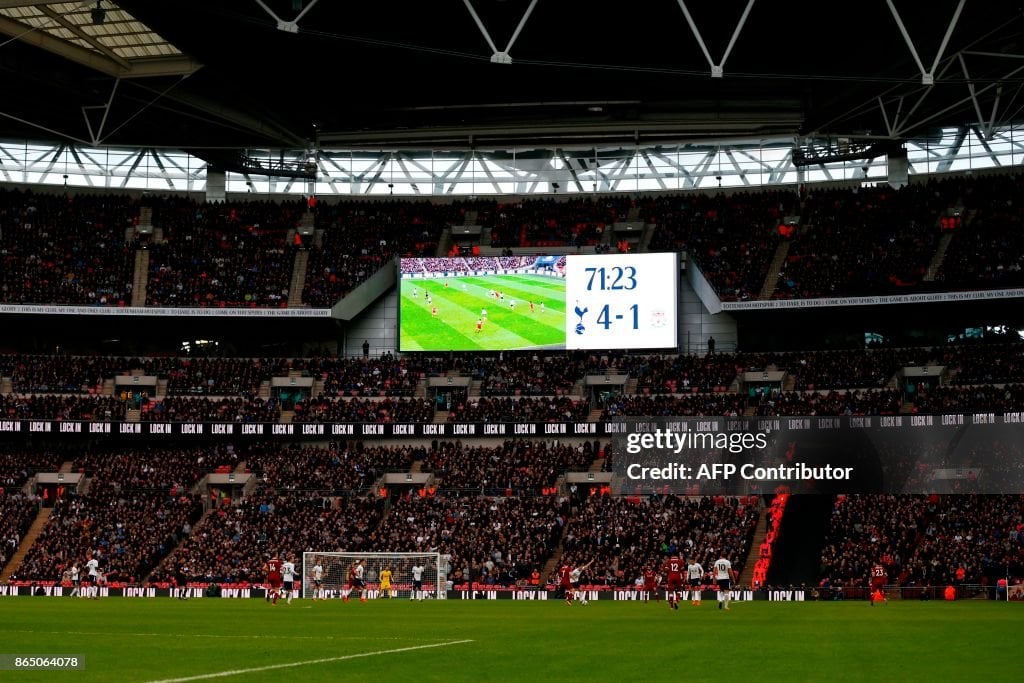


It was the pomp of the Mauricio Pochettino era at Tottenham Hotspur. Following their remarkable second place finish in the Premier League, the 2017/18 season started largely as expected.
Spurs sat third behind Manchester United and Manchester City. Losing to Chelsea and drawing to both Burnley and Swansea City meant there was some concern over whether to move to Wembley was the right call.
A narrow win against Bournemouth put to bed any suspicions of a 'hoodoo', but they now had a much firmer test in the visit of Liverpool.
Jurgen Klopp's men were in eighth and had some middling results. Victories against Leicester and Arsenal were mixed with draws to Watford and Newcastle, as well as a 5-0 battering at the hands of eventual champions Man City.
The game very much went Tottenham's way.
Even then, nearly seven years ago, Spurs beating the Reds was a relative rarity, last emerging victorious in 2012. But through goals from Heung-Min Son and Dele Alli as well as a Harry Kane brace, the Lilywhites won 4-1.
However, a dismal afternoon for Klopp would prove to be pivotal in the development of his project and the transformation of the club.
This will not necessarily be detailing the history of these respective clubs, but rather how and why their differing futures came to be.
-
As one goes up, another must fall
Football is always in flux. Sustaining eras of success is as much about change as it is keeping a solid foundation. And under Pochettino, Tottenham have carved out an incredibly strong first eleven.
The season prior was the Lilywhites' best ever finish in the Premier League, coming second to Antonio Conte's Chelsea. They scored the most goals, conceded the fewest and lost only four times.
While not the pinnacle of Pochettino's achievements, it was footballing apex of Spurs' 2010s renaissance, with a forthright, imposing style of play that heralded results and goals. Something that was severely lacking in the tenures of Andre Villas-Boas and Tim Sherwood.
The crux of the squad around that time was made from preassembled players. The only addition to the first team in the summer of 2016 was Victor Wanyama.
Every other player - Kyle Walker, Jan Vertonghen, Christian Eriksen, Mousa Dembele just to name a few - had been at the club for years already and were simply good enough and game enough to live up to Pochettino's coaching methods.
This isn't unusual. Most managers, including Jurgen Klopp, mix the squad they already have with key improvements. However, in Tottenham's case, this reliance would become a bigger problem.
Liverpool, meanwhile, were still developing under Klopp. After replacing Brendan Rodgers in 2015, the German's impact was more filled with promise than a seismic change.
A UEFA Europa League final in his first season was coupled with an eighth placed finish. Though a return to Europe's elite alongside Spurs subsided in 2016/17 as they edged fourth.
Looking back at the line-up that secured UEFA Champions League qualification (a 3-0 home win over Middlesbrough), it's filled with heroes of Klopp's reign.
James Milner, Roberto Firmino, Joel Matip, Adam Lallana and Georgino Wijnaldum for instance. Sadio Mane was out injured, Trent Alexander-Arnold was on the bench and Divock Origi came on as a late substitution.
There were still pieces of the jigsaw to be placed, but this was a squad on the way up rather than, in Spurs' case, one that was waning.
In Liverpool's corner, the defeat prompted a revisiting of the failed coup of Virgil van Dijk the following January, immediately bringing a calm, assured presence to their defence.
The goalkeeper and defensive midfield were also on the transfer radars, leading to the purchases of Alisson Becker and Fabinho the next summer.
Though not the last hurrah of Pochettino's time by any means, this victory in question was a marker of how talented the squad remained even without additional assets.
A late dash for Lucas Moura in January was the last signing for over a year and proof that Spurs were mostly relying on the Argentine manager's miracle work to keep reaching the top four.
Furthermore, the 4-1 at Wembley was almost the last bastion of the Premier League transitional seasons during the mid-2010s.
The earlier years were still largely dominated by Sir Alex Ferguson's Manchester United and their sky blue city rivals while the middle of the decade was a transition between that and the tactical revolution to come.
-
Pressing and payments
Counter-pressing football, while certainly not a new invention, was becoming the fashion. Pochettino, Klopp and Pep Guardiola were all proponents of this trend during the 2010s.
But running after the ball and closing spaces is hard work. And no matter how good the athlete, it will take a toll after a while. So if squad refreshment is important at a fundamental level, it's especially vital in such a physically demanding style of play.
Afforded the riches of the UAE-backed City Football Group, Guardiola was able shape the squad as he pleased. Liverpool and Tottenham didn't have that same luxury.
Since 2014, the Reds and Spurs have a net spend of £-472.26 million and £-568.16 million respectively compared to Man City's £-1.021.52 billion over that same period.
It's clear that, despite both being valued in the hundreds of millions, there was a money gap that was difficult to bridge. However, neither side floundered (yet).
Both sides would put on incredible runs to reach the Champions League final in 2018/19, with Tottenham not buying any players in two consecutive windows that year.
It was a remarkable achievement for each club.
Pochettino had managed to squeeze the very last ounce of quality from a Spurs side still chronically under replenished, and Klopp's men were a John Stones goal line clearance away from claiming a Premier League title alongside their eventual European crown.
With a fresher squad, Liverpool were able to keep their standards high at the turn of the decade while Spurs were running on fumes.
Though a change in manager to one (or Special One) Jose Mourinho was less tasking in the pressing department his appointment led to wider cultural issues at the club, which will be detailed later.
Tottenham and Liverpool were also similar in their relationship with their club owners.
ENIC Group, an investment company originally owned by Joe Lewis, own Spurs and Fenway Sports Group are the owners of Liverpool alongside baseball's Boston Red Sox and ice hockey's Pittsburgh Penguins.
Both clubs have corresponding grievances too - that the ownership is more focused on building a business rather than investing properly in the footballing side of things.
Yet, as established, one team has collected numerous trophies in recent years while the other still awaits its first since 2008.
The difference it seems doesn't necessarily come from the amount of money spent, but the quality of the recruitment.
-
Hierarchies and directors
Michael Edwards is now a name synonymous with Liverpool's success. His work as sporting director during Klopp's peak was revered for its shrewd, near pinpoint accurate success rate.
Mohammed Salah, Sadio Mane, Andrew Robertson, van Dijk and Alisson the standout names on Edwards' transfer CV, as well as under the radar acquisitions such as Fabinho, Xherdan Shaqiri and Thiago Alcantara.
Edwards began his career as chief analyst for Portsmouth, helping Harry Redknapp oversee a famous FA Cup win in 2008 before moving to Tottenham in the same role.
He would switch to Merseyside in 2011 and work his way up to the sporting director seat in 2016. Maybe some would think that, had Edwards remained at White Hart Lane, Spurs would have been blessed with his nous for transfer business.
Except, Tottenham had Paul Mitchell who, while not celebrated in the same way as Edwards, played a major role in the link between Pochettino and the boardroom.
Mitchell was head of recruitment at Southampton when the Argentinian came to St Mary's. They formed a close relationship, which helped see the Saints finish eighth in the Premier League.
Mitchell made the same move to north London in 2014, being involved in the signings of Dele, Wanyama and Toby Alderweireld. Crucially, he was never promoted to sporting director or a role akin to it.
It is said Mitchell was frustrated working in the confides that chairman Daniel Levy imposed. Whether those limitations were financial ones is unknown, but highly suspected. He eventually left the club in 2018 after serving a 16 month notice.
Perhaps Levy was hesitant to place Mitchell in such a position because of the failings of Franco Baldini, the technical director who oversaw Gareth Bale's departure and the subsequent seven signings bought with the incoming £85 million accrued for the Welshman.
Levy, notorious for having a large say in transfer negotiations, may have also been keen to keep control of the incomings and outgoings himself.
Either way, there was a break down in club structure. Business became more haphazard and, well, less impressive. Pochettino paid in the price a mere seven months after reaching a European cup final.
-
Club identity
On the pitch, Jurgen Klopp reflected Liverpool. His passion on the side lines was that of an Anfield supporter and his 'gengenpressing' tactics made them near impossible to beat at time.
Even if there wasn't spending on the levels of Man City, Manchester United or Chelsea, they were regular trophy contenders, eventually winning their first Premier League title in 2019/20.
It was in-your-face, competitive and, most pertinently, rewarding football that fans delighted in.
The next season would be less fruitful as an injury crisis exposed a squad lacking in real depth.
As much Liverpool struggled to retain the Premier League, they still had Klopp and they still had Edwards, which would lead to a revival that very nearly heralded England's first quadruple.
Tottenham, meanwhile, may have had an early resurgence under Mourinho, but that would prove to be an ill-fated tenure. As would his replacement Nuno Espirito Santo.
Though the spending problems may have been similar, Liverpool had a high quality internal model that was able to breed success through solidity and a clear identity.
With their new £1 billion stadium, Spurs wanted to aspire to be a club of routine success in short bursts. Levy was no stranger to a quick turnover of head coaches, and so taking the club into a more 'Chelsea-like' set up seemed to be his vision.
Tottenham Hotspur, however, aren't that kind of club and the only way they could have been is if Roman Abramovich had chosen them over the Blues in 2003.
Steve Hitchen was appointed as technical performance director in 2018, overseeing scouting and recruitment that left a lot to be desired.
His biggest blemishes were the big money moves for Giovani Lo Celso and Tanguy Ndombele. While not bad pickups at the time, the failure of each to establish themselves in the first team put the recruitment under a microscope.
Short term success was found in Fabio Paratici, who had become renowned for his transfer activity that kept Juventus on top in Italy for so long.
Antonio Conte was brought in. The counter-pressing had been totally replaced by counter attacking. Eventually, it turned stale, uncompetitive and unrewarding.
However, after being found guilty of false accounting, Paratici was banned from world football for 30 months while a dip in results led to Conte being sacked.
Prior to hiring Ange Postecoglou, Spurs were dry of any sort of identity, particularly one that aligned itself with the attacking, entertaining football the club was known for.
As for Liverpool, as well as coming runners-up to Real Madrid once again in the 2021/22 Champions League, Liverpool went into their first window in close to a decade without Michael Edwards.
He left with an open letter to fans. "I’ve loved working here, but I am a big believer in change," Edwards wrote. "That’s how I believe businesses/football clubs stay ahead; you need to evolve and at the heart of this kind of process is always people.
"That evolution has always been central to Liverpool’s history and I hope that this is one thing that doesn’t change."
Julian Ward was chosen to replace him, having worked with Edwards as a scout and later technical director. Though Ward would only last a year in the sporting director hot seat.
Another departure around this time that is worth noting is head of research Ian Graham, whose detailed, data-led approach lent itself perfectly to uncovering signings for Edwards to go after.
It's possibly no coincidence that the rupture in the scouting and analytic departments caused Liverpool's most underwhelming season since the days of Rodgers in 2022/23.
Signings Darwin Nunez and Cody Gakpo didn't produce the immediate impact that was needed in the wake of Mane and Firmino leaving. They were much different profiles and struggled with consistent returns in front of goal.
Ward's replacement, Jörg Schmadtke, will be leaving at the end of this season having only been in charge for one season.
-
The Future
Michael Edwards has now returned to preside over the post-Klopp era in a more senior role and. His duties won't only include searching for the person to replace 'The Normal One' but also Schmadtke's successor.
Johan Lange, formerly key to the rebuilding of Aston Villa, has assumed the role of technical director at the Tottenham Hotspur Stadium as the club stitches together a semblance of the football operations they briefly possessed under Mitchell.
Even then Postecoglou recently admitted that "we [Tottenham] need change. Change has to happen.
"I've got to build a squad I think can play our football. For that to happen, there have to be exits."
Time will only tell whether the Australian will lead Spurs to glory in this, the next stage of the ever long flux.
The controversial 2-1 win for Spurs back in was the first time they had beaten Klopp's Liverpool since the 4-1 at Wembley.
If the 0-0 at White Hart Lane in 2015 - Klopp's first game as Liverpool boss - heralded a new era for each side, and that Wembley clash being the turning point in their respective fortunes, then this Sunday's game signifies the end of a decade of differences.
With Arne Slot likely taking the reigns from Klopp next season, and Postecoglou entering his pivotal second season with Tottenham, this fixture could further prove to be a benchmark for both clubs in the seasons to come.
